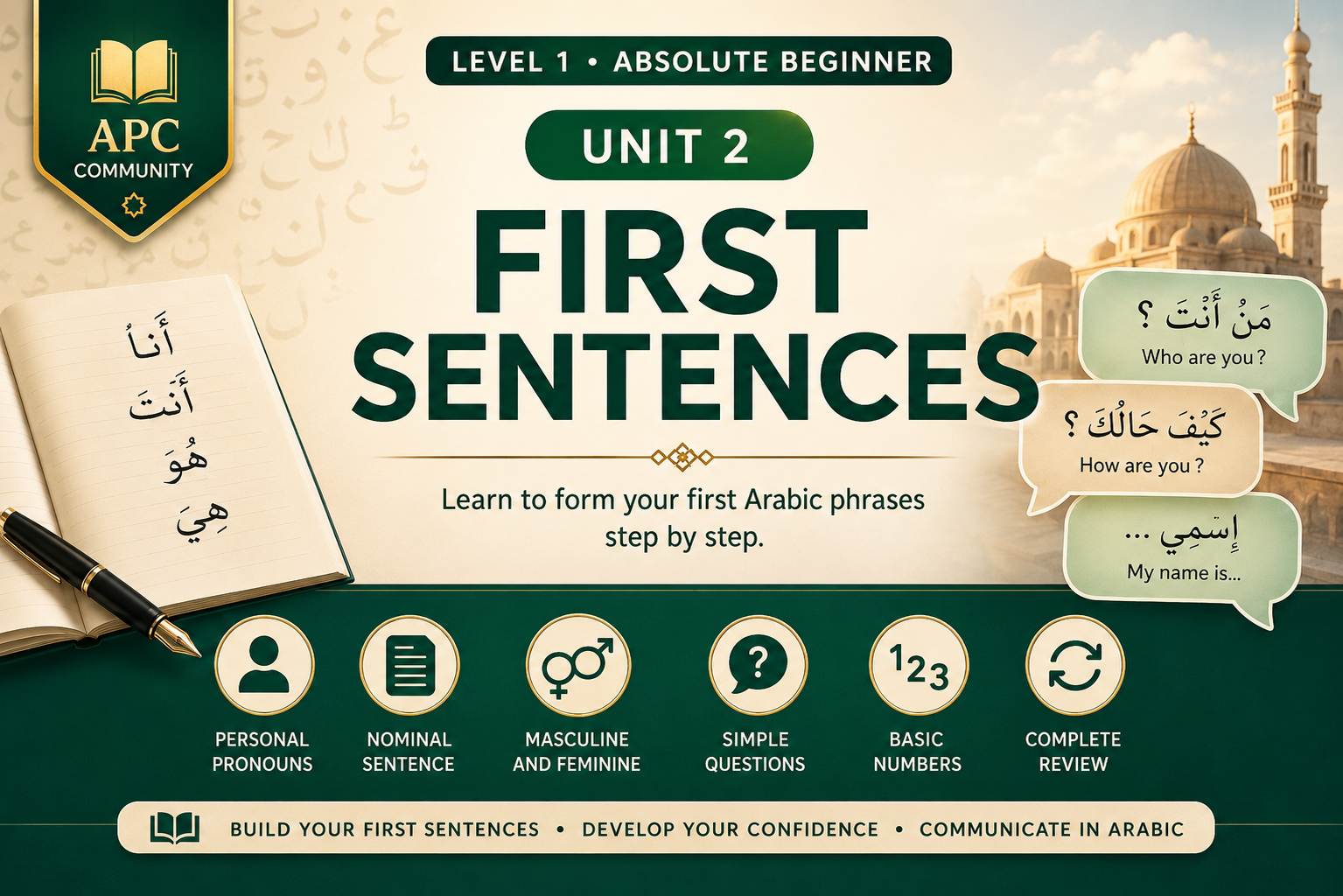
Arabic Language Course for Beginners — Complete Guide to Arabic
LEVEL 1 — ABSOLUTE BEGINNER
Unit 1 — First Steps in Arabic
Welcome to your first real unit of communication in Arabic.
In the previous chapters, you discovered the Arabic language, its writing system, its letters, its vowels, and its main sounds. Now, we are going to start using this knowledge to understand and produce real words and real sentences.
In this unit, you will learn to:
- greet someone in Arabic;
- respond to a greeting;
- recognize and use some important letters;
- complete simple words;
- read your first Arabic words;
- write short words;
- say your name;
- ask another person’s name;
- say where you come from;
- begin a short and simple conversation.
Take your time. You do not need to memorize all the content immediately. The goal is to understand gradually, review the examples, and begin recognizing words naturally.
Lesson 28 — Hello and Greetings
Greetings are among the first words we learn in a new language. They allow us to start a conversation, welcome someone, and respond politely.
In Arabic, there are several ways to say hello. Some are very general, while others are connected to specific times of the day.
1. السلام عليكم — Hello / Peace Be Upon You
السَّلَامُ عَلَيْكُمْ
Transliteration: as-salāmu ʿalaykum
Literal Translation: peace be upon you.
This is one of the best-known and most widely used greetings in the Arab world.
The usual response is:
وَعَلَيْكُمُ السَّلَامُ
Transliteration: wa ʿalaykumu as-salām
Translation: and peace be upon you too.
2. مرحبًا — Hello / Welcome
مَرْحَبًا
Transliteration: marḥaban
Translation: hello / welcome.
This is a simple and general greeting that you can hear in many situations.
3. أهلًا — Hi / Hello
أَهْلًا
Transliteration: ahlan
Translation: hi / hello / welcome.
4. صباح الخير — Good Morning
صَبَاحُ الْخَيْرِ
Transliteration: ṣabāḥ al-khayr
Translation: good morning.
You can use it in the morning.
A common response is:
صَبَاحُ النُّورِ
Transliteration: ṣabāḥ an-nūr
Literal Translation: morning of light.
5. مساء الخير — Good Evening
مَسَاءُ الْخَيْرِ
Transliteration: masāʾ al-khayr
Translation: good evening.
A common response is:
مَسَاءُ النُّورِ
Transliteration: masāʾ an-nūr
Literal Translation: evening of light.
6. كيف حالك؟ — How Are You?
When speaking to a man:
كَيْفَ حَالُكَ؟
Transliteration: kayfa ḥāluka?
Translation: how are you?
When speaking to a woman:
كَيْفَ حَالُكِ؟
Transliteration: kayfa ḥāluki?
Translation: how are you?
7. أنا بخير — I Am Fine
أَنَا بِخَيْرٍ
Transliteration: anā bikhayr
Translation: I am fine.
8. شكرًا — Thank You
شُكْرًا
Transliteration: shukran
Translation: thank you.
One possible response is:
عَفْوًا
Transliteration: ʿafwan
Translation: you're welcome / no problem.
9. إلى اللقاء — Goodbye
إِلَى اللِّقَاءِ
Transliteration: ilā al-liqāʾ
Translation: goodbye.
10. مع السلامة — Goodbye
مَعَ السَّلَامَةِ
Transliteration: maʿa as-salāmah
Translation: goodbye / go in peace.
10 Mini-Conversation Examples
Example 1
أ: السَّلَامُ عَلَيْكُمْ
ب: وَعَلَيْكُمُ السَّلَامُ
Translation:
A: Hello.
B: Hello to you too.
Example 2
أ: مَرْحَبًا
ب: أَهْلًا
Translation:
A: Hello.
B: Hi.
Example 3
أ: صَبَاحُ الْخَيْرِ
ب: صَبَاحُ النُّورِ
Translation:
A: Good morning.
B: Good morning.
Example 4
أ: مَسَاءُ الْخَيْرِ
ب: مَسَاءُ النُّورِ
Translation:
A: Good evening.
B: Good evening.
Example 5
أ: كَيْفَ حَالُكَ؟
ب: أَنَا بِخَيْرٍ
Translation:
A: How are you?
B: I am fine.
Example 6
أ: كَيْفَ حَالُكِ؟
ب: أَنَا بِخَيْرٍ
Translation:
A: How are you?
B: I am fine.
Example 7
أ: شُكْرًا
ب: عَفْوًا
Translation:
A: Thank you.
B: You're welcome.
Example 8
أ: مَرْحَبًا، كَيْفَ حَالُكَ؟
ب: بِخَيْرٍ، شُكْرًا
Translation:
A: Hello, how are you?
B: Fine, thank you.
Example 9
أ: السَّلَامُ عَلَيْكُمْ
ب: وَعَلَيْكُمُ السَّلَامُ
أ: كَيْفَ حَالُكَ؟
ب: أَنَا بِخَيْرٍ
Translation:
A: Hello.
B: Hello to you too.
A: How are you?
B: I am fine.
Example 10
أ: شُكْرًا
ب: عَفْوًا
أ: مَعَ السَّلَامَةِ
ب: إِلَى اللِّقَاءِ
Translation:
A: Thank you.
B: You're welcome.
A: Goodbye.
B: See you / goodbye.
Lesson 29 — The Arabic Alphabet: First Letters
You have already discovered the letters of the Arabic alphabet. In this lesson, we are now going to start using them in a practical way.
Our goal is not to learn all 28 letters at once. We will move forward gradually.
Let's begin with a few letters that are easy to recognize.
| Letter | Name | Approximate Sound | Example | Translation |
|---|---|---|---|---|
| ا | alif | ā / vowel support | أَب | father |
| ب | ba | b | بَاب | door |
| ت | ta | t | تَمْر | dates |
| ن | nun | n | نُور | light |
| م | mim | m | مَاء | water |
| ل | lam | l | لَبَن | milk |
| س | sin | s | سَمَك | fish |
| ك | kaf | k | كِتَاب | book |
| د | dal | d | دَرْس | lesson |
| ر | ra | r | رَجُل | man |
10 Examples for Recognizing Letters
- بَاب — bāb — door
- بِنْت — bint — girl
- تَمْر — tamr — dates
- مَاء — māʾ — water
- نُور — nūr — light
- لَبَن — laban — milk
- سَمَك — samak — fish
- كِتَاب — kitāb — book
- دَرْس — dars — lesson
- رَجُل — rajul — man
When you look at a word, do not try to read everything immediately. Start by recognizing one letter.
For example:
كِتَاب
You can gradually recognize:
ك + ت + ا + ب
Then learn to read them together:
kitāb — book
ℹ️ Über diesen Kurs

Mr Ray
- 🌍 Sprache English
- 👥 Teilnehmer 0
- 👁 Aufrufe 1,626
- 📚 Ressourcen 3
- 📄 PDF 1
- 🎥 Videos 0
- 📝 Quizze 2
- 🔗 Links 0
- 🕒 Lesezeit 33 min
- 📅 Aktualisiert August 26, 2026