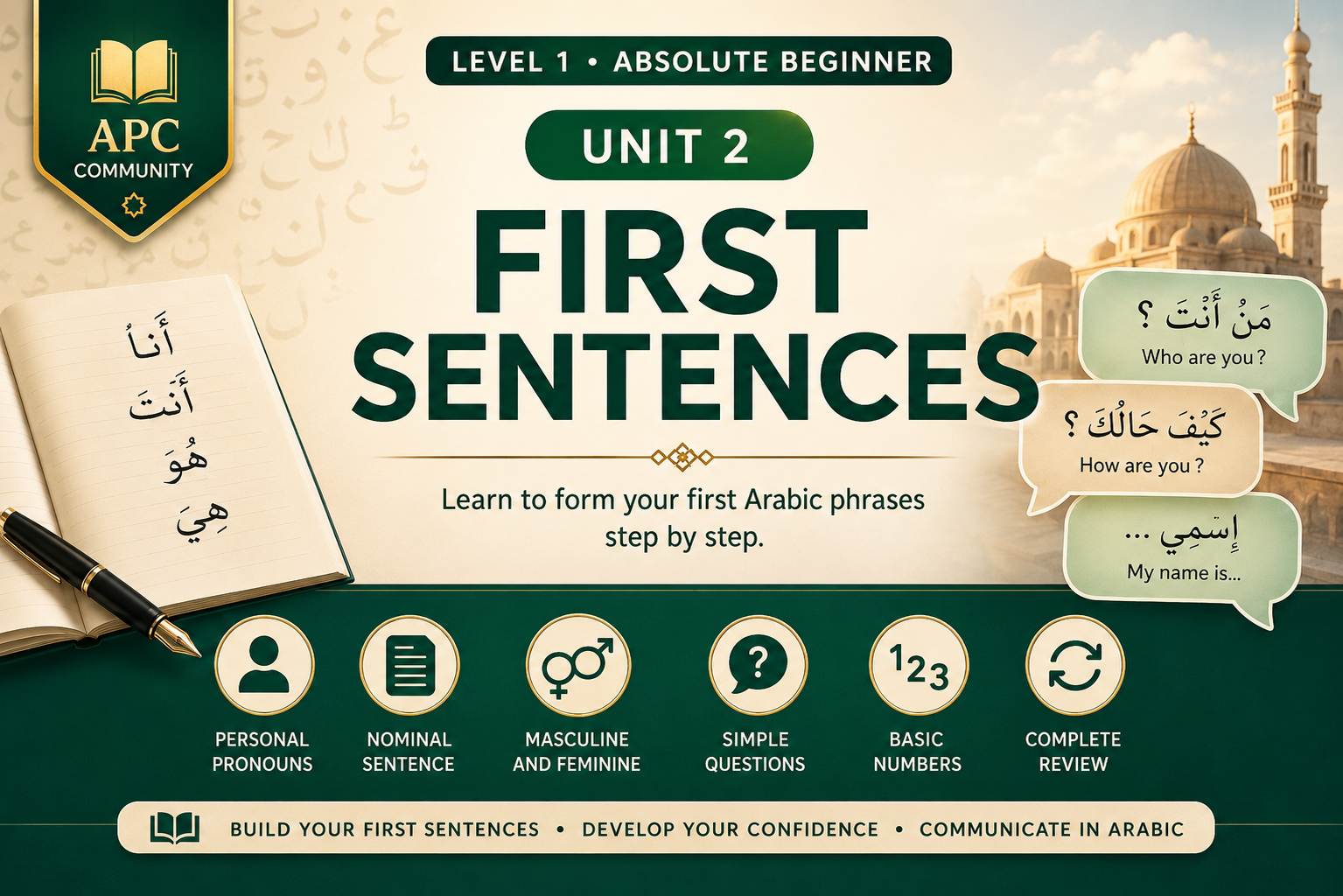
Arabic Language Course for Beginners — Complete Guide to Arabic
Lesson 37 — Asking Simple Questions
Now that we can form short sentences, we are going to learn how to ask questions.
Here are some essential question words.
| Arabic | Transliteration | Translation |
|---|---|---|
| مَا؟ | Mā? | What? |
| مَنْ؟ | Man? | Who? |
| أَيْنَ؟ | Ayna? | Where? |
| مَتَى؟ | Matā? | When? |
| كَيْفَ؟ | Kayfa? | How? |
| لِمَاذَا؟ | Limādhā? | Why? |
10 Examples of Simple Questions
1. مَا هَذَا؟
Transliteration: Mā hādhā?
Translation: What is this?
2. مَنْ هَذَا؟
Transliteration: Man hādhā?
Translation: Who is this?
3. مَنْ أَنْتَ؟
Transliteration: Man anta?
Translation: Who are you? — when speaking to a man or a boy.
4. مَنْ أَنْتِ؟
Transliteration: Man anti?
Translation: Who are you? — when speaking to a woman or a girl.
5. أَيْنَ الْبَيْتُ؟
Transliteration: Ayna al-baytu?
Translation: Where is the house?
6. أَيْنَ الْكِتَابُ؟
Transliteration: Ayna al-kitābu?
Translation: Where is the book?
7. كَيْفَ حَالُكَ؟
Transliteration: Kayfa ḥāluka?
Translation: How are you? — when speaking to a man or a boy.
8. كَيْفَ حَالُكِ؟
Transliteration: Kayfa ḥāluki?
Translation: How are you? — when speaking to a woman or a girl.
9. مَتَى الدَّرْسُ؟
Transliteration: Matā ad-darsu?
Translation: When is the lesson?
10. لِمَاذَا تَتَعَلَّمُ الْعَرَبِيَّةَ؟
Transliteration: Limādhā tataʿallamu al-ʿarabiyyata?
Translation: Why are you learning Arabic?
Simple Answers
A question becomes even more useful when we know how to answer it. Here are some examples:
مَنْ هَذَا؟
Transliteration: Man hādhā?
Translation: Who is this?
هَذَا أَحْمَدُ
Transliteration: Hādhā Aḥmadu
Translation: This is Ahmed.
مَا هَذَا؟
Transliteration: Mā hādhā?
Translation: What is this?
هَذَا كِتَابٌ
Transliteration: Hādhā kitābun
Translation: This is a book.
Lesson 38 — Basic Numbers
Numbers are essential in everyday life. We use them to count, give our age, talk about a quantity, understand a number, a date, or a time.
In this first lesson on numbers, we are going to learn the numbers from 1 to 10.
The Numbers from 1 to 10
| Number | Arabic | Transliteration | Translation |
|---|---|---|---|
| 1 | وَاحِدٌ | Wāḥidun | One |
| 2 | اِثْنَانِ | Ithnāni | Two |
| 3 | ثَلَاثَةٌ | Thalāthatun | Three |
| 4 | أَرْبَعَةٌ | Arbaʿatun | Four |
| 5 | خَمْسَةٌ | Khamsatun | Five |
| 6 | سِتَّةٌ | Sittatun | Six |
| 7 | سَبْعَةٌ | Sabʿatun | Seven |
| 8 | ثَمَانِيَةٌ | Thamāniyatun | Eight |
| 9 | تِسْعَةٌ | Tisʿatun | Nine |
| 10 | عَشَرَةٌ | ʿAsharatun | Ten |
10 Examples with Numbers
1. كِتَابٌ وَاحِدٌ
Transliteration: Kitābun wāḥidun
Translation: One book.
2. قَلَمٌ وَاحِدٌ
Transliteration: Qalamun wāḥidun
Translation: One pen.
3. اِثْنَانِ
Transliteration: Ithnāni
Translation: Two.
4. ثَلَاثَةٌ
Transliteration: Thalāthatun
Translation: Three.
5. أَرْبَعَةٌ
Transliteration: Arbaʿatun
Translation: Four.
6. خَمْسَةٌ
Transliteration: Khamsatun
Translation: Five.
7. سِتَّةٌ
Transliteration: Sittatun
Translation: Six.
8. سَبْعَةٌ
Transliteration: Sabʿatun
Translation: Seven.
9. ثَمَانِيَةٌ
Transliteration: Thamāniyatun
Translation: Eight.
10. تِسْعَةٌ
Transliteration: Tisʿatun
Translation: Nine.
11. عَشَرَةٌ
Transliteration: ʿAsharatun
Translation: Ten.
Important
The complete grammar of numbers in Arabic is more complex and depends, among other things, on the gender of the noun being counted.
For now, focus especially on reading, pronunciation, and recognizing the numbers from 1 to 10. More advanced rules will be studied gradually.
Lesson 39 — Unit 2 Review
Congratulations! You have just completed Unit 2: First Sentences.
In this unit, you started to go much further than simply recognizing words. You can now understand the structure of short Arabic sentences.
1. Personal Pronouns
You learned, in particular:
أَنَا — أَنْتَ — أَنْتِ — هُوَ — هِيَ — نَحْنُ
Transliteration: Anā — Anta — Anti — Huwa — Hiya — Naḥnu
Translation: I — You masculine — You feminine — He — She — We
2. The Nominal Sentence
You discovered that in the present tense, Arabic can form a sentence without using a separate word for “to be”.
أَنَا طَالِبٌ
Transliteration: Anā ṭālibun
Translation: I am a student.
هِيَ مُعَلِّمَةٌ
Transliteration: Hiya muʿallimatun
Translation: She is a teacher.
3. Masculine and Feminine
You learned that some words change according to gender.
طَالِبٌ — طَالِبَةٌ
Transliteration: Ṭālibun — Ṭālibatun
Translation: Male student — Female student
كَبِيرٌ — كَبِيرَةٌ
Transliteration: Kabīrun — Kabīratun
Translation: Big — Big (feminine)
4. Simple Questions
You can now recognize several question words:
- مَا؟ — Transliteration: Mā? — Translation: What?
- مَنْ؟ — Transliteration: Man? — Translation: Who?
- أَيْنَ؟ — Transliteration: Ayna? — Translation: Where?
- مَتَى؟ — Transliteration: Matā? — Translation: When?
- كَيْفَ؟ — Transliteration: Kayfa? — Translation: How?
- لِمَاذَا؟ — Transliteration: Limādhā? — Translation: Why?
5. Basic Numbers
You started learning the numbers from 1 to 10.
وَاحِدٌ — اِثْنَانِ — ثَلَاثَةٌ — أَرْبَعَةٌ — خَمْسَةٌ
سِتَّةٌ — سَبْعَةٌ — ثَمَانِيَةٌ — تِسْعَةٌ — عَشَرَةٌ
10 Complete Sentences to Review
1. أَنَا طَالِبٌ
Transliteration: Anā ṭālibun
Translation: I am a student.
2. أَنَا طَالِبَةٌ
Transliteration: Anā ṭālibatun
Translation: I am a female student.
3. هُوَ مُعَلِّمٌ
Transliteration: Huwa muʿallimun
Translation: He is a teacher.
4. هِيَ مُعَلِّمَةٌ
Transliteration: Hiya muʿallimatun
Translation: She is a teacher.
5. الْكِتَابُ جَدِيدٌ
Transliteration: Al-kitābu jadīdun
Translation: The book is new.
6. الْبَيْتُ كَبِيرٌ
Transliteration: Al-baytu kabīrun
Translation: The house is big.
7. مَا هَذَا؟
Transliteration: Mā hādhā?
Translation: What is this?
8. مَنْ هَذَا؟
Transliteration: Man hādhā?
Translation: Who is this?
9. أَيْنَ الْكِتَابُ؟
Transliteration: Ayna al-kitābu?
Translation: Where is the book?
10. نَحْنُ طُلَّابٌ
Transliteration: Naḥnu ṭullābun
Translation: We are students.
End of Unit 2
You now know how to use personal pronouns, understand the structure of a simple nominal sentence, recognize the masculine and feminine, ask basic questions, and read the basic numbers from 1 to 10.
This knowledge will be essential for the rest of the course, because it will now allow us to talk about ourselves, our family, other people, and our environment.
🚀 This is not the end!
New lessons are coming soon. Stay tuned and come back regularly to discover the next lessons on APC COMMUNITY.
🔔 Want to be notified when a new lesson is published?
Make sure you enroll in this course by clicking the three-dot menu (⋮) at the top of the page, just after the course title, and selecting the option to enroll.Once you are enrolled, you can receive notifications when new lessons are added to the course.
See you in the next lesson! 📚
ℹ️ Acerca de este curso

Mr Ray
- 🌍 Idioma English
- 👥 Estudiantes 0
- 👁 Visualizaciones 1,647
- 📚 Recursos 3
- 📄 PDF 1
- 🎥 Videos 0
- 📝 Cuestionarios 2
- 🔗 Enlaces 0
- 🕒 Lectura 33 min
- 📅 Actualizado August 26, 2026