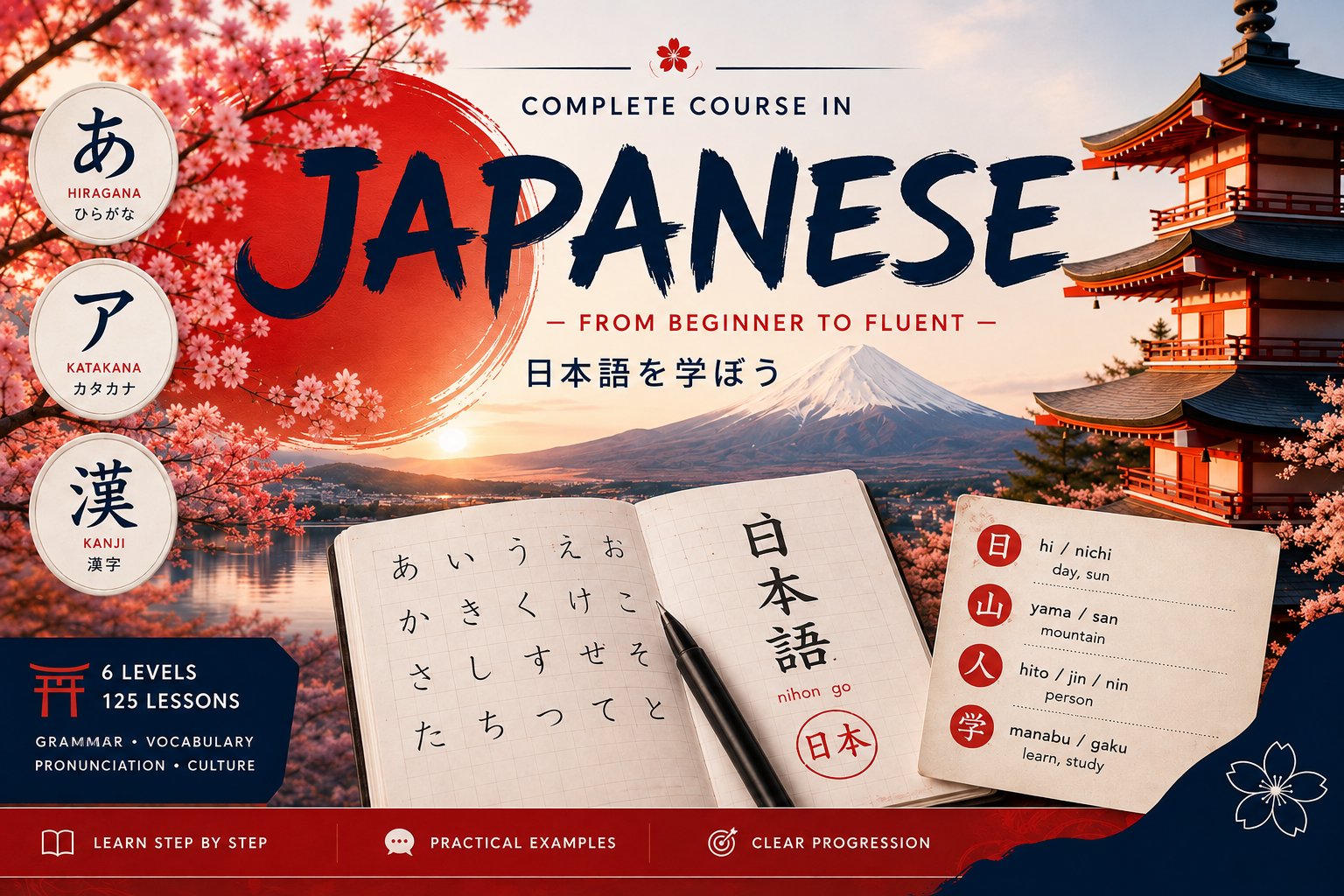
Japanese Language Course for Beginners — Learn Hiragana, Katakana, Kanji, Grammar & Basic Japanese
Lesson 1 — What Is Japanese?
Japanese is the main language spoken in Japan. It is a fascinating language with its own grammar, sounds, vocabulary, and writing systems. For an English speaker, Japanese may look very different at first, but you do not need to understand everything immediately.
Learning Japanese is a gradual process. You will first become familiar with the sounds and appearance of the language, then begin recognizing words and patterns, and later learn how to build your own sentences.
One of the most important things to understand from the beginning is that Japanese does not work exactly like English. Word order can be different, subjects are often omitted when they are understood from context, and Japanese uses several writing systems together.
1. Japan and the Japanese language
In Japanese, Japan is written:
日本
Romaji: Nihon / Nippon
Meaning: Japan
Both Nihon and Nippon refer to Japan. Nihon is very common in everyday speech, while Nippon is also used in certain formal, traditional, or national contexts.
The Japanese language is called:
日本語
Romaji: Nihongo
Meaning: Japanese / Japanese language
The final character, 語, is associated with language or words. You will see it in the names of many languages.
💡 Remember: 日本 means Japan, while 日本語 means Japanese language.
2. Your first Japanese sentence
Let's look at a very simple sentence:
これは日本語です。
Romaji: Kore wa Nihongo desu.
English: This is Japanese.
You do not need to understand every part of this sentence yet. For now, simply observe it:
- これ — kore — this;
- は — pronounced wa in this sentence;
- 日本語 — Nihongo — Japanese;
- です — desu — a common polite ending used in simple statements.
Notice something important: the Japanese sentence does not follow exactly the same order as the English sentence. This is one of the differences you will gradually learn throughout the course.
3. Japanese has its own sentence structure
English often follows a pattern like:
Subject + Verb + Object
I eat bread.
I + eat + bread
Japanese often places the main verb at or near the end of the sentence. A simple pattern can look like:
Subject + Information + Verb
私はパンを食べます。
Romaji: Watashi wa pan o tabemasu.
English: I eat bread.
Here, the important action, 食べます — tabemasu — “eat,” comes at the end.
💡 First observation: You do not need to memorize Japanese grammar yet. Just begin noticing where words appear in a sentence. As you see more examples, the patterns will become easier to recognize.
4. The subject is not always spoken
Japanese often leaves out words that are already understood from the context. This is very different from what English learners may expect.
Look at these two examples:
私は食べます。
Romaji: Watashi wa tabemasu.
English: I eat.
食べます。
Romaji: Tabemasu.
Possible English meaning: I eat. / I will eat.
In the second example, the word 私 — watashi — “I” is not spoken. If the speaker is already understood from the situation, Japanese does not always need to repeat it.
This means that context is extremely important in Japanese. Sometimes the English translation needs words that are not explicitly written in the Japanese sentence.
5. Japanese uses several writing systems
One of the first things you will notice about Japanese is its writing. Japanese does not use only one alphabet. A single sentence can contain different types of characters.
The three main writing systems are:
- Hiragana — ひらがな
- Katakana — カタカナ
- Kanji — 漢字
You will study each of these systems in detail later. For now, simply understand that they work together in modern Japanese.
私は学生です。
Romaji: Watashi wa gakusei desu.
English: I am a student.
Even though you may not yet recognize every character, this sentence already gives you an example of how different Japanese writing systems can appear together.
6. A closer look at the word 日本語
Let's return to one of the most important words in this lesson:
日本語
Romaji: Nihongo
Meaning: Japanese language
This word contains three characters:
- 日 — commonly associated with the sun or day;
- 本 — commonly associated with origin or base;
- 語 — associated with language or words.
For now, do not worry about learning the detailed meanings and readings of every character. Kanji can have multiple readings and can be used in different ways depending on the word. You will learn how this system works step by step.
7. Your first words in Japanese
Here are some useful words to begin recognizing. Do not try to memorize all of them immediately. Read them slowly, look at the Japanese characters, and say the romaji aloud.
| Japanese | Romaji | English |
|---|---|---|
| はい | Hai | Yes |
| いいえ | Iie | No |
| こんにちは | Konnichiwa | Hello / Good afternoon |
| ありがとう | Arigatō | Thank you |
| 日本 | Nihon / Nippon | Japan |
| 日本語 | Nihongo | Japanese language |
| 人 | Hito | Person |
| 私 | Watashi | I / me |
| 友達 | Tomodachi | Friend |
| 学生 | Gakusei | Student |
| 本 | Hon | Book |
| 水 | Mizu | Water |
8. Read your first Japanese sentences
Now let's finish this introduction with several simple sentences. You are not expected to understand all the grammar yet. Your goal is to start seeing Japanese as a real language made of words, sounds, and repeating patterns.
- 日本語です。
Romaji: Nihongo desu.
English: It is Japanese. - 私は学生です。
Romaji: Watashi wa gakusei desu.
English: I am a student. - これは本です。
Romaji: Kore wa hon desu.
English: This is a book. - これは水です。
Romaji: Kore wa mizu desu.
English: This is water. - こんにちは。
Romaji: Konnichiwa.
English: Hello. - ありがとう。
Romaji: Arigatō.
English: Thank you. - はい。
Romaji: Hai.
English: Yes. - いいえ。
Romaji: Iie.
English: No.
🎯 Your goal for this lesson: Do not try to master Japanese immediately. After completing this lesson, you should simply be able to recognize that 日本 means Japan, 日本語 means Japanese language, and that Japanese has its own sentence patterns and writing systems.
🧠 What to remember
- Japan is written 日本 and can be read as Nihon or Nippon.
- Japanese is called 日本語 — Nihongo.
- Japanese sentence structure can be different from English, and the main verb often comes at or near the end.
- Japanese often omits the subject when it is clear from the context.
- Context is an important part of understanding Japanese.
- Japanese mainly uses Hiragana, Katakana, and Kanji.
- A single Japanese sentence can use multiple writing systems together.
- You have already seen and read several real Japanese words and sentences.
🌸 Lesson 2 — Why Learn Japanese?
Everyone has a different reason for learning Japanese. Some people want to travel to Japan, communicate with Japanese speakers, understand anime or manga, explore Japanese culture, study abroad, or use Japanese in their professional lives.
There is no single “correct” reason to learn Japanese. Your reason is personal. What matters most is understanding what you want to be able to do with the language.
Maybe your first goal is simply to understand a few words. Maybe you want to order food in Japanese, make friends, watch a Japanese film without relying completely on subtitles, read a sign, travel more confidently, or eventually have a full conversation.
A clear reason gives your learning direction. When Japanese becomes difficult, remembering why you started can help you stay motivated and continue making progress.
🌸 Important: You do not need one huge reason to learn Japanese. A simple goal such as “I want to understand basic Japanese” is already a good reason to begin.
1. Travel to Japan with more confidence
One of the most practical reasons to learn Japanese is travel. You do not need to speak Japanese perfectly to make a trip easier. Even a small number of useful words and phrases can help you greet people, ask questions, understand simple information, order food, shop, and deal with everyday situations.
Imagine arriving somewhere and being able to say hello, ask for help, apologize when you need someone's attention, ask where something is, or say that you do not understand. These small interactions can make everyday situations feel much less intimidating.
Here are some useful phrases for a traveler:
| Japanese | Romaji | English |
|---|---|---|
| こんにちは | Konnichiwa | Hello / Good afternoon |
| おはようございます | Ohayō gozaimasu | Good morning |
| こんばんは | Konbanwa | Good evening |
| ありがとうございます | Arigatō gozaimasu | Thank you very much |
| すみません | Sumimasen | Excuse me / I'm sorry |
| お願いします | Onegaishimasu | Please |
| はい | Hai | Yes |
| いいえ | Iie | No |
| どこですか | Doko desu ka? | Where is it? |
| いくらですか | Ikura desu ka? | How much is it? |
| わかりません | Wakarimasen | I don't understand |
| 日本語がわかりません | Nihongo ga wakarimasen | I don't understand Japanese |
| 英語を話せますか | Eigo o hanasemasu ka? | Can you speak English? |
Travel example: asking for help
Let's look at a simple situation. Imagine that you are looking for a station and want to ask someone for help:
すみません。
Romaji: Sumimasen.
English: Excuse me.
Then you can ask:
駅はどこですか。
Romaji: Eki wa doko desu ka?
English: Where is the station?
You will learn how to build questions like this later. For now, notice that learning a language is not only about memorizing isolated words. Even a few complete phrases can immediately help you communicate in real situations.
2. Discover Japanese culture through the language
Learning Japanese can also give you a deeper way to explore Japanese culture. Language and culture are closely connected. The words people choose, the way they speak, and the expressions they use can reflect social relationships, habits, traditions, and everyday life.
Japanese can help you explore many different areas, including literature, films, music, video games, manga, anime, food, history, traditional arts, modern culture, and daily communication.
Learning the language can also help you notice details that are difficult to see through translation alone. You may begin recognizing repeated words, greetings, names, expressions, and patterns that appear in Japanese media and everyday life.
🌸 Remember: Learning Japanese is not only about translating Japanese words into English. It is also about understanding how Japanese speakers express ideas in different situations.
3. Understand Japanese content directly
Another powerful reason to learn Japanese is the ability to understand more content directly. At first, you may only recognize a few words. Later, those words can become short phrases, sentences, and eventually larger pieces of spoken or written content.
You may encounter Japanese in films, music, books, manga, anime, games, videos, websites, signs, menus, news, and social media.
Here are some useful words you may encounter:
| Japanese | Romaji | English |
|---|---|---|
| 映画 | Eiga | Movie / Film |
| 音楽 | Ongaku | Music |
| 本 | Hon | Book |
| 漫画 | Manga | Manga / Japanese comics |
| アニメ | Anime | Animation / Anime |
| ゲーム | Gēmu | Game |
| ニュース | Nyūsu | News |
| 写真 | Shashin | Photo / Photograph |
| 動画 | Dōga | Video |
| 言葉 | Kotoba | Word / Language / Expression |
| 日本語 | Nihongo | Japanese language |
| 字幕 | Jimaku | Subtitles |
Imagine recognizing a word before anyone translates it for you. For example, if you see 音楽, you may eventually recognize that it refers to music. If you see 映画, you may recognize that the topic is a movie or film.
These small moments of recognition are important. They show that the language is gradually becoming familiar to you.
4. Study, work, and future opportunities
Japanese can also be useful for academic and professional goals. The value of Japanese depends on your personal path and the kind of work or studies you want to pursue.
Depending on your interests, Japanese may be useful in areas such as:
- education and language teaching;
- international business;
- technology and software;
- translation and interpretation;
- tourism and hospitality;
- research and academic studies;
- international companies;
- media and entertainment;
- gaming and digital content;
- culture and international exchange;
- communication and customer support.
You do not need to know your future career right now. Learning Japanese can simply become another skill that grows with you. As your interests change, you may discover new ways to use the language.
5. Communicate with more people
At its core, a language is a tool for communication. Learning Japanese can help you connect with people, understand simple conversations, introduce yourself, ask questions, and share your own ideas.
Even beginner Japanese can create small moments of connection. A greeting, a thank-you, or a simple question can be the beginning of a conversation.
はじめまして。
Romaji: Hajimemashite.
English: Nice to meet you.
私の名前はアレックスです。
Romaji: Watashi no namae wa Arekkusu desu.
English: My name is Alex.
日本語を勉強しています。
Romaji: Nihongo o benkyō shite imasu.
English: I am studying Japanese.
These sentences may look complicated now, but later you will understand how they are built word by word. For the moment, simply notice that your future goal is not only to recognize Japanese — it is also to use it.
6. Set your own learning goal
Your reason for learning Japanese can help you choose what to focus on. Different goals may require different priorities.
- Travel: focus on greetings, questions, directions, food, shopping, and polite everyday expressions.
- Anime, manga, or games: focus on listening, common vocabulary, reading, and understanding everyday expressions.
- Conversation: focus on speaking, listening, useful phrases, and sentence patterns.
- Reading: focus on Hiragana, Katakana, Kanji, vocabulary, and grammar.
- Study or work: focus on building strong skills across reading, writing, listening, and speaking.
🎯 Your goal can change. You may start learning Japanese because of anime and later become interested in travel, conversation, culture, reading, or professional opportunities. That is completely normal.
7. Talk about your motivation in Japanese
You can already begin looking at sentences that express reasons, interests, and personal goals. You will study the grammar behind them later.
For now, read each sentence and focus on its general meaning.
- 日本語を勉強します。
Romaji: Nihongo o benkyō shimasu.
English: I study Japanese. - 日本語を勉強したいです。
Romaji: Nihongo o benkyō shitai desu.
English: I want to study Japanese. - 日本へ行きたいです。
Romaji: Nihon e ikitai desu.
English: I want to go to Japan. - 日本が好きです。
Romaji: Nihon ga suki desu.
English: I like Japan. - 日本の文化が好きです。
Romaji: Nihon no bunka ga suki desu.
English: I like Japanese culture. - アニメが好きです。
Romaji: Anime ga suki desu.
English: I like anime. - 日本語は面白いです。
Romaji: Nihongo wa omoshiroi desu.
English: Japanese is interesting. - 日本語は難しいです。
Romaji: Nihongo wa muzukashii desu.
English: Japanese is difficult. - でも、楽しいです。
Romaji: Demo, tanoshii desu.
English: But it is fun. - 毎日勉強します。
Romaji: Mainichi benkyō shimasu.
English: I study every day. - もっと日本語を話したいです。
Romaji: Motto Nihongo o hanashitai desu.
English: I want to speak more Japanese. - 日本語をもっと理解したいです。
Romaji: Nihongo o motto rikai shitai desu.
English: I want to understand Japanese better.
8. Build a habit, not just motivation
Motivation can help you begin, but it may change from day to day. You may feel excited one week and less motivated the next. This is normal when learning any language.
Small and regular practice is often more useful than waiting for the perfect moment to study for many hours. Reading a few Japanese words, reviewing a short lesson, listening carefully to a sentence, or practicing for a few minutes can all become part of your progress.
少しずつ勉強します。
Romaji: Sukoshi zutsu benkyō shimasu.
English: I study little by little.
This is a good idea to remember throughout the course: you do not need to learn everything today. Japanese is built step by step, word by word, pattern by pattern.
💡 Learning mindset: Do not ask, “How much Japanese do I still have to learn?” Instead, ask, “What can I understand today that I could not understand before?”
🧠 What to remember
- People learn Japanese for many different reasons, including travel, communication, culture, entertainment, study, and work.
- Even basic Japanese can help you communicate in real everyday situations.
- Learning Japanese can help you understand more content directly, from words and signs to conversations and media.
- Your personal reason for learning can give you direction and help you stay motivated.
- Your goals can change as you progress.
- You do not need to master Japanese immediately. Regular practice and gradual progress are more important than trying to learn everything at once.
- Japanese is a language to recognize, understand, and eventually use to communicate.
ℹ️ About this Course

Mr Ray
- 🌍 Language English
- 👥 Students 0
- 👁 Views 1,661
- 📚 Resources 3
- 📄 PDF 1
- 🎥 Videos 0
- 📝 Quizzes 2
- 🔗 Links 0
- 🕒 Reading 39 min
- 📅 Updated August 26, 2026