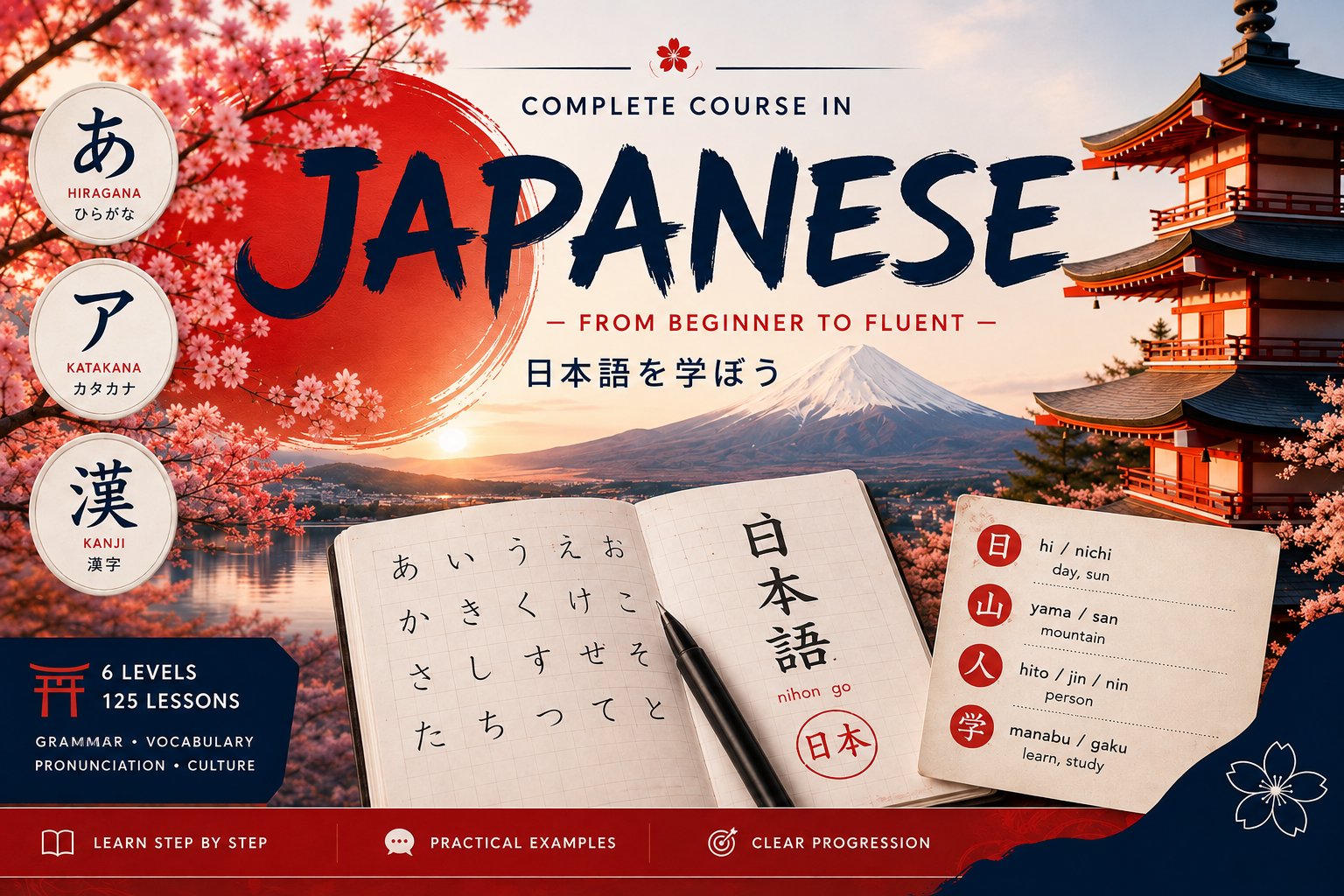
Japanese Language Course for Beginners — Learn Hiragana, Katakana, Kanji, Grammar & Basic Japanese
🗣️ Lesson 5 — Spoken Japanese and Written Japanese
A language can be used in more than one way. The way we speak is not always presented in exactly the same way when we write.
In Japanese, one of the most important parts of learning is gradually connecting what you hear, what you say, what you see written, and what it means.
At first, this may seem more complicated than learning a language that uses only the Latin alphabet. Japanese uses several writing systems, and a single word can sometimes be shown in different ways for learning purposes.
However, you do not need to learn everything at once. The goal is to build your reading skills step by step.
💡 The learning path: When you see a new Japanese word, try to connect these four things:
- Japanese writing: what the word looks like.
- Sound: how the word is pronounced.
- Romaji: a temporary pronunciation guide using the Latin alphabet.
- Meaning: what the word means in English.
1. Japanese is spoken and written in different ways
When someone speaks Japanese, you hear sounds flowing together. You do not see Hiragana, Katakana, Kanji, or spaces while listening.
For example, if someone says:
Sound: Nihongo o benkyō shite imasu.
Meaning: I am studying Japanese.
When the same idea is written in Japanese, it can appear like this:
日本語を勉強しています。
Romaji: Nihongo o benkyō shite imasu.
English: I am studying Japanese.
Notice that the spoken sentence and the written sentence represent the same language. The difference is simply that one is heard and the other is seen.
As a beginner, you may initially rely heavily on Romaji. That is normal. But gradually, you will train yourself to recognize Japanese writing directly.
2. Japanese uses several writing systems
Modern Japanese mainly uses three important writing systems: Hiragana, Katakana, and Kanji.
These systems are not completely separate languages. They work together inside Japanese writing.
| Writing System | Main Role | Example | Romaji |
|---|---|---|---|
| Hiragana | A fundamental Japanese phonetic writing system used for many grammatical elements and native Japanese words. | にほん | Nihon |
| Katakana | Commonly used for many foreign loanwords, foreign names, onomatopoeia, and other special uses. | テレビ | Terebi |
| Kanji | Characters that carry meaning and are used extensively in Japanese writing. | 日本 | Nihon |
You will study each of these systems in much greater detail later. For now, the important idea is simple:
Japanese writing = Hiragana + Katakana + Kanji
In real Japanese texts, these systems often appear together in the same sentence.
私は日本語を勉強しています。
Romaji: Watashi wa Nihongo o benkyō shite imasu.
English: I am studying Japanese.
Even though you do not yet know how to identify every character, you can already see that different types of Japanese writing appear together. That is completely normal in Japanese.
3. One word can be shown in different forms
During your learning journey, the same Japanese word may be presented in different forms to help you understand its pronunciation and meaning.
Let's use the word for Japan as an example.
| Type | Example | Reading / Meaning |
|---|---|---|
| Kanji | 日本 | Nihon / Nippon — Japan |
| Hiragana | にほん | Nihon — Japan |
| Romaji | Nihon | Japanese pronunciation written with the Latin alphabet |
| English | Japan | Meaning in English |
These forms help you see the connection between writing, pronunciation, and meaning.
⚠️ Important: Romaji is useful at the beginning because it helps you pronounce Japanese words before you can read the Japanese writing systems.
However, the long-term goal is to gradually become able to read Hiragana, Katakana, and Kanji directly.
Think of Romaji as a bridge: it helps you enter the language, but eventually you should become less dependent on it.
4. A first look at Hiragana, Katakana, and Kanji
Let's compare several words so that you can begin noticing the visual differences between the writing systems.
| Japanese | Writing Type | Romaji | English |
|---|---|---|---|
| ありがとう | Hiragana | Arigatō | Thank you |
| こんにちは | Hiragana | Konnichiwa | Hello |
| テレビ | Katakana | Terebi | Television |
| ホテル | Katakana | Hoteru | Hotel |
| 日本 | Kanji | Nihon | Japan |
| 水 | Kanji | Mizu | Water |
| 本 | Kanji | Hon | Book |
Do not worry about memorizing every character yet. At this stage, simply begin looking carefully at the different shapes and becoming familiar with how Japanese writing appears.
5. Japanese sentences do not use spaces like English
In English, we normally separate words with spaces:
I study Japanese.
We can easily see the individual words:
I + study + Japanese
Standard Japanese writing normally does not place a space between every word in the same way:
私は日本語を勉強します。
Romaji: Watashi wa Nihongo o benkyō shimasu.
English: I study Japanese.
At first, a Japanese sentence may look like one long group of characters. As you learn more vocabulary, grammar, Hiragana, Katakana, and Kanji, you will gradually learn to recognize where one element ends and another begins.
For learning purposes, we can temporarily break the sentence into parts:
私 + は + 日本語 + を + 勉強します
You do not need to understand all of the grammar yet. The purpose of this example is to show you that Japanese readers gradually learn to recognize familiar words, characters, particles, and grammatical patterns.
💡 Reading tip: Do not try to identify every character individually forever. As your vocabulary grows, begin training your eyes to recognize familiar groups of characters as complete words and expressions.
6. Japanese punctuation helps you read
Although Japanese does not normally use spaces between every word, punctuation still helps organize written sentences.
| Japanese Mark | Common Name | General Function |
|---|---|---|
| 。 | Japanese period | Marks the end of a sentence |
| 、 | Japanese comma | Separates parts of a sentence |
| ? | Question mark | Can be used to show a question in many modern contexts |
| ! | Exclamation mark | Shows emphasis, excitement, or strong emotion |
これは本です。
Romaji: Kore wa hon desu.
English: This is a book.
The character 。 tells you that the sentence has ended.
7. The same language can look different depending on the writing
Some Japanese words can be presented differently depending on the situation, the level of writing, or the learning material.
For example, the word for Japanese language is commonly written:
日本語 — Nihongo — Japanese language
For learning and pronunciation purposes, you may also encounter:
にほんご — Nihongo
The meaning is the same. The first version uses Kanji and the second version is written entirely in Hiragana.
This is useful for beginners because Hiragana versions can help learners read words before they have learned the Kanji.
| Common Writing | Hiragana Reading Form | Romaji | English |
|---|---|---|---|
| 日本 | にほん | Nihon | Japan |
| 日本語 | にほんご | Nihongo | Japanese language |
| 学生 | がくせい | Gakusei | Student |
| 先生 | せんせい | Sensei | Teacher |
| 友達 | ともだち | Tomodachi | Friend |
8. First vocabulary: different writing styles
The following examples will help you become familiar with words written in Hiragana, Katakana, Kanji, and combinations of different systems.
| Japanese | Romaji | English | Writing Observation |
|---|---|---|---|
| 私 | Watashi | I / me | Kanji |
| 日本 | Nihon | Japan | Kanji |
| 日本語 | Nihongo | Japanese language | Kanji |
| 学生 | Gakusei | Student | Kanji |
| 先生 | Sensei | Teacher | Kanji |
| 友達 | Tomodachi | Friend | Kanji combination |
| 本 | Hon | Book | Kanji |
| 水 | Mizu | Water | Kanji |
| ありがとう | Arigatō | Thank you | Hiragana |
| こんにちは | Konnichiwa | Hello | Hiragana |
| テレビ | Terebi | Television | Katakana |
| ホテル | Hoteru | Hotel | Katakana |
| コーヒー | Kōhī | Coffee | Katakana |
| スマートフォン | Sumātofon | Smartphone | Katakana |
9. Reading Japanese step by step
When you begin reading Japanese, do not rush directly to the English translation.
A useful method is to follow these steps:
- Look at the Japanese sentence. Try to notice familiar characters or words.
- Read the Japanese slowly. Do not worry about speed.
- Check the Romaji. Use it to confirm the pronunciation.
- Read the English meaning.
- Return to the Japanese sentence. Try reading it again without immediately looking at the Romaji.
🌱 Good habit: Every time you learn a new Japanese word, try to look at the Japanese writing before looking at the Romaji.
Even if you cannot read it yet, your eyes will gradually become more familiar with the shape of the language.
10. Fifteen sentences to read progressively
Read each sentence slowly. First observe the Japanese writing, then try to read it. After that, check the Romaji and finally confirm the English meaning.
- 私は学生です。
Romaji: Watashi wa gakusei desu.
English: I am a student. - 私は先生です。
Romaji: Watashi wa sensei desu.
English: I am a teacher. - これは本です。
Romaji: Kore wa hon desu.
English: This is a book. - これは水です。
Romaji: Kore wa mizu desu.
English: This is water. - 私は日本人です。
Romaji: Watashi wa Nihonjin desu.
English: I am Japanese. - 日本語を勉強します。
Romaji: Nihongo o benkyō shimasu.
English: I study Japanese. - 日本語を話します。
Romaji: Nihongo o hanashimasu.
English: I speak Japanese. - 私は日本が好きです。
Romaji: Watashi wa Nihon ga suki desu.
English: I like Japan. - こんにちは。
Romaji: Konnichiwa.
English: Hello. - ありがとうございます。
Romaji: Arigatō gozaimasu.
English: Thank you. - これはテレビです。
Romaji: Kore wa terebi desu.
English: This is a television. - 私は水を飲みます。
Romaji: Watashi wa mizu o nomimasu.
English: I drink water. - 本を読みます。
Romaji: Hon o yomimasu.
English: I read a book. - 友達と話します。
Romaji: Tomodachi to hanashimasu.
English: I speak with a friend. - 私は日本語が少しわかります。
Romaji: Watashi wa Nihongo ga sukoshi wakarimasu.
English: I understand a little Japanese.
11. A first reading challenge
Now try reading these expressions before checking the Romaji.
日本
日本語
ありがとう
こんにちは
テレビ
私は学生です。
日本語を勉強します。
Now check your answers:
| Japanese | Romaji | English |
|---|---|---|
| 日本 | Nihon | Japan |
| 日本語 | Nihongo | Japanese language |
| ありがとう | Arigatō | Thank you |
| こんにちは | Konnichiwa | Hello |
| テレビ | Terebi | Television |
| 私は学生です。 | Watashi wa gakusei desu. | I am a student. |
| 日本語を勉強します。 | Nihongo o benkyō shimasu. | I study Japanese. |
12. Your first goal as a Japanese reader
Your goal is not to memorize every character immediately.
Instead, begin building recognition little by little.
For example, by the end of this first chapter, you should begin recognizing some familiar Japanese words visually:
- 日本 — Nihon — Japan
- 日本語 — Nihongo — Japanese language
- 私 — Watashi — I / me
- 学生 — Gakusei — student
- 先生 — Sensei — teacher
- 本 — Hon — book
- 水 — Mizu — water
- ありがとう — Arigatō — thank you
- こんにちは — Konnichiwa — hello
- テレビ — Terebi — television
🧠 Remember: Reading is a skill built through repeated exposure.
Every time you see a familiar Japanese word, you strengthen the connection between its appearance, pronunciation, and meaning.
🧠 End of Chapter 1 — What You Know Now
You have now completed your first introduction to some of the most important characteristics of the Japanese language.
- The Japanese language is called 日本語 — Nihongo.
- Japan is written 日本 and can be read as Nihon or Nippon.
- Japanese sentence structure works differently from English.
- Context plays an important role in understanding Japanese.
- Politeness and social relationships influence the way people communicate.
- です — desu — is an important form in polite Japanese sentences.
- ます — masu — is an important polite verb ending.
- さん — san — is a common polite suffix used after another person's name.
- Japanese uses three major writing systems: Hiragana, Katakana, and Kanji.
- These writing systems often work together in real Japanese sentences.
- Japanese sentences do not normally use spaces between every word in the same way English does.
- Romaji is useful as a temporary pronunciation guide, but your long-term goal is to read Japanese writing directly.
- You have already started building your first Japanese reading vocabulary.
- You do not need to understand or memorize every character yet. Recognition and confidence will grow gradually through repeated exposure and practice.
➡️ In the next chapter, we will move directly into one of the most important foundations of Japanese literacy: the Japanese writing systems themselves.
You will begin learning how Japanese sounds are represented in writing, starting your journey toward reading Japanese without depending entirely on Romaji.
ℹ️ À propos de ce cours

Mr Ray
- 🌍 Langue English
- 👥 Étudiants 0
- 👁 Vues 1,672
- 📚 Ressources 3
- 📄 PDF 1
- 🎥 Vidéos 0
- 📝 Quiz 2
- 🔗 Liens 0
- 🕒 Lecture 39 min
- 📅 Mis à jour August 26, 2026