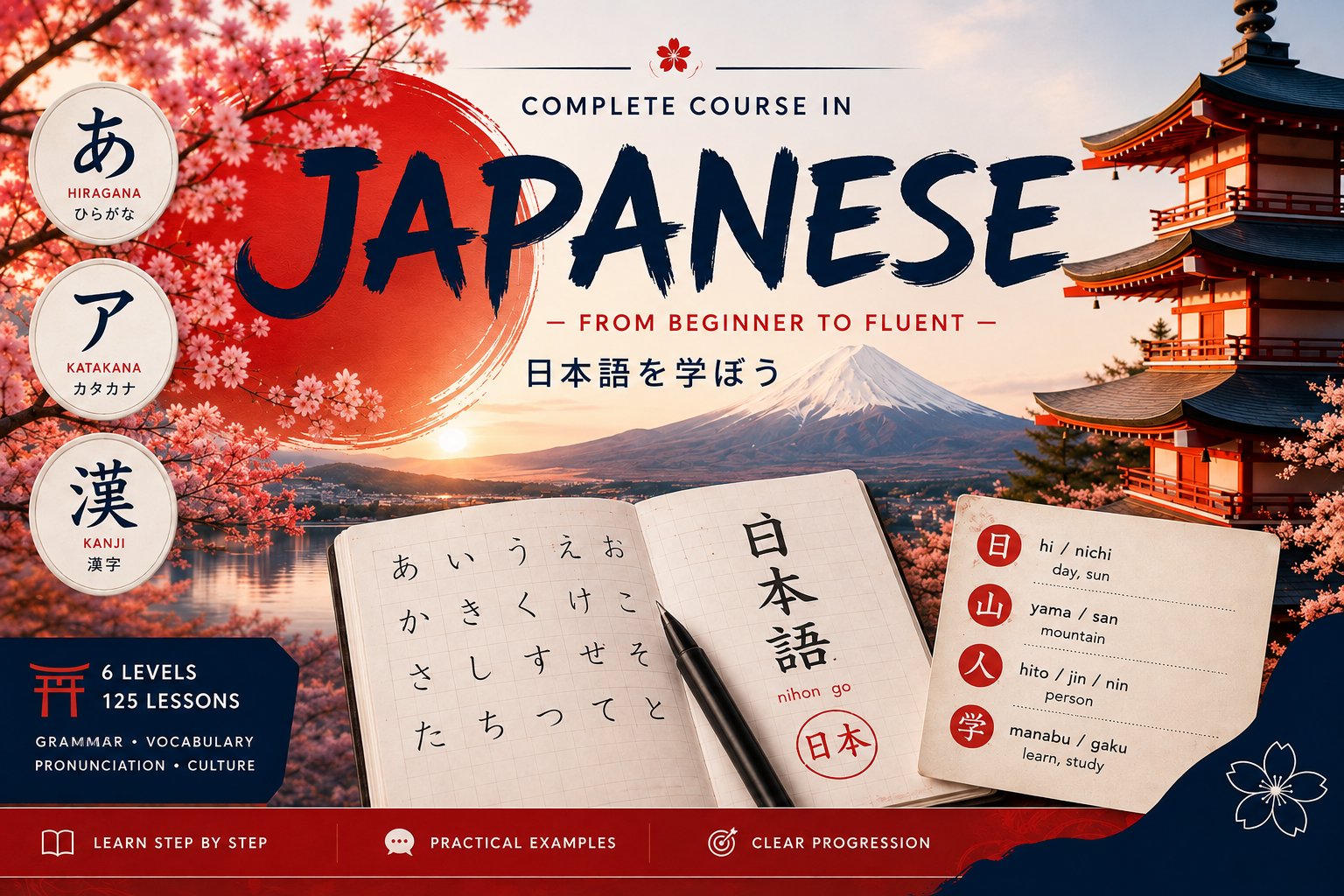
Japanese Language Course for Beginners — Learn Hiragana, Katakana, Kanji, Grammar & Basic Japanese
🙇 Lesson 4 — Language Levels and Politeness
One of the most important characteristics of Japanese is the role that context and social relationships play in communication.
In Japanese, people do not always speak in exactly the same way to everyone. The words and forms you choose can depend on who you are speaking to, how well you know that person, your relationship, the situation, and the level of formality expected.
For example, you may speak differently with a close friend, a teacher, a customer, a stranger, a colleague, an older person, or someone you have just met.
This does not mean that you need to memorize every level of Japanese politeness immediately. Japanese politeness is a large topic, and you will learn it gradually.
At the beginning of this course, the most important goal is simple: learn how to communicate in a clear, natural, and polite way in common everyday situations.
🙇 Important: When you are a beginner, using a standard polite form is often a safe and useful choice when speaking to people you do not know well.
You do not need to sound extremely formal all the time. You simply need to begin understanding that Japanese communication can change according to the situation.
1. A first look at Japanese speech levels
Japanese has different ways of speaking. As a beginner, you can think of them as a spectrum rather than a collection of completely separate languages.
Some expressions are casual and are commonly used with close friends or family. Others are polite and useful in everyday interactions. Japanese also has more formal and respectful forms used in particular social and professional situations.
| General Level | Typical Situation | Example |
|---|---|---|
| Casual | Close friends, family, informal situations | ありがとう — Arigatō |
| Polite | Strangers, teachers, everyday polite communication | ありがとうございます — Arigatō gozaimasu |
| More formal / respectful | Particular professional, business, or highly respectful situations | More advanced forms studied later |
For now, the middle level — standard polite Japanese — will be especially important for this course.
💡 Beginner strategy: First learn useful standard polite forms. Later, as your Japanese improves, you will become more comfortable recognizing and using casual, formal, and highly respectful expressions.
2. The polite form です — desu
One of the first important Japanese expressions to recognize is:
です — desu
です — desu — is frequently used in polite Japanese sentences. Depending on the sentence, it can help express ideas similar to “am,” “is,” or “are” in English, although Japanese and English grammar do not work in exactly the same way.
You should therefore avoid thinking that です always translates as one single English word. Its role depends on the sentence.
[Topic / Subject] + [Information] + です
Look at these simple examples:
| Japanese | Romaji | English |
|---|---|---|
| 私は学生です。 | Watashi wa gakusei desu. | I am a student. |
| 私は先生です。 | Watashi wa sensei desu. | I am a teacher. |
| これは本です。 | Kore wa hon desu. | This is a book. |
| これは日本語です。 | Kore wa Nihongo desu. | This is Japanese. |
| 田中さんです。 | Tanaka-san desu. | This is Mr. / Ms. Tanaka. |
| 日本人です。 | Nihonjin desu. | I am Japanese. / He or she is Japanese. |
| 学生ではありません。 | Gakusei dewa arimasen. | I am not a student. |
| 先生ですか。 | Sensei desu ka? | Are you a teacher? |
Notice something important: Japanese often leaves out information when it is already clear from the context.
For example:
学生です。
Romaji: Gakusei desu.
English: I am a student. / He is a student. / She is a student.
The exact English translation depends on the context. Later in the course, you will learn more about how Japanese speakers use context to understand information that is not explicitly repeated.
3. The polite verb ending ます — masu
Another important form you have already seen is:
ます — masu
While です often appears at the end of polite sentences involving descriptions or nouns, many polite verb forms end in ます.
You do not need to master verb conjugation yet. For now, begin recognizing this common polite pattern.
| Japanese | Romaji | English |
|---|---|---|
| 話します | Hanashimasu | Speak / will speak |
| 勉強します | Benkyō shimasu | Study / will study |
| 行きます | Ikimasu | Go / will go |
| 食べます | Tabemasu | Eat / will eat |
| 飲みます | Nomimasu | Drink / will drink |
私は日本語を勉強します。
Romaji: Watashi wa Nihongo o benkyō shimasu.
English: I study Japanese. / I will study Japanese.
日本語を話します。
Romaji: Nihongo o hanashimasu.
English: I speak Japanese.
As with です, the full meaning of a Japanese sentence depends on context. Japanese does not always express time in exactly the same way English does.
4. The suffix さん — san
When speaking politely about someone or directly addressing someone, the suffix さん — san — is extremely common.
It is generally placed after a person's name:
Name + さん
For beginners, -san is often loosely translated as Mr., Ms., Mrs., or sometimes simply understood as a polite name suffix. However, there is no single English equivalent that works in every situation.
It is better to think of さん as an important Japanese marker of polite address.
- 田中さん
Romaji: Tanaka-san
English: Mr. / Ms. Tanaka - 山田さん
Romaji: Yamada-san
English: Mr. / Ms. Yamada - 佐藤さん
Romaji: Satō-san
English: Mr. / Ms. Satō - 鈴木さん
Romaji: Suzuki-san
English: Mr. / Ms. Suzuki - 田中さんは学生です。
Romaji: Tanaka-san wa gakusei desu.
English: Mr. / Ms. Tanaka is a student. - 山田さんは先生です。
Romaji: Yamada-san wa sensei desu.
English: Mr. / Ms. Yamada is a teacher. - 佐藤さん、こんにちは。
Romaji: Satō-san, konnichiwa.
English: Hello, Mr. / Ms. Satō. - 鈴木さん、ありがとうございます。
Romaji: Suzuki-san, arigatō gozaimasu.
English: Thank you, Mr. / Ms. Suzuki. - 田中さんは日本人です。
Romaji: Tanaka-san wa Nihonjin desu.
English: Mr. / Ms. Tanaka is Japanese. - 山田さんは友達です。
Romaji: Yamada-san wa tomodachi desu.
English: Mr. / Ms. Yamada is a friend.
💡 Important: Do not automatically add さん to your own name when introducing yourself in a normal situation. It is generally used when referring to or addressing another person.
5. Different ways to say “thank you”
Japanese has several ways to express gratitude. The best expression can depend on the relationship, the situation, and the level of politeness.
| Expression | Romaji | General Use |
|---|---|---|
| どうも | Dōmo | A simple “thanks” depending on the context |
| ありがとう | Arigatō | Thank you — common and relatively casual |
| ありがとうございます | Arigatō gozaimasu | Thank you — polite |
| どうもありがとうございます | Dōmo arigatō gozaimasu | Thank you very much — polite and stronger |
| ありがとうございました | Arigatō gozaimashita | Thank you very much for what you did |
The last form, ありがとうございました, is commonly used when thanking someone for something that has already happened or has just been completed.
6. Polite communication in everyday situations
Here are some useful expressions that you can begin using in real situations. These are especially valuable for a beginner because they help you greet people, ask for help, show understanding, and communicate when something is difficult.
- こんにちは。
Romaji: Konnichiwa.
English: Hello. - ありがとうございます。
Romaji: Arigatō gozaimasu.
English: Thank you. - どうもありがとうございます。
Romaji: Dōmo arigatō gozaimasu.
English: Thank you very much. - すみません。
Romaji: Sumimasen.
English: Excuse me. / I'm sorry. - お願いします。
Romaji: Onegaishimasu.
English: Please. / I would like this, please. - はい、わかりました。
Romaji: Hai, wakarimashita.
English: Yes, I understand. / Okay, I understand. - すみません、わかりません。
Romaji: Sumimasen, wakarimasen.
English: Sorry, I don't understand. - もう一度お願いします。
Romaji: Mō ichido onegaishimasu.
English: One more time, please. - ゆっくり話してください。
Romaji: Yukkuri hanashite kudasai.
English: Please speak slowly. - 日本語を勉強しています。
Romaji: Nihongo o benkyō shite imasu.
English: I am studying Japanese. - 日本語が少しわかります。
Romaji: Nihongo ga sukoshi wakarimasu.
English: I understand a little Japanese. - 日本語を話せません。
Romaji: Nihongo o hanasemasen.
English: I cannot speak Japanese. - 英語を話せますか。
Romaji: Eigo o hanasemasu ka?
English: Can you speak English? - 大丈夫です。
Romaji: Daijōbu desu.
English: It's okay. / I'm fine. / No problem. - よろしくお願いします。
Romaji: Yoroshiku onegaishimasu.
General meaning: Nice to meet you. / I look forward to working with you. / Thank you in advance — depending on the context.
7. Why context matters
Some Japanese expressions cannot be translated with exactly one fixed English sentence because their meaning changes according to the situation.
A good example is:
すみません — Sumimasen
Depending on the situation, it can mean:
- Excuse me.
- I'm sorry.
- Thank you for the trouble.
- Excuse me, may I ask something?
Imagine wanting to ask a stranger for directions:
すみません。駅はどこですか。
Romaji: Sumimasen. Eki wa doko desu ka?
English: Excuse me. Where is the station?
Here, すみません means “Excuse me”.
Now imagine that you accidentally bump into someone:
すみません。
Romaji: Sumimasen.
English: I'm sorry.
The same Japanese expression is understood differently because the context changes.
8. Casual and polite: a first comparison
As you progress, you will begin noticing that Japanese can use different forms to express similar ideas.
| Casual | Polite | General Meaning |
|---|---|---|
| ありがとう Arigatō | ありがとうございます Arigatō gozaimasu | Thank you |
| わかる Wakaru | わかります Wakarimasu | Understand |
| わからない Wakaranai | わかりません Wakarimasen | Do not understand |
| 食べる Taberu | 食べます Tabemasu | Eat |
| 行く Iku | 行きます Ikimasu | Go |
⚠️ Do not memorize all of these grammar changes yet. This table is only a first introduction. You will learn how Japanese verbs change step by step later in the course.
For now, simply begin noticing that polite Japanese often uses forms such as です and ます.
9. A short polite conversation
Let's bring several expressions together in a simple conversation between two people meeting for the first time.
A: こんにちは。はじめまして。
Romaji: Konnichiwa. Hajimemashite.
English: Hello. Nice to meet you.
A: 私はアレックスです。
Romaji: Watashi wa Arekkusu desu.
English: I am Alex.
B: こんにちは。私は田中です。
Romaji: Konnichiwa. Watashi wa Tanaka desu.
English: Hello. I am Tanaka.
A: 日本語を勉強しています。
Romaji: Nihongo o benkyō shite imasu.
English: I am studying Japanese.
B: そうですか。頑張ってください。
Romaji: Sō desu ka. Ganbatte kudasai.
English: I see. Please do your best. / Good luck.
A: ありがとうございます。
Romaji: Arigatō gozaimasu.
English: Thank you.
A: よろしくお願いします。
Romaji: Yoroshiku onegaishimasu.
English: Nice to meet you. / I look forward to getting to know you.
10. What you should focus on now
Japanese politeness is a large subject, so do not try to learn every rule immediately.
At this stage, focus on recognizing and using a small number of useful polite expressions correctly.
- です — desu
- ます — masu
- さん — san
- ありがとうございます — Arigatō gozaimasu
- すみません — Sumimasen
- お願いします — Onegaishimasu
- わかりません — Wakarimasen
- もう一度お願いします — Mō ichido onegaishimasu
🌱 Remember: You do not need perfect Japanese to communicate politely. Learning a few useful expressions and understanding when to use them is already an important first step.
🧠 What to remember
- Japanese communication is strongly influenced by context and social relationships.
- People may speak differently with friends, strangers, teachers, customers, colleagues, and other people.
- です — desu — is a fundamental form used in many polite sentences.
- ます — masu — is an important polite verb ending.
- さん — san — is a common polite suffix used after another person's name.
- Japanese has different ways to express gratitude, depending on the situation and level of politeness.
- Expressions such as すみません can have different English meanings depending on context.
- Standard polite Japanese is an excellent foundation for a beginner.
- You do not need to master advanced politeness immediately. You will learn Japanese speech levels gradually throughout your learning journey.
- For now, focus on understanding the situation, recognizing polite patterns, and building confidence with useful everyday expressions.
ℹ️ इस पाठ्यक्रम के बारे में

Mr Ray
- 🌍 भाषा English
- 👥 छात्र 0
- 👁 दृश्य 1,662
- 📚 संसाधन 3
- 📄 PDF 1
- 🎥 वीडियो 0
- 📝 क्विज़ 2
- 🔗 लिंक 0
- 🕒 पढ़ना 39 min
- 📅 अपडेट किया गया August 26, 2026