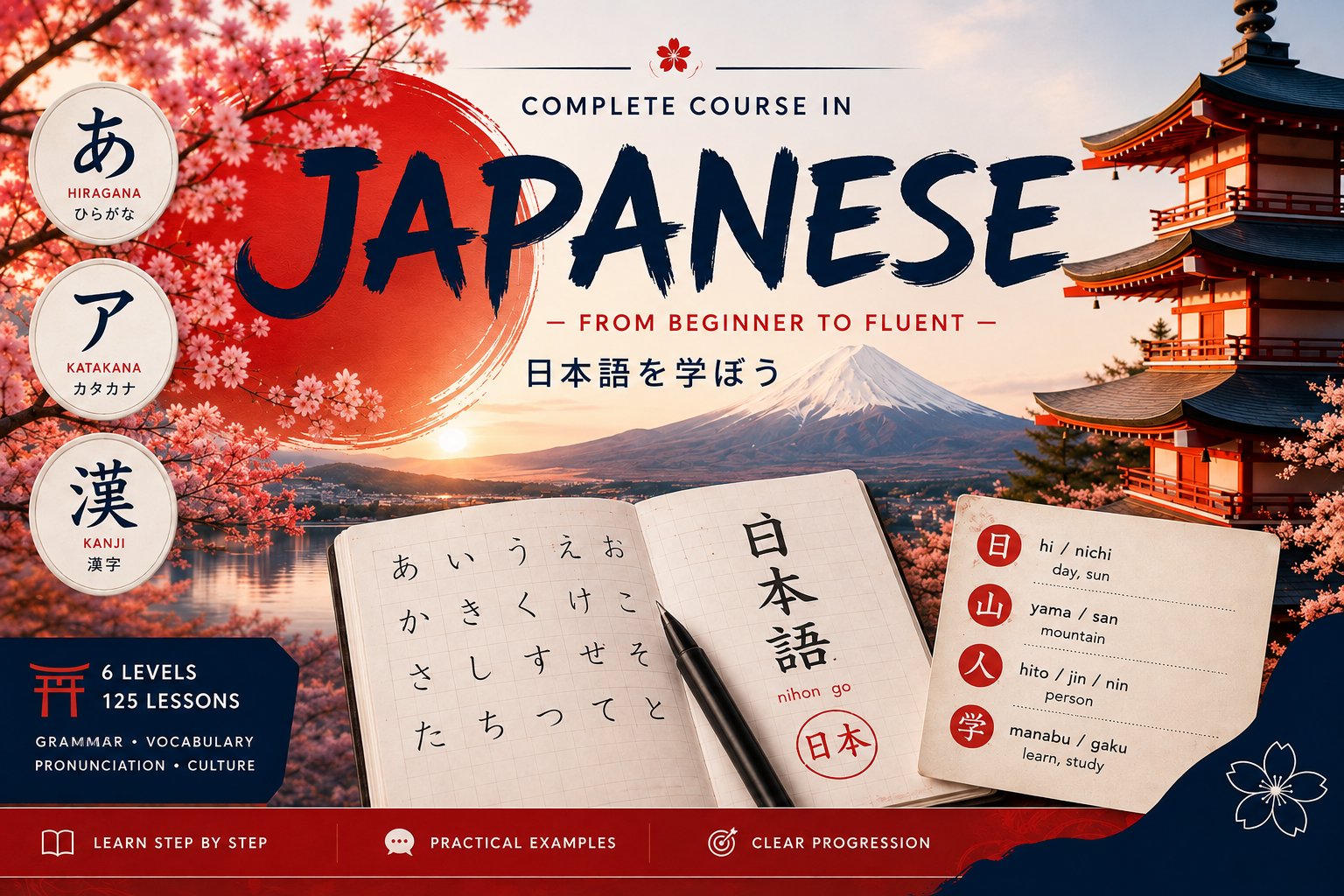
Japanese Language Course for Beginners — Learn Hiragana, Katakana, Kanji, Grammar & Basic Japanese
🌍 Lesson 3 — Japanese Around the World
Japanese is most closely associated with Japan, where it is used in everyday life, education, business, entertainment, media, government, and countless social situations.
However, Japanese is not limited to people living in Japan. It is also studied and used by learners, students, teachers, professionals, and Japanese-speaking communities in many parts of the world.
You may be learning Japanese from another country, studying online, practicing with friends, watching Japanese content, or preparing for future travel. This means that learning Japanese can connect you with people and ideas far beyond one location.
🌍 Important idea: Japanese is the language of Japan, but Japanese learners can be found all over the world. You do not need to live in Japan to begin learning and using the language.
1. Japan in Japanese
The name of Japan is written:
日本 — Nihon / Nippon
Both Nihon and Nippon refer to Japan. You have already seen these two readings in the previous lessons. Nihon is especially common in everyday conversation, while Nippon can also appear in official, traditional, national, or other specific contexts.
The word for the Japanese language is:
日本語 — Nihongo — Japanese language
Notice the difference:
| Japanese | Romaji | English |
|---|---|---|
| 日本 | Nihon / Nippon | Japan |
| 日本語 | Nihongo | Japanese language |
| 日本人 | Nihonjin | Japanese person / Japanese people |
This is an important pattern to begin recognizing. The word 日本 refers to Japan, while adding another character can change the meaning.
私は日本に住んでいます。
Romaji: Watashi wa Nihon ni sunde imasu.
English: I live in Japan.
Here, the word 住んでいます — sunde imasu — expresses the idea of living or residing somewhere.
日本語を勉強しています。
Romaji: Nihongo o benkyō shite imasu.
English: I am studying Japanese.
These two examples already allow you to express two important ideas: where you live and what language you are studying.
2. Japan, Japanese, and Japanese people
English often uses the word Japanese in different ways. It can refer to the language, people, food, culture, or other things connected with Japan.
Japanese usually uses more specific words. For example:
| Japanese | Romaji | Meaning |
|---|---|---|
| 日本 | Nihon | Japan |
| 日本語 | Nihongo | Japanese language |
| 日本人 | Nihonjin | Japanese person |
| 日本文化 | Nihon bunka | Japanese culture |
| 日本料理 | Nihon ryōri | Japanese cuisine |
💡 Notice the pattern: 日本 appears at the beginning of several words related to Japan. As your vocabulary grows, recognizing familiar parts inside longer words will become increasingly useful.
3. Japanese is learned around the world
People have many different reasons for learning Japanese. Some are interested in travel, culture, anime, manga, games, music, literature, work, study, or communication with Japanese speakers.
Regardless of where a learner comes from, the goal is often similar: gradually understanding more Japanese and becoming able to use it with greater confidence.
Let's look at different people learning Japanese:
- 私は日本語を勉強しています。
Romaji: Watashi wa Nihongo o benkyō shite imasu.
English: I am studying Japanese. - 彼は日本語を勉強しています。
Romaji: Kare wa Nihongo o benkyō shite imasu.
English: He is studying Japanese. - 彼女は日本語を勉強しています。
Romaji: Kanojo wa Nihongo o benkyō shite imasu.
English: She is studying Japanese. - 私たちは日本語を勉強しています。
Romaji: Watashitachi wa Nihongo o benkyō shite imasu.
English: We are studying Japanese. - 友達も日本語を勉強しています。
Romaji: Tomodachi mo Nihongo o benkyō shite imasu.
English: My friend is also studying Japanese. - 多くの人が日本語を学んでいます。
Romaji: Ōku no hito ga Nihongo o manande imasu.
English: Many people are learning Japanese. - 世界中で日本語を学ぶ人がいます。
Romaji: Sekaijū de Nihongo o manabu hito ga imasu.
English: There are people learning Japanese all around the world. - 日本語を話す人もいます。
Romaji: Nihongo o hanasu hito mo imasu.
English: There are also people who speak Japanese. - 日本語の先生です。
Romaji: Nihongo no sensei desu.
English: I am a Japanese teacher. / He or she is a Japanese teacher. - 日本語を教えています。
Romaji: Nihongo o oshiete imasu.
English: I am teaching Japanese. - 少し日本語がわかります。
Romaji: Sukoshi Nihongo ga wakarimasu.
English: I understand a little Japanese. - もっと日本語を話したいです。
Romaji: Motto Nihongo o hanashitai desu.
English: I want to speak more Japanese.
Do not worry if you cannot explain all the grammar yet. At this stage, these examples help you become familiar with useful patterns and repeated words such as 日本語, 勉強, 学ぶ, and 話す.
4. Talking about countries and languages
As you learn Japanese, you may want to talk about where you come from and what languages you speak.
You will study these grammar patterns in more detail later, but here are some useful examples:
私はアメリカ出身です。
Romaji: Watashi wa Amerika shusshin desu.
English: I am from the United States.
私はイギリス出身です。
Romaji: Watashi wa Igirisu shusshin desu.
English: I am from the United Kingdom.
英語を話します。
Romaji: Eigo o hanashimasu.
English: I speak English.
日本語も話します。
Romaji: Nihongo mo hanashimasu.
English: I also speak Japanese.
The word も — mo — often adds the idea of “also”. You will study particles and sentence structure more carefully later.
5. Useful country and language vocabulary
Country names and language names are useful because they allow you to begin talking about yourself and other people.
| Country / Language | Japanese | Romaji |
|---|---|---|
| Japan | 日本 | Nihon |
| Japanese | 日本語 | Nihongo |
| United States | アメリカ | Amerika |
| English | 英語 | Eigo |
| United Kingdom | イギリス | Igirisu |
| France | フランス | Furansu |
| French | フランス語 | Furansugo |
| China | 中国 | Chūgoku |
| Chinese | 中国語 | Chūgokugo |
| Korea | 韓国 | Kankoku |
| Korean | 韓国語 | Kankokugo |
💡 A useful pattern: You have already seen that 語 — go — often appears in the names of languages: 日本語, 英語, フランス語, 中国語.
6. Modern Japanese uses international words
Modern Japanese also contains many words that originally came from other languages. These borrowed words are commonly called loanwords.
Many of them are written in Katakana. You do not need to learn the Katakana alphabet yet. For now, these examples simply show you one of the important ways Katakana is used in modern Japanese.
Some borrowed words may look or sound familiar to English speakers, but remember that Japanese pronunciation follows Japanese sound patterns. Therefore, a word borrowed from English may not sound exactly the same as its original English pronunciation.
| Japanese | Romaji | English Meaning |
|---|---|---|
| ホテル | Hoteru | Hotel |
| レストラン | Resutoran | Restaurant |
| コーヒー | Kōhī | Coffee |
| テレビ | Terebi | Television / TV |
| コンピューター | Konpyūtā | Computer |
| インターネット | Intānetto | Internet |
| スマートフォン | Sumātofon | Smartphone |
| バス | Basu | Bus |
| タクシー | Takushī | Taxi |
| カメラ | Kamera | Camera |
| ドア | Doa | Door |
| テーブル | Tēburu | Table |
| スポーツ | Supōtsu | Sports |
| ニュース | Nyūsu | News |
| ゲーム | Gēmu | Game |
7. Why loanwords are useful for beginners
Loanwords can be encouraging for beginners because they show that not every Japanese word is completely unfamiliar. Sometimes you can recognize the origin of a word once you become familiar with Japanese pronunciation.
For example, compare:
ホテル
Romaji: Hoteru
English: Hotel
タクシー
Romaji: Takushī
English: Taxi
カメラ
Romaji: Kamera
English: Camera
However, do not assume that every Katakana word has exactly the same meaning as a similar English word. Some borrowed words have changed their meaning, usage, or nuance in Japanese. You will gradually learn to understand them in their Japanese context.
8. Read and understand these world-related sentences
Now read the following sentences. You are not expected to understand every grammar point yet. Focus on recognizing words you have already seen.
- 日本語を勉強しています。
Romaji: Nihongo o benkyō shite imasu.
English: I am studying Japanese. - 私は日本に住んでいます。
Romaji: Watashi wa Nihon ni sunde imasu.
English: I live in Japan. - 友達はアメリカに住んでいます。
Romaji: Tomodachi wa Amerika ni sunde imasu.
English: My friend lives in the United States. - 彼女は英語と日本語を話します。
Romaji: Kanojo wa Eigo to Nihongo o hanashimasu.
English: She speaks English and Japanese. - 世界中で日本語を学ぶ人がいます。
Romaji: Sekaijū de Nihongo o manabu hito ga imasu.
English: There are people learning Japanese all around the world. - 日本語は面白いです。
Romaji: Nihongo wa omoshiroi desu.
English: Japanese is interesting. - 日本語は難しいですが、楽しいです。
Romaji: Nihongo wa muzukashii desu ga, tanoshii desu.
English: Japanese is difficult, but it is fun. - ホテルはどこですか。
Romaji: Hoteru wa doko desu ka?
English: Where is the hotel? - タクシーをお願いします。
Romaji: Takushī o onegaishimasu.
English: A taxi, please. - コーヒーをお願いします。
Romaji: Kōhī o onegaishimasu.
English: Coffee, please.
🎯 Your goal after this lesson: You should be able to recognize the difference between 日本 — Japan, 日本語 — Japanese language, and 日本人 — a Japanese person. You should also understand that Japanese is learned internationally and that modern Japanese includes many words from other languages.
🧠 What to remember
- 日本 — Nihon / Nippon — means Japan.
- 日本語 — Nihongo — means Japanese language.
- 日本人 — Nihonjin — means a Japanese person.
- Japanese is associated primarily with Japan but is also learned by people around the world.
- You can use Japanese to talk about where you live, what language you study, and what languages you speak.
- The character 語 — go — often appears in the names of languages.
- Modern Japanese includes many loanwords from other languages.
- Many foreign-origin words are written in Katakana.
- A familiar English word may sound different when adapted to Japanese pronunciation.
- You are already beginning to recognize Japanese in real words, sentences, countries, languages, and everyday situations.
ℹ️ Informazioni su questo corso

Mr Ray
- 🌍 Lingua English
- 👥 Studenti 0
- 👁 Visualizzazioni 1,713
- 📚 Risorse 3
- 📄 PDF 1
- 🎥 Video 0
- 📝 Quiz 2
- 🔗 Link 0
- 🕒 Lettura 39 min
- 📅 Aggiornato August 26, 2026