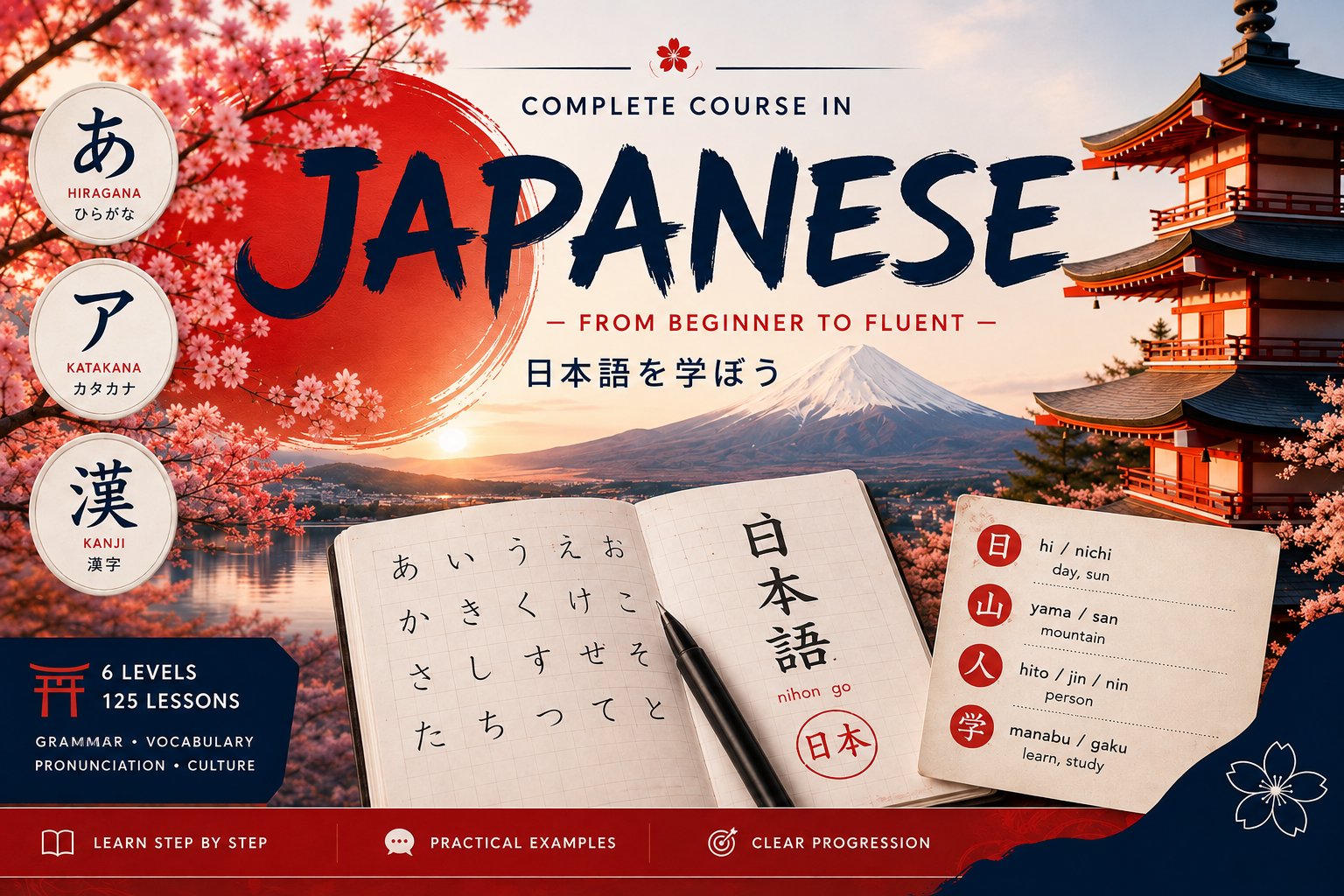
Japanese Language Course for Beginners — Learn Hiragana, Katakana, Kanji, Grammar & Basic Japanese
🇯🇵 CHAPTER 2
📚 Japanese Writing Systems
Japanese uses several writing systems that work together. To read and write Japanese naturally, you need to understand the role of Hiragana, Katakana, and Kanji.
This section is a complete reference library. We will gradually explore Japanese characters, their readings, pronunciation, uses, and many examples of real Japanese words.
🗾 1. The Three Main Writing Systems
Modern Japanese mainly uses three writing systems:
あ
Hiragana — ひらがな
Hiragana is used for Japanese words, grammatical endings, particles, and many verb and adjective forms.
たべます
Tabemasu
→ I eat / will eat
ア
Katakana — カタカナ
Katakana is mainly used for words of foreign origin, many foreign names, sounds, and a large number of modern words.
ホテル
Hoteru
→ Hotel
漢
Kanji — 漢字
Kanji generally represent an idea, a concept, or an important part of a word's meaning.
山
Yama
→ Mountain
💡 One Japanese Sentence Can Use Several Writing Systems
私は日本語を勉強します。
Romaji: Watashi wa nihongo o benkyō shimasu.
English: I study Japanese.
- 私 → Kanji
- は → Hiragana
- 日本語 → Kanji
- を → Hiragana
- 勉強 → Kanji
- します → Hiragana
So it is completely normal to see several types of Japanese writing in a single sentence.
2. Complete Hiragana — ひらがな
Hiragana is one of the first writing systems that every beginner should learn.
Each character generally represents a mora, a basic Japanese sound unit. Unlike the English alphabet, Japanese characters do not simply represent one consonant or one vowel. Many characters represent a consonant-and-vowel sound together.
🔤 The Five Japanese Vowels
あasimilar to the “a” in father
いisimilar to the “ee” in see
うusimilar to “oo,” but usually shorter and less rounded
えesimilar to the “e” in get
おoa clear Japanese “o” sound
🎯 Important Rule
Japanese vowels are generally pronounced clearly and consistently. They do not change as much as English vowels.
At the beginning, try to pronounce each sound simply and clearly:
あ い う え お
a · i · u · e · o
🔹 The K Row
かka
きki
くku
けke
こko
🔹 The S Row
さsa
しshi
すsu
せse
そso
🔹 The T Row
たta
ちchi
つtsu
てte
とto
🔹 The N Row
なna
にni
ぬnu
ねne
のno
🔹 The H Row
はha
ひhi
ふfu
へhe
ほho
🔹 The M Row
まma
みmi
むmu
めme
もmo
🔹 The Y Row
やya
ゆyu
よyo
🔹 The R Row
らra
りri
るru
れre
ろro
🔹 The W Row and the Character ん
わwa
をwousually pronounced “o” when used as a particle
んn
📖 10 Examples to Start Reading Hiragana
あさAsa→ Morning
いえIe→ House / home
うみUmi→ Sea
えきEki→ Train station
おかしOkashi→ Sweets / snack
かさKasa→ Umbrella
ねこNeko→ Cat
いぬInu→ Dog
やまYama→ Mountain
さくらSakura→ Cherry blossom
3. Dakuten and Handakuten
Some Japanese characters change their sound with the help of small marks.
゛
Dakuten
Dakuten changes certain sounds. For example:
か → が
ka → ga
さ → ざ
sa → za
゜
Handakuten
Handakuten is mainly used with the H row to produce P sounds.
は → ぱ
ha → pa
🔤 Hiragana with Dakuten
が ぎ ぐ げ ご
ga · gi · gu · ge · go
ざ じ ず ぜ ぞ
za · ji · zu · ze · zo
だ ぢ づ で ど
da · ji · zu · de · do
ば び ぶ べ ぼ
ba · bi · bu · be · bo
🔤 Hiragana with Handakuten
ぱ ぴ ぷ ぺ ぽ
pa · pi · pu · pe · po
📖 10 Examples
がくせいGakusei→ Student
ぎんこうGinkō→ Bank
ぐんGun→ Group / army, depending on context
げんきGenki→ Well / healthy / energetic
ごはんGohan→ Rice / meal
ざっしZasshi→ Magazine
じかんJikan→ Time / hour
でんしゃDensha→ Electric train / train
ぱんPan→ Bread
ぺんPen→ Pen
4. Combined Sounds — Yōon
Combined sounds are created when a character combines with a small ゃ, ゅ, or ょ.
Look carefully at the difference:
きや = ki + ya
きゃ = kya
The second character is smaller, so the sounds combine into one unit.
| Hiragana | Romaji |
|---|---|
| きゃ | kya |
| きゅ | kyu |
| きょ | kyo |
| しゃ | sha |
| しゅ | shu |
| しょ | sho |
| ちゃ | cha |
| ちゅ | chu |
| ちょ | cho |
| にゃ | nya |
| にゅ | nyu |
| にょ | nyo |
| ひゃ | hya |
| ひゅ | hyu |
| ひょ | hyo |
| みゃ | mya |
| みゅ | myu |
| みょ | myo |
| りゃ | rya |
| りゅ | ryu |
| りょ | ryo |
| ぎゃ | gya |
| ぎゅ | gyu |
| ぎょ | gyo |
| じゃ | ja |
| じゅ | ju |
| じょ | jo |
| びゃ | bya |
| びゅ | byu |
| びょ | byo |
| ぴゃ | pya |
| ぴゅ | pyu |
| ぴょ | pyo |
📖 10 Examples of Combined Sounds
| Japanese | Romaji | Meaning |
|---|---|---|
| きょう | Kyō | Today |
| きゃく | Kyaku | Customer / guest |
| しゃしん | Shashin | Photograph / photo |
| しゅくだい | Shukudai | Homework |
| しょうがくせい | Shōgakusei | Elementary school student |
| ちゃ | Cha | Tea |
| ちょっと | Chotto | A little / a moment |
| にゅうがく | Nyūgaku | Entering a school / enrollment |
| りょこう | Ryokō | Trip / travel |
| じゅう | Jū | Ten |
5. Small Japanese Characters
Some Japanese characters can be written in a smaller form. Their size changes their role inside a word.
Small Vowels in Hiragana
ぁ ぃ ぅ ぇ ぉ
Small Y Characters
ゃ ゅ ょ
Small Vowels in Katakana
ァ ィ ゥ ェ ォ
Small Y Characters in Katakana
ャ ュ ョ
The Small っ and Small ッ
っ and ッ are extremely important.
They create a short pause before the following consonant. This pause can completely change the meaning of a word.
| Japanese | Romaji | English |
|---|---|---|
| きて | kite | Come |
| きって | kitte | Stamp |
📖 10 Examples with the Small っ
| Japanese | Romaji | Meaning |
|---|---|---|
| がっこう | Gakkō | School |
| ざっし | Zasshi | Magazine |
| きって | Kitte | Stamp |
| ちょっと | Chotto | A little / a moment |
| やっぱり | Yappari | As expected / after all |
| まって | Matte | Wait! |
| もっと | Motto | More |
| ずっと | Zutto | All the time / much longer |
| けっこん | Kekkon | Marriage |
| いっしょ | Issho | Together |
6. Long Vowel Sounds
In Japanese, vowel length is important. A longer vowel can change the word and its meaning.
ああ · いい · うう · えい · おう
In Katakana, the following symbol is very often used:
ー
This symbol lengthens the vowel that comes before it.
おばさんObasan
→ Aunt / middle-aged woman
おばあさんObāsan
→ Grandmother
ビルBiru
→ Building
ビールBīru
→ Beer
📖 10 Examples of Long Vowel Sounds
きょうKyō→ Today
がっこうGakkō→ School
とうきょうTōkyō→ Tokyo
せんせいSensei→ Teacher
おとうさんOtōsan→ Father
おかあさんOkāsan→ Mother
コーヒーKōhī→ Coffee
ケーキKēki→ Cake
パーティーPātī→ Party
タクシーTakushī→ Taxi
7. Complete Katakana — カタカナ
Katakana represents almost the same basic sounds as Hiragana, but the characters themselves are different.
It is especially used for foreign words, foreign names, modern vocabulary, certain sound effects, and other stylistic purposes.
🔤 The Vowels
ア イ ウ エ オ
a · i · u · e · o
🔤 The Main Katakana Rows
カ キ ク ケ コ
ka · ki · ku · ke · ko
サ シ ス セ ソ
sa · shi · su · se · so
タ チ ツ テ ト
ta · chi · tsu · te · to
ナ ニ ヌ ネ ノ
na · ni · nu · ne · no
ハ ヒ フ ヘ ホ
ha · hi · fu · he · ho
マ ミ ム メ モ
ma · mi · mu · me · mo
ヤ ユ ヨ
ya · yu · yo
ラ リ ル レ ロ
ra · ri · ru · re · ro
ワ ヲ
wa · wo
ン
n
📖 10 Real Katakana Examples
コーヒーKōhī→ Coffee
テレビTerebi→ Television
ホテルHoteru→ Hotel
タクシーTakushī→ Taxi
バスBasu→ Bus
レストランResutoran→ Restaurant
コンピューターKonpyūtā→ Computer
スマートフォンSumātofon→ Smartphone
チョコレートChokorēto→ Chocolate
パンPan→ Bread
8. Modified Katakana and Foreign Sounds
Modern Japanese also uses special combinations to represent sounds found in foreign languages.
ファ
fa
フィ
fi
フェ
fe
フォ
fo
ティ
ti
ディ
di
ウィ
wi
ウェ
we
ウォ
wo
チェ
che
シェ
she
ジェ
je
📖 10 Examples of Modern Japanese
ファッションFasshon→ Fashion
ファイルFairu→ File
フィルムFirumu→ Film
フェスティバルFesutibaru→ Festival
フォークFōku→ Fork
パーティーPātī→ Party
ディナーDinā→ Dinner
ウェブWebu→ Web
チェスChesu→ Chess
ジェットJetto→ Jet
ℹ️ 关于本课程

Mr Ray
- 🌍 语言 English
- 👥 学员 0
- 👁 浏览量 1,684
- 📚 资源 3
- 📄 PDF 1
- 🎥 视频 0
- 📝 测验 2
- 🔗 链接 0
- 🕒 阅读 39 min
- 📅 更新于 August 26, 2026