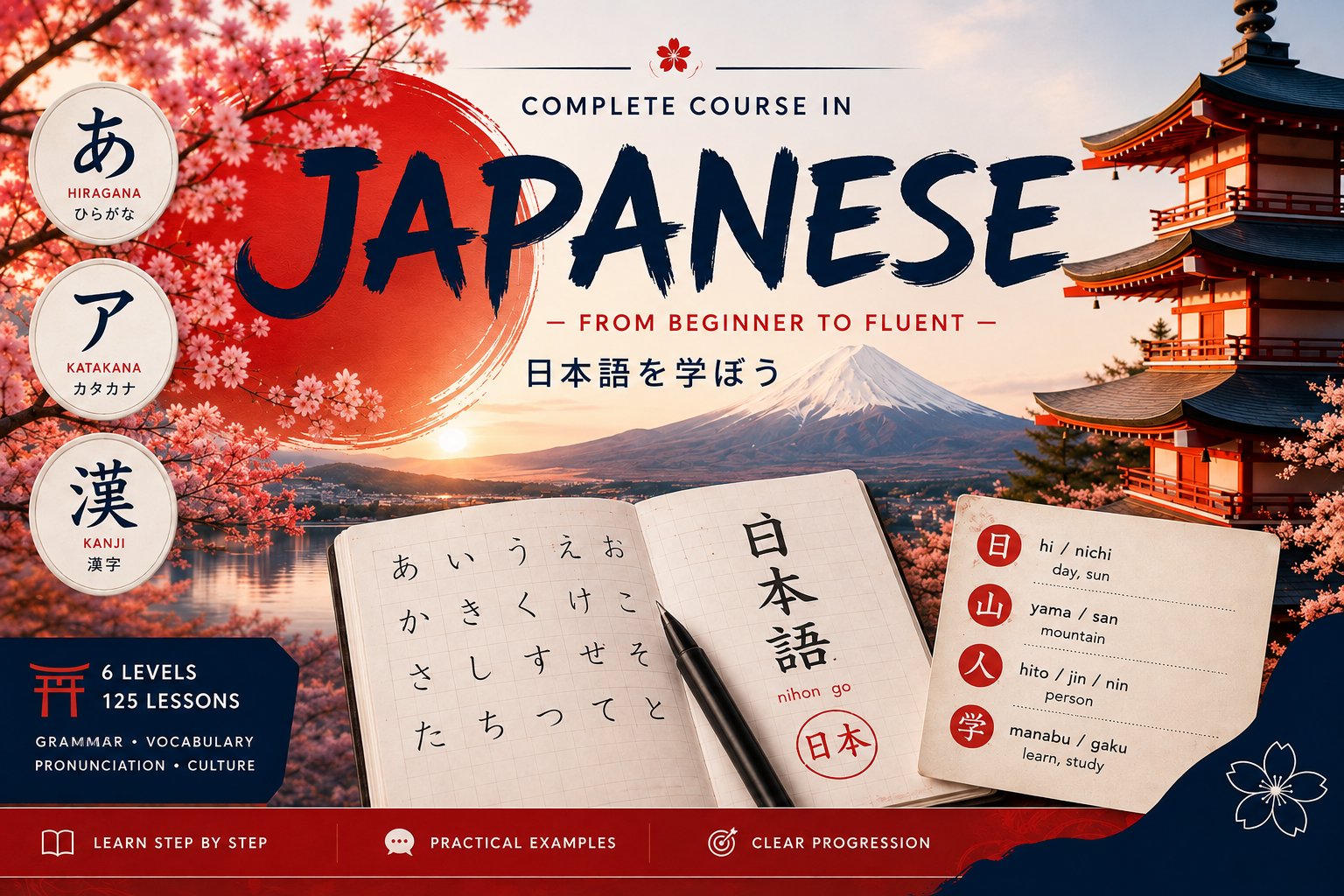
Japanese Language Course for Beginners — Learn Hiragana, Katakana, Kanji, Grammar & Basic Japanese
9. The Character ん / ン
The character ん in Hiragana and ン in Katakana generally represent a sound close to n.
Its pronunciation can adapt slightly to the sound that follows it, but for now, simply remember:
ん n
ン n
📖 10 Examples
にほんNihon→ Japan
ほんHon→ Book
せんせいSensei→ Teacher
でんしゃDensha→ Train
しんぶんShinbun→ Newspaper
みんなMinna→ Everyone
コンビニKonbini→ Convenience store
レモンRemon→ Lemon
パンPan→ Bread
ペンPen→ Pen
10. Kanji — 漢字
Kanji are different from Hiragana and Katakana.
While Kana mainly represent sounds, a Kanji is generally associated with an idea or a meaning.
For example:
山 yama → mountain
The character 山 is associated with the idea of a mountain.
📚 10 Essential Kanji
人 hito / jin / nin Person
日 hi / nichi Day / sun
月 tsuki / getsu Moon / month
火 hi / ka Fire
水 mizu / sui Water
木 ki / moku Tree / wood
金 kane / kin Gold / money
土 tsuchi / do Earth / soil
山 yama / san Mountain
川 kawa / sen River
11. Onyomi and Kunyomi
A Kanji can have several different readings. This is one of the major differences between Kanji and ordinary alphabets.
音読み — Onyomi
This is generally a reading historically adapted from Chinese pronunciation.
It often appears in compound words containing two or more Kanji.
訓読み — Kunyomi
This is generally a Japanese reading associated with the meaning of the Kanji.
It frequently appears when a Kanji represents a native Japanese word.
山
Example: 山
やま — yama
Common Japanese reading
→ Mountain
さん — san
Used in certain compound words
富士山Romaji: Fujisan
English: Mount Fuji
12. Essential Basic Kanji
You do not need to learn every Kanji immediately. We will discover them gradually throughout the course.
For each Kanji, you should gradually learn:
- The character
- Its main idea
- Its important readings
- Real words that use the Kanji
- Its context of use
日
Main Meaning
Day / sun
Important Readings
ひ — hi
にち — nichi
Example 1
日本Romaji: Nihon
English: Japan
Example 2
日曜日Romaji: Nichiyōbi
English: Sunday
📖 10 Examples with Basic Kanji
日本Nihon→ Japan
日本語Nihongo→ Japanese language
山Yama→ Mountain
川Kawa→ River
水Mizu→ Water
火曜日Kayōbi→ Tuesday
月曜日Getsuyōbi→ Monday
木曜日Mokuyōbi→ Thursday
金曜日Kinyōbi→ Friday
人Hito→ Person
13. How the Writing Systems Work Together
Now that you know the different systems, let's see how they appear together in real Japanese sentences.
私は日本語を勉強します。
私 Kanji は Hiragana 日本語 Kanji を Hiragana 勉強 Kanji します Hiragana
Romaji:
Watashi wa nihongo o benkyō shimasu.
English:
I study Japanese.
📖 10 Sentences to Observe the Writing Systems
私は学生です。
Watashi wa gakusei desu.
→ I am a student.
日本語を勉強します。
Nihongo o benkyō shimasu.
→ I study Japanese.
私は水を飲みます。
Watashi wa mizu o nomimasu.
→ I drink water.
山を見ます。
Yama o mimasu.
→ I look at the mountain.
今日は月曜日です。
Kyō wa getsuyōbi desu.
→ Today is Monday.
私は日本に行きます。
Watashi wa Nihon ni ikimasu.
→ I am going to Japan.
これは本です。
Kore wa hon desu.
→ This is a book.
友達と話します。
Tomodachi to hanashimasu.
→ I speak with a friend.
東京は大きいです。
Tōkyō wa ōkii desu.
→ Tokyo is big.
コンピューターを使います。
Konpyūtā o tsukaimasu.
→ I use a computer.
🎯 KEY TAKEAWAYS
The Japanese Character Library
You now know the essential foundations of the Japanese writing systems.
あ Hiragana Japanese words and grammar
ア Katakana Foreign words and modern Japanese
漢 Kanji Ideas and meanings
Your Progression:
Complete Hiragana → Dakuten and Handakuten → Combined sounds → Small characters → Small っ → Long vowel sounds → Katakana → Foreign sounds → Kanji → Onyomi and Kunyomi → Reading real Japanese sentences
🌸 From now on, Japanese characters should no longer feel completely mysterious. Step by step, you will be able to recognize them, pronounce them, combine them, and begin reading real Japanese words and real Japanese sentences.
🚀 This is not the end!
New lessons are coming soon. Stay tuned and come back regularly to discover the next lessons on APC COMMUNITY.🔔 Want to be notified when a new lesson is published?
Make sure you enroll in this course by clicking the three-dot menu (⋮) at the top of the page, just after the course title, and selecting the option to enroll.
Once you are enrolled, you can receive notifications when new lessons are added to the course.
See you in the next lesson! 📚
ℹ️ 关于本课程

Mr Ray
- 🌍 语言 English
- 👥 学员 0
- 👁 浏览量 1,693
- 📚 资源 3
- 📄 PDF 1
- 🎥 视频 0
- 📝 测验 2
- 🔗 链接 0
- 🕒 阅读 39 min
- 📅 更新于 August 26, 2026