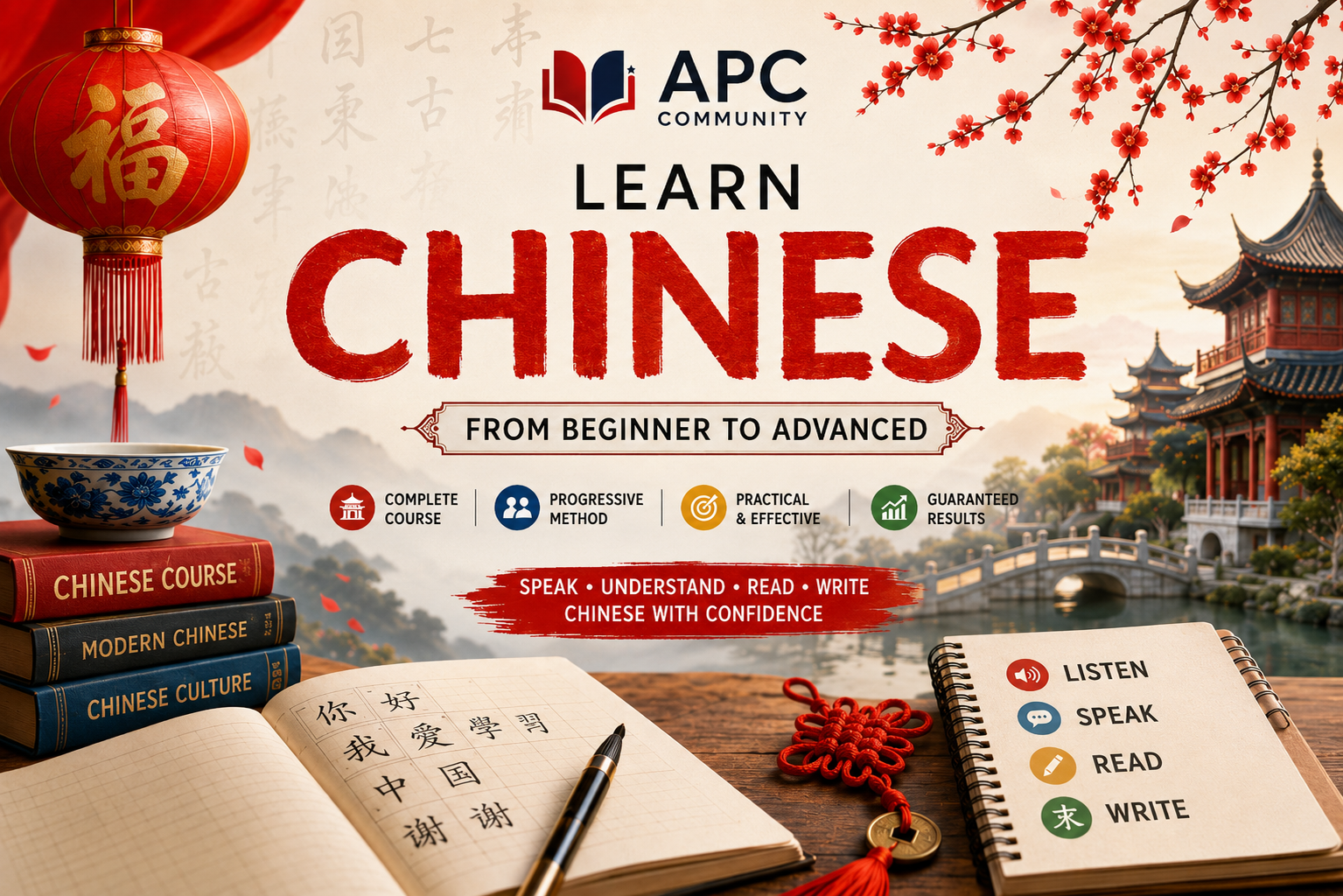
Chinese Mandarin Course for Beginners — Learn Pinyin, Chinese Characters, Tones, Vocabulary & Basic Grammar
Chapter 1 - Introduction to Chinese
Lesson 1 - What Is Mandarin Chinese?
When we say that we want to learn "Chinese," we generally mean Mandarin Chinese, called 普通话 (Pǔtōnghuà) in China.
Mandarin is the most widely spoken variety of Chinese. It is the official language of the People's Republic of China and one of the official languages of several international organizations.
Chinese is very different from English in its writing system, pronunciation, and the way sentences are constructed. However, it also has a very interesting feature: its basic grammar is often simpler than that of many European languages.
💡 An Important Idea
Mandarin is not written with an alphabet like A, B, C, D. It mainly uses Chinese characters.
Some Words You Will Encounter Very Often
中文
Pinyin: Zhōngwén
Translation: Chinese language
普通话
Pinyin: Pǔtōnghuà
Translation: Standard Mandarin
中国
Pinyin: Zhōngguó
Translation: China
中国人
Pinyin: Zhōngguó rén
Translation: Chinese person
汉语
Pinyin: Hànyǔ
Translation: Chinese language
At the beginning, you do not need to memorize everything. The most important thing is to understand that you will gradually learn to listen to, pronounce, read, recognize, and use the Chinese language.
Lesson 2 — Why Learn Chinese?
Each person may have a different reason for learning Chinese. Some people want to travel, while others want to work with Chinese companies, study, discover a culture, or simply learn a new language.
There is no single right reason to learn Chinese. Your personal goal can become your main source of motivation.
Here Are Some Possible Reasons
- 🌍 Communicate with Chinese people.
- ✈️ Travel to China or Chinese-speaking regions.
- 🎓 Study at a university.
- 💼 Develop professional opportunities.
- 📚 Read and discover Chinese culture.
- 🎬 Understand Chinese films and content.
- 🗣️ Develop your communication skills.
- 🧠 Train your memory with Chinese characters.
- 🤝 Communicate more effectively in an international environment.
- 🚀 Learn a language that will be useful in the future.
🎯 Your Goal
Ask yourself: "Why do I want to learn Chinese?"
Keep your answer in mind. It will help you keep going even when certain characters or pronunciations seem difficult.
Lesson 3 — Chinese Around the World
Mandarin Chinese is spoken by a very large number of people. It plays an important role in communication, education, business, technology, and international exchanges.
Chinese is used mainly in mainland China, but different varieties of Chinese are also spoken in many regions and communities around the world.
Chinese Can Open Doors in Many Different Fields
| Field | Why Chinese Can Be Useful |
|---|---|
| 💼 Work | Communicate in an international professional environment. |
| 🎓 Education | Access programs, documents, and learning opportunities. |
| ✈️ Travel | Understand information and communicate more easily. |
| 🤝 Relationships | Meet and connect with new people. |
| 🎭 Culture | Discover literature, cinema, music, and traditions. |
| 💻 Technology | Better understand certain digital and international professional environments. |
Learning Chinese therefore does not simply mean learning words. It also means learning a new way of communicating and discovering a vast cultural world.
Lesson 4 — Simplified and Traditional Chinese
Chinese characters mainly exist in two writing systems that you will often hear about: Simplified Chinese characters and Traditional Chinese characters.
Simplified characters generally use a simpler written form. Traditional characters preserve more complex historical forms.
Examples
| Simplified Character | Traditional Character | Pinyin | Translation |
|---|---|---|---|
| 学 | 學 | xué | to study / to learn |
| 国 | 國 | guó | country |
| 书 | 書 | shū | book |
| 车 | 車 | chē | car |
| 门 | 門 | mén | door |
| 东 | 東 | dōng | east |
| 风 | 風 | fēng | wind |
| 鱼 | 魚 | yú | fish |
| 马 | 馬 | mǎ | horse |
| 鸟 | 鳥 | niǎo | bird |
💡 In This Book
We will mainly use Simplified Chinese characters.
You will be able to gradually discover Traditional Chinese characters later.
Lesson 5 — Mandarin and Other Chinese Languages
It is important to understand that the word "Chinese" refers to a very broad linguistic reality.
Mandarin is the variety that we will learn in this book. It is used as the standard language in education, many forms of media, and official communication.
There are also other varieties spoken in different regions, sometimes with very different pronunciations.
🎯 Our Goal
In this course, when we say "Chinese," we will mainly be referring to Standard Mandarin Chinese — 普通话.
Some Names to Recognize
普通话
Pinyin: Pǔtōnghuà
Translation: Standard Mandarin
汉语
Pinyin: Hànyǔ
Translation: Chinese language
中文
Pinyin: Zhōngwén
Translation: Chinese / Chinese language
Lesson 6 — How to Use This Book
This book is designed to guide you step by step, from your very first contact with Chinese to increasingly natural communication.
You do not need to learn everything at once. Move forward step by step.
A Good Learning Method
- 📖 Read the lesson carefully.
- 🔊 Listen to and repeat the pronunciation.
- 🧠 Learn the new vocabulary.
- 🇨🇳 Observe the characters.
- 🔤 Read the Pinyin.
- ✍️ Write some important words again.
- 💬 Repeat the sentences aloud.
- 🗣️ Try to create your own sentences.
- 🔄 Regularly review previous lessons.
- 🚀 Use what you learn in real life.
⭐ Important Rule
It is better to learn a little every day and review regularly than to try to memorize a very large amount of content in a single day.
Lesson 7 — How to Make Progress Effectively
Learning Chinese requires consistency. Characters, sounds, and tones become much easier when you encounter them regularly.
10 Useful Habits
- Study regularly.
- Listen to Chinese often.
- Repeat aloud.
- Do not be afraid of making mistakes.
- Learn words in sentences.
- Review previously learned characters.
- Do not ignore the tones.
- Compare the Pinyin and the characters.
- Practice writing gradually.
- Use Chinese as often as possible.
Your goal is not to be perfect immediately. Your goal is to gradually become able to understand and communicate.
ℹ️ इस पाठ्यक्रम के बारे में
Mr Ray
- 🌍 भाषा English
- 👥 छात्र 0
- 👁 दृश्य 251
- 📚 संसाधन 3
- 📄 PDF 1
- 🎥 वीडियो 0
- 📝 क्विज़ 2
- 🔗 लिंक 0
- 🕒 पढ़ना 16 min
- 📅 अपडेट किया गया August 26, 2026