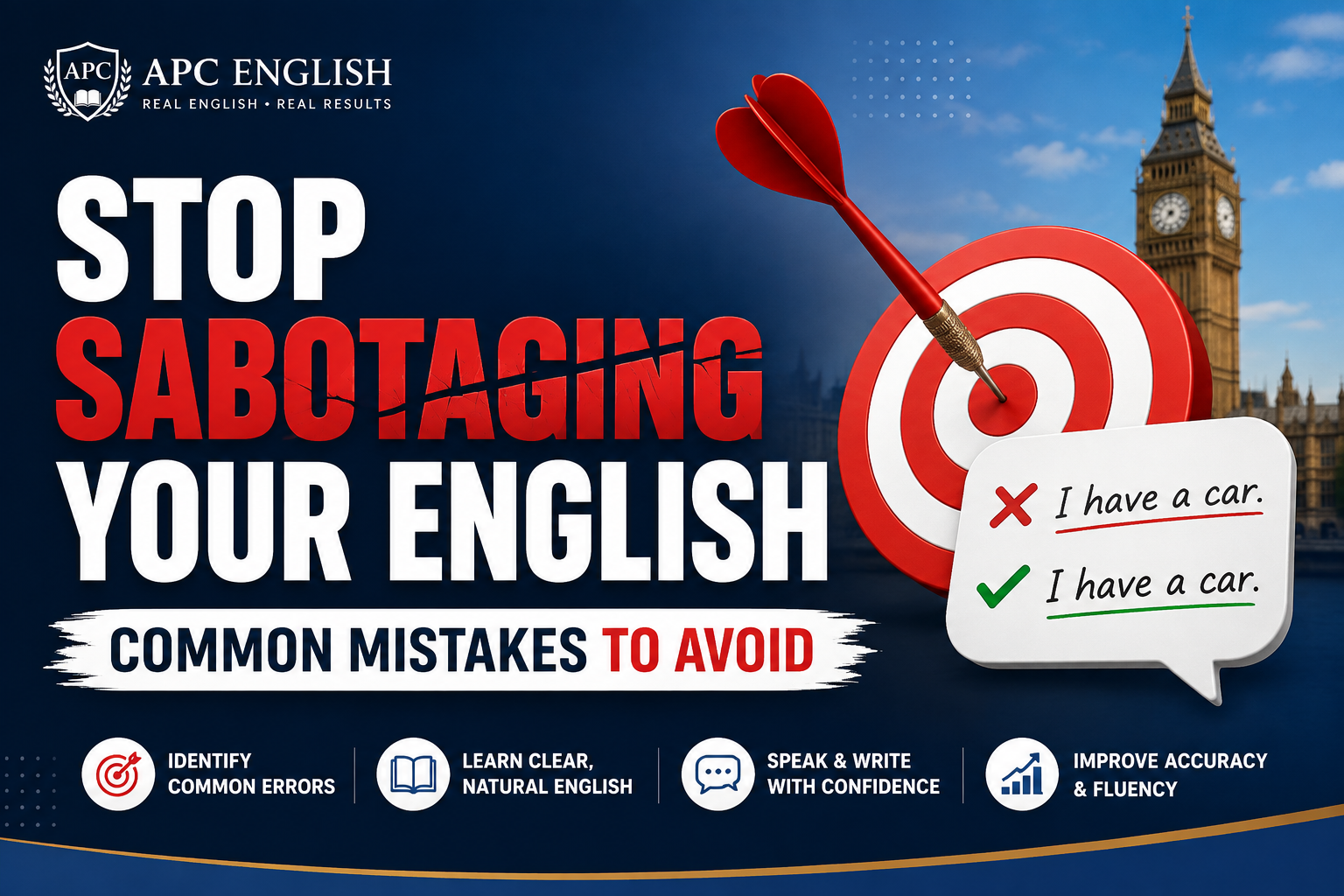
Stop Sabotaging Your English: Common English Mistakes to Avoid and Speak More Naturally
5. Misusing “Have” and “Be”
Have and be are two of the most important verbs in English, but learners sometimes use one when English requires the other.
This is especially common when another language expresses an idea differently from English. Learning the English structure directly can prevent many repeated mistakes.
Have vs. Be
As a general rule, have is commonly used for possession and certain fixed expressions, while be is commonly used for identity, age, feelings, conditions, and descriptions.
Talking About Age
In English, age is expressed with the verb be.
❌ I have 25 years.
✅ I am 25 years old.
The same structure is used with other subjects:
She is 18 years old.
He is 40 years old.
They are 30 years old.
Talking About Feelings and Physical States
English commonly uses be for many feelings and physical states.
✅ I am hungry.
✅ I am thirsty.
✅ I am tired.
✅ I am cold.
These expressions use be rather than have.
Talking About Possession
Use have to talk about possession, relationships, or things that someone possesses.
I have a car.
She has a new phone.
We have two children.
Common Expressions with Be
Many common English expressions use forms of be.
I am hungry.
I am thirsty.
I am tired.
She is afraid.
They are ready.
Common Expressions with Have
English also uses have in many fixed expressions. These combinations should be learned as complete expressions.
have a car
have breakfast
have a shower
have a problem
have a question
Compare the Two Patterns
Be + feeling / state
I am hungry.
Have + possession
I have a car.
Common Learner Errors
❌ I have hungry.
✅ I am hungry.
❌ I have 25 years.
✅ I am 25 years old.
❌ I am a car.
✅ I have a car.
Three Ideas to Remember
Age → be
I am 25 years old.
Feelings and physical states → be
I am hungry.
Possession → have
I have a car.
Do Not Translate the Structure Directly
When learning an expression, focus on the English structure rather than choosing the verb by translating it word for word from another language.
Ask yourself: “How is this idea normally expressed in English?”
Useful Sentence Patterns
Subject + be + adjective
I am tired.
Subject + be + age
I am 25 years old.
Subject + have + noun
I have a car.
Subject + have + common expression
I have breakfast at 8 o'clock.
Build Natural English Habits
The best way to avoid confusing have and be is to learn common expressions as complete patterns and reuse them regularly.
I am hungry.
I am tired.
I am 25 years old.
I have a car.
I have a question.
Next Step
You have now seen why have and be cannot always be chosen by translating directly from another language.
Next, we will examine another major area of English mistakes: a, an, and the.
6. Articles — “A”, “An” and “The”
Articles are small words, but they are one of the most common sources of mistakes for English learners.
English mainly uses three articles: a, an, and the. In some situations, no article is used at all.
Learning when to use each form is essential for producing clear and natural English.
“A”
Use a before a singular countable noun when you are referring to one non-specific person or thing.
a + singular countable noun
a book
a car
a teacher
For example:
I bought a book.
“An”
Use an instead of a before a singular countable noun when the following word begins with a vowel sound.
an + singular countable noun
an apple
an orange
an interesting book
The important point is the sound, not simply the spelling of the word.
“The”
Use the when the person or thing is specific or already known to the listener or reader.
the + specific noun
the book
the car
the teacher
First Mention vs. Known Information
One of the most useful ways to understand the difference between a and the is to look at whether something is being mentioned for the first time or is already known.
I saw a dog.
The dog was very friendly.
The first sentence introduces the dog, so a is used. Once the dog is identified, the can be used because both people know which dog is being discussed.
Singular Countable Nouns
A singular countable noun generally needs a determiner such as a, an, or the when used in a normal sentence.
✅ I bought a car.
✅ The car is new.
✅ My car is outside.
❌ I bought car.
No Article
English sometimes uses no article when speaking about things in a general sense, especially with plural countable nouns and many uncountable nouns.
Books are useful.
Water is important.
Students need practice.
The meaning changes when the reference becomes specific.
Books are useful.
The books on this table are useful.
Common Mistakes
Learners often forget an article, use the wrong article, or use a or an when the noun is specific.
❌ I bought car.
✅ I bought a car.
❌ She is teacher.
✅ She is a teacher.
❌ I saw dog. Dog was friendly.
✅ I saw a dog. The dog was friendly.
Useful Patterns to Remember
a + singular countable noun
a student
an + singular countable noun beginning with a vowel sound
an apple
the + specific or already known noun
the student
no article + general plural or uncountable noun
Students need practice.
A Simple Decision Process
When you are unsure which article to use, ask yourself a few questions:
- Is the noun singular and countable?
- Am I talking about one non-specific thing?
- Is the thing specific or already known?
- Am I speaking about something in general?
These questions can help you choose between a, an, the, and no article.
Next Step
Articles are closely connected to another important topic: whether a noun can be counted or not.
Next, we will examine countable and uncountable nouns, including much, many, few, little, some, and any.
7. Countable and Uncountable Nouns
Understanding whether a noun is countable or uncountable is essential for choosing the correct words around it.
This distinction affects which determiners and quantifiers you can use, including many, much, few, little, some, and any.
Countable Nouns
Countable nouns refer to things that can be counted as separate units. They have singular and plural forms.
one book → two books
one car → three cars
one student → many students
A singular countable noun can normally be used with a, an, or another determiner.
a book
an apple
the student
Uncountable Nouns
Uncountable nouns refer to substances, concepts, information, materials, or things that are not normally treated as separate individual units.
information
advice
water
money
These nouns are generally not used with a or an when referring to the substance or concept in general.
Many
Use many with plural countable nouns.
many + plural countable noun
many books
many students
many questions
Much
Use much with uncountable nouns.
much + uncountable noun
much information
much money
much time
Few and A Few
Use few and a few with plural countable nouns.
few books
very small number of books
a few books
some books; a small number of books
Little and A Little
Use little and a little with uncountable nouns.
little time
almost no time
a little time
some time
Some
Some can be used with both plural countable nouns and uncountable nouns.
some books
some information
some advice
Any
Any is commonly used in questions and negative sentences with plural countable and uncountable nouns.
Do you have any questions?
I don't have any money.
We don't have any information.
Common Vocabulary Mistakes
Some nouns that may look countable to learners are normally uncountable in English.
A very common example is advice.
❌ an advice
❌ advices
✅ some advice
✅ a piece of advice
Some Advice vs. A Piece of Advice
Advice is normally uncountable, so we do not usually say an advice or two advices.
some advice
She gave me some advice.
a piece of advice
He gave me a useful piece of advice.
Many Books
Books are countable, so use many with them.
many books
I have many books.
Much Information
Information is uncountable, so use much when the context requires it.
much information
We don't have much information.
Some Advice
some advice
Can you give me some advice?
A Piece of Advice
a piece of advice
Let me give you a piece of advice.
Quick Comparison
| Expression | Type | Example |
|---|---|---|
| many | plural countable | many books |
| much | uncountable | much information |
| few | plural countable | few books |
| little | uncountable | little time |
| some | countable plural / uncountable | some advice |
| any | countable plural / uncountable | any information |
A Simple Rule to Remember
Ask yourself whether the noun can normally be counted as separate units.
Countable:
one book → two books → many books
Uncountable:
information → much information
Once you identify the noun type, choosing words such as many, much, few, and little becomes much easier.
Next Step
Now that you understand the difference between countable and uncountable nouns, we can look more closely at one of the most common areas of confusion: much, many, a lot, few, and little.
8. Confusing “Much”, “Many”, “A Lot”, “Few” and “Little”
Words such as much, many, a lot of, few, and little are used to talk about quantity.
The main difficulty is knowing which expressions can be used with countable nouns and which ones are used with uncountable nouns. The meaning can also change depending on whether the quantity is presented as large, small, sufficient, or insufficient.
Many + Countable Nouns
Use many with plural countable nouns.
many + plural countable noun
many books
many students
many questions
For example:
There are many students in the classroom.
Much + Uncountable Nouns
Use much with uncountable nouns.
much + uncountable noun
much information
much money
much time
For example:
We don't have much time.
A Lot of
A lot of can be used with both plural countable nouns and uncountable nouns.
a lot of books
a lot of information
a lot of people
a lot of money
It is especially common in everyday English.
She has a lot of friends.
We have a lot of work.
Few vs. A Few
Use few and a few with plural countable nouns.
few books
almost no books; a very small number
a few books
some books; a small number
The presence of a changes the meaning and tone. Few often suggests that the number is smaller than expected or insufficient, while a few usually presents the small number more positively or neutrally.
Few
Few people came to the meeting.
This suggests that the number was very small.
A Few
A few people came to the meeting.
This means that some people came, even though the number was small.
Little vs. A Little
Use little and a little with uncountable nouns.
little time
almost no time; not enough time
a little time
some time; a small amount of time
Little
We have little time.
This suggests that there is almost no time available.
A Little
We have a little time.
This means that some time is available, even though the amount is small.
Difference in Meaning
The difference between few and a few, or between little and a little, is not simply grammatical. It also changes the meaning of the sentence.
Few students passed the exam.
Almost no students passed.
A few students passed the exam.
Some students passed.
There is little water left.
Almost no water is left.
There is a little water left.
Some water is still available.
Quick Comparison
| Expression | Noun Type | General Meaning |
|---|---|---|
| many | plural countable | a large number |
| much | uncountable | a large amount |
| a lot of | countable / uncountable | a large quantity |
| few | plural countable | almost none / very small number |
| a few | plural countable | some / small number |
| little | uncountable | almost none / very small amount |
| a little | uncountable | some / small amount |
Common Mistakes
❌ much books
✅ many books
❌ many information
✅ much information
❌ little students
✅ few students
❌ few time
✅ little time
Learn the Noun Type First
Before choosing a quantity expression, first identify whether the noun is countable or uncountable.
Countable: books → many books / a few books
Uncountable: information → much information / a little information
Next Step
Quantity words become much easier when you recognize the type of noun and understand the difference in meaning between similar expressions.
Next, we will examine another small group of words that causes many mistakes: prepositions.
9. Prepositions — The Small Words That Cause Big Problems
Prepositions are short words, but they are responsible for many common English mistakes.
Words such as in, on, at, to, for, from, by, and with may look simple, but their correct use depends heavily on context and common expressions.
The best way to learn many prepositions is to study them in complete phrases rather than trying to memorize one translation for each word.
In
In is commonly used with enclosed spaces, areas, months, years, and longer periods of time.
in a car
in the house
in July
in 2026
On
On is commonly used with days and dates and with certain surfaces and forms of transportation.
on Monday
on July 5
on the table
on a bus
At
At is commonly used for specific points in time and certain locations or situations.
at night
at 8 o'clock
at home
at school
To
To is commonly used to indicate movement toward a destination or another person.
go to school
go to work
give it to me
For
For can express purpose, duration, or the intended recipient of something.
a gift for you
for two hours
something for work
From
From commonly indicates origin, starting point, or source.
I am from Spain.
The train comes from London.
from Monday to Friday
By
By has several uses. It can indicate the method of transportation, the person responsible for an action, or a deadline.
by bus
by train
a book by Shakespeare
by tomorrow
With
With commonly indicates accompaniment, a tool, or a person or thing involved in an action.
with my friend
write with a pen
coffee with milk
Prepositions of Time
English commonly uses at, on, and in differently when talking about time.
| Preposition | Typical Use | Example |
|---|---|---|
| at | specific time / certain expressions | at 8 o'clock / at night |
| on | days / dates | on Monday |
| in | months / years / longer periods | in July / in 2026 |
Prepositions of Place
In, on, and at can also describe location, but the correct choice depends on the relationship between the person or object and the place.
in the room
on the table
at home
Prepositions of Movement
To is commonly used to indicate movement toward a destination.
go + to + destination
I go to school every morning.
Notice that the preposition is part of the complete expression.
Prepositions and Transportation
English uses different prepositions depending on the type of transportation.
in a car
in a taxi
on a bus
on a train
Common Expressions with Prepositions
Some combinations should be learned as complete expressions because their prepositions cannot always be predicted from another language.
at night
on Monday
in July
at home
in a car
on a bus
Common Learner Mistakes
❌ in Monday
✅ on Monday
❌ on July
✅ in July
❌ in night
✅ at night
❌ on a car
✅ in a car
Do Not Translate Prepositions Word for Word
One of the most important lessons about prepositions is that a preposition in one language does not always correspond to the same preposition in English.
Instead of memorizing isolated translations, learn common combinations as complete English expressions.
Learn the whole expression:
at night
on Monday
in July
at home
in a car
on a bus
A Practical Learning Strategy
When you encounter a new preposition, learn it together with the words around it.
Instead of learning only: at
learn: at night, at home, at school.
Instead of learning only: on
learn: on Monday, on a bus, on the table.
Next Step
Prepositions may be small words, but using them correctly makes a major difference to the naturalness of your English.
Next, we will examine another important source of unnatural English: word order and how to build natural English sentences.
ℹ️ حول هذه الدورة

Mr Ray
- 🌍 اللغة English
- 👥 الطلاب 0
- 👁 المشاهدات 135
- 📚 الموارد 2
- 📄 PDF 1
- 🎥 الفيديوهات 0
- 📝 الاختبارات 1
- 🔗 الروابط 0
- 🕒 القراءة 94 min
- 📅 آخر تحديث August 31, 2026