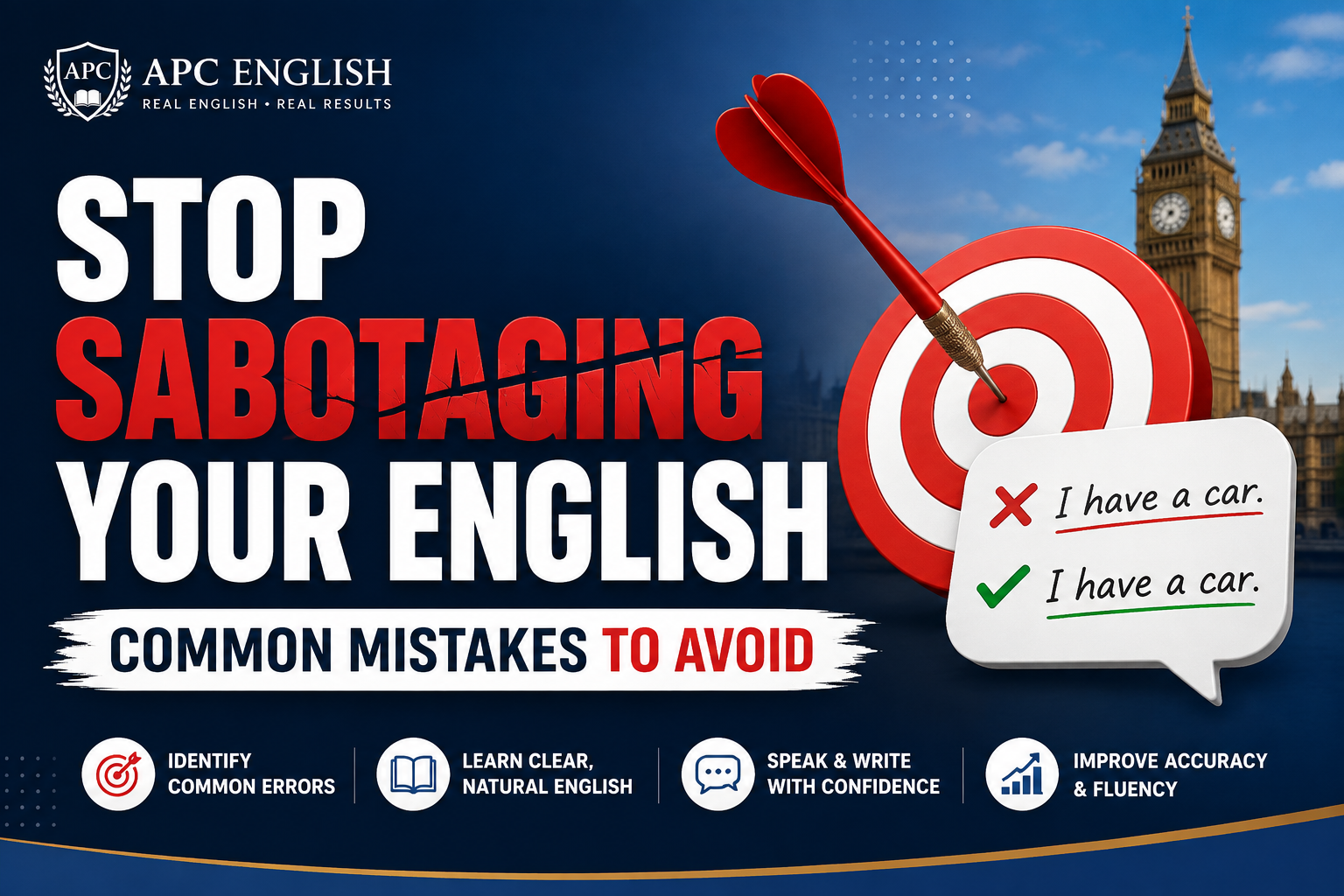
Stop Sabotaging Your English: Common English Mistakes to Avoid and Speak More Naturally
15. Present Perfect vs. Past Simple
The present perfect and the past simple can both refer to past events, but they do not always communicate the same idea.
Understanding the difference is important because learners often choose the tense by translating directly from another language instead of considering the relationship between the past event and the present.
Past Simple — Completed Past Events
Use the past simple when talking about a completed event at a finished or specific time in the past.
I visited London last year.
She finished the book yesterday.
They moved here in 2020.
Present Perfect — Connection with the Present
The present perfect is commonly used when a past event has a connection with the present, when the exact past time is not the focus, or when talking about experiences.
have / has + past participle
I have visited London.
She has finished the book.
Life Experiences
The present perfect is commonly used to talk about experiences without focusing on a specific completed time.
I have visited Spain.
She has never tried sushi.
Have you ever been to London?
The focus is on whether the experience has happened, not on exactly when it happened.
Finished Time vs. Unfinished Time
The choice of tense can depend on whether the time period is finished or still connected to the present.
I saw him yesterday.
“Yesterday” is a finished time period.
I have seen him today.
“Today” is still connected to the present.
Recent Events
The present perfect is often used for recent events when the result or current relevance is important.
I have just finished my work.
She has just arrived.
Ever and Never
Ever and never are commonly used with the present perfect when talking about life experiences.
Have / Has + subject + ever + past participle?
Have you ever visited Spain?
Subject + have / has + never + past participle
I have never visited Spain.
Already, Yet and Just
These words frequently appear with the present perfect.
I have already finished.
Have you finished yet?
She has just arrived.
Since and For
Since and for are commonly used with the present perfect to describe situations that began in the past and continue to the present.
since 2021
starting point
for five years
duration
Compare Present Perfect and Past Simple
I visited Spain in 2022.
Specific completed past time.
I have visited Spain.
Life experience; no specific finished time is given.
Common Mistakes
❌ I have seen him yesterday.
✅ I saw him yesterday.
❌ I went to Spain several times.
✅ I have been to Spain several times.
The important question is not simply “Is the action in the past?” Both tenses can refer to the past. The important question is how the speaker connects the event to the present and whether a specific finished time is given.
A Useful Decision Process
- Is the event connected to a specific finished past time?
- Is the event a life experience without a specific time?
- Is the result or relevance connected to the present?
- Is the time period finished or still continuing?
Next Step
The difference between the present perfect and the past simple becomes even clearer when talking about duration.
Next, we will focus specifically on for and since.
16. “For” vs. “Since”
For and since are both commonly used to describe how long a situation has continued, especially with the present perfect.
The main difference is simple: for introduces a duration, while since introduces a starting point.
For + Duration
Use for when you mention the length of time.
for + period of time
for five years
for two hours
for three weeks
For example:
I have lived here for five years.
Since + Starting Point
Use since when you mention the point at which the situation began.
since + starting point
since 2021
since Monday
since last year
For example:
I have lived here since 2021.
Compare For and Since
I have lived here for five years.
Five years = duration.
I have lived here since 2021.
2021 = starting point.
More Examples with For
I have worked here for three years.
She has studied English for two years.
We have been friends for a long time.
More Examples with Since
I have worked here since 2023.
She has studied English since January.
We have been friends since school.
Common Mistakes
❌ I have lived here since five years.
✅ I have lived here for five years.
❌ I have lived here for 2021.
✅ I have lived here since 2021.
A Simple Rule to Remember
FOR → How long?
for five years
SINCE → Since when?
since 2021
For and Since with the Present Perfect
These expressions are especially common when a situation started in the past and continues into the present.
I have lived here for five years.
I have lived here since 2021.
She has worked here for ten years.
She has worked here since 2016.
Think in Duration vs. Starting Point
Before choosing the preposition, ask yourself what information you are giving.
Duration:
five years → for five years
Starting point:
2021 → since 2021
Next Step
You now know how to distinguish a duration introduced by for from a starting point introduced by since.
Next, we will study modal verbs such as can, could, should, must, have to, may, and might.
17. Modal Verbs — Can, Could, Should, Must, Have to
Modal verbs are essential for expressing ability, permission, obligation, advice, possibility, and other meanings in everyday English.
Common modal verbs and modal expressions include can, could, should, must, have to, may, and might.
One important characteristic of modal verbs is that they are usually followed by the base form of another verb.
Can
Can is commonly used to express ability, permission, and possibility.
I can swim.
Ability.
Can I come in?
Permission.
We can meet tomorrow.
Possibility.
Could
Could can be used to talk about past ability, possibility, and polite requests.
I could swim when I was five.
Past ability.
It could rain later.
Possibility.
Could you help me?
Polite request.
Should
Should is commonly used to give advice, make recommendations, or say what is considered appropriate.
You should study more.
She should see a doctor.
We should leave now.
Must
Must is commonly used to express strong obligation, necessity, or a rule.
You must wear a seat belt.
I must finish this today.
Visitors must show identification.
Have to
Have to is also used to express obligation or necessity.
I have to work tomorrow.
She has to leave early.
We have to wear uniforms.
May
May can express possibility and, in more formal situations, permission.
It may rain tonight.
Possibility.
May I come in?
Formal permission.
Might
Might commonly expresses possibility.
I might go tomorrow.
She might be late.
Modal Verbs and Their Main Uses
| Modal | Main Use | Example |
|---|---|---|
| can | ability, permission, possibility | I can swim. |
| could | past ability, possibility, polite requests | Could you help me? |
| should | advice, recommendation | You should study. |
| must | strong obligation, necessity | You must stop. |
| have to | obligation, necessity | I have to work. |
| may | possibility, formal permission | It may rain. |
| might | possibility | She might come. |
The Basic Modal Structure
After a modal verb, use the base form of the main verb.
Subject + modal + base verb
I can speak English.
She should study.
They might come.
Do not add to after the modal in this structure.
❌ I can to swim.
✅ I can swim.
Permission
Several modal verbs can be used to ask for permission, but their level of formality can differ.
Can I leave early?
Could I leave early?
May I leave early?
Obligation
Must and have to are both commonly used to express obligation.
You must finish this today.
You have to finish this today.
Advice
Should is the most common modal verb for giving advice.
You should + base verb
You should rest.
Possibility
May and might are commonly used to express possibility.
It may rain.
It might rain.
Common Learner Errors
❌ She can to speak English.
✅ She can speak English.
❌ You should to study.
✅ You should study.
❌ He must to leave.
✅ He must leave.
Learn Modal Verbs as Structures
The easiest way to use modal verbs correctly is to learn their complete sentence pattern.
can + base verb
I can help you.
should + base verb
You should try again.
must + base verb
We must leave now.
might + base verb
She might come later.
Next Step
The modal verbs must and have to both express obligation, but there are important differences in how they are used and understood.
Next, we will examine must vs. have to, including rules, personal necessity, negative forms, and common mistakes.
18. “Must” vs. “Have to”
Must and have to are both commonly used to express obligation or necessity.
In many situations, they can communicate a similar idea, but the source and meaning of the obligation can be different.
Must — Strong Obligation
Must is often used when the speaker presents an obligation as strong, necessary, or important.
You must be careful.
I must finish this work today.
You must follow the rules.
Have to — External Requirement or Necessity
Have to is commonly used when an obligation comes from a rule, requirement, schedule, situation, or external authority.
I have to wear a uniform at work.
We have to pay before Friday.
She has to take the exam.
Rules and Requirements
Have to is especially common when describing requirements imposed by a situation or institution.
Students have to wear uniforms.
Employees have to arrive on time.
Personal Necessity
Must can be used when the speaker personally expresses a strong sense of necessity.
I must study tonight.
The speaker presents studying as a personal necessity.
Must vs. Have to in Similar Situations
I must leave now.
Strong necessity expressed by the speaker.
I have to leave now.
The situation or circumstances require the speaker to leave.
In everyday English, the distinction is sometimes less strict, and have to is extremely common for ordinary obligations.
Negative Forms
The negative forms of must and have to are especially important because they do not mean exactly the same thing.
Mustn't
Mustn't means that something is prohibited or not allowed.
You mustn't smoke here.
Visitors mustn't enter this room.
Don't Have to
Don't have to means that something is not necessary. It does not mean that the action is prohibited.
You don't have to come early.
You can come later if you want.
Mustn't vs. Don't Have to
You mustn't touch that.
It is prohibited.
You don't have to touch that.
It is not necessary.
Common Mistakes
❌ You must to leave.
✅ You must leave.
❌ You mustn't to go.
✅ You mustn't go.
❌ You don't must go.
✅ You don't have to go.
Sentence Patterns
must + base verb
You must study.
have to + base verb
You have to study.
mustn't + base verb
You mustn't smoke here.
don't / doesn't have to + base verb
You don't have to stay.
Next Step
You now know the main difference between must and have to, including obligation, external requirements, personal necessity, prohibition, and lack of necessity.
Next, we will focus on can and could, especially their use for ability, permission, requests, and polite English.
19. “Can”, “Could” and Polite English
Can and could are among the most useful modal verbs in everyday English.
They can express ability and permission, and they are also frequently used when making requests. The choice between them can affect the level of politeness or formality.
Can — Ability
Use can to talk about someone's ability to do something.
can + base verb
I can swim.
She can speak English.
He can drive.
They can help us.
Can — Permission
Can is commonly used in everyday English to ask for or give permission.
Can I use your phone?
Can I sit here?
Can we leave now?
Can — Requests
Can you...? is one of the most common structures for making everyday requests.
Can you + base verb?
Can you help me?
Can you open the door?
Can you repeat that?
Can you wait a moment?
Could — Polite Requests
Could is commonly used to make requests in a more polite or less direct way.
Could you + base verb?
Could you help me?
Could you open the window?
Could you repeat that, please?
Could you wait a moment?
Can You Help Me? vs. Could You Help Me?
Can you help me?
Common and natural in everyday situations.
Could you help me?
More polite or slightly more formal.
Both questions are correct. The difference is mainly one of tone, politeness, and context.
Formal and Informal Usage
Can is extremely common in everyday conversation. Could can make a request sound more polite, especially when speaking to someone you do not know well.
Can you help me?
Could you help me?
In both cases, the speaker is asking for help. The second form simply creates a slightly softer request.
Could for Past Ability
Could can also describe a general ability in the past.
I could swim when I was six.
She could read English at a young age.
Could for Possibility
Could can also express possibility.
It could rain later.
We could go tomorrow.
Common Learner Errors
❌ Can you to help me?
✅ Can you help me?
❌ Could you to repeat that?
✅ Could you repeat that?
❌ I can speaking English.
✅ I can speak English.
Basic Patterns to Remember
can + base verb
I can help you.
Can + subject + base verb?
Can you help me?
could + base verb
I could swim when I was six.
Could + subject + base verb?
Could you help me?
Polite English in Everyday Situations
Using could can be useful when you want a request to sound softer without making the sentence unnecessarily complicated.
Can you send me the file?
Could you send me the file, please?
Can you repeat that?
Could you repeat that, please?
Key Idea
The most important point is not to think of could as simply a “more correct” version of can. Both are correct, but they can communicate different meanings depending on context.
For everyday requests, both Can you...? and Could you...? are natural. The second one generally sounds more polite or less direct.
Next Step
You have now learned how modal verbs can express ability, permission, obligation, advice, possibility, and polite requests.
Keep these structures in mind as you continue through the course, especially the rule that modal verbs are normally followed by the base form of the main verb.
ℹ️ حول هذه الدورة

Mr Ray
- 🌍 اللغة English
- 👥 الطلاب 0
- 👁 المشاهدات 213
- 📚 الموارد 2
- 📄 PDF 1
- 🎥 الفيديوهات 0
- 📝 الاختبارات 1
- 🔗 الروابط 0
- 🕒 القراءة 94 min
- 📅 آخر تحديث August 31, 2026