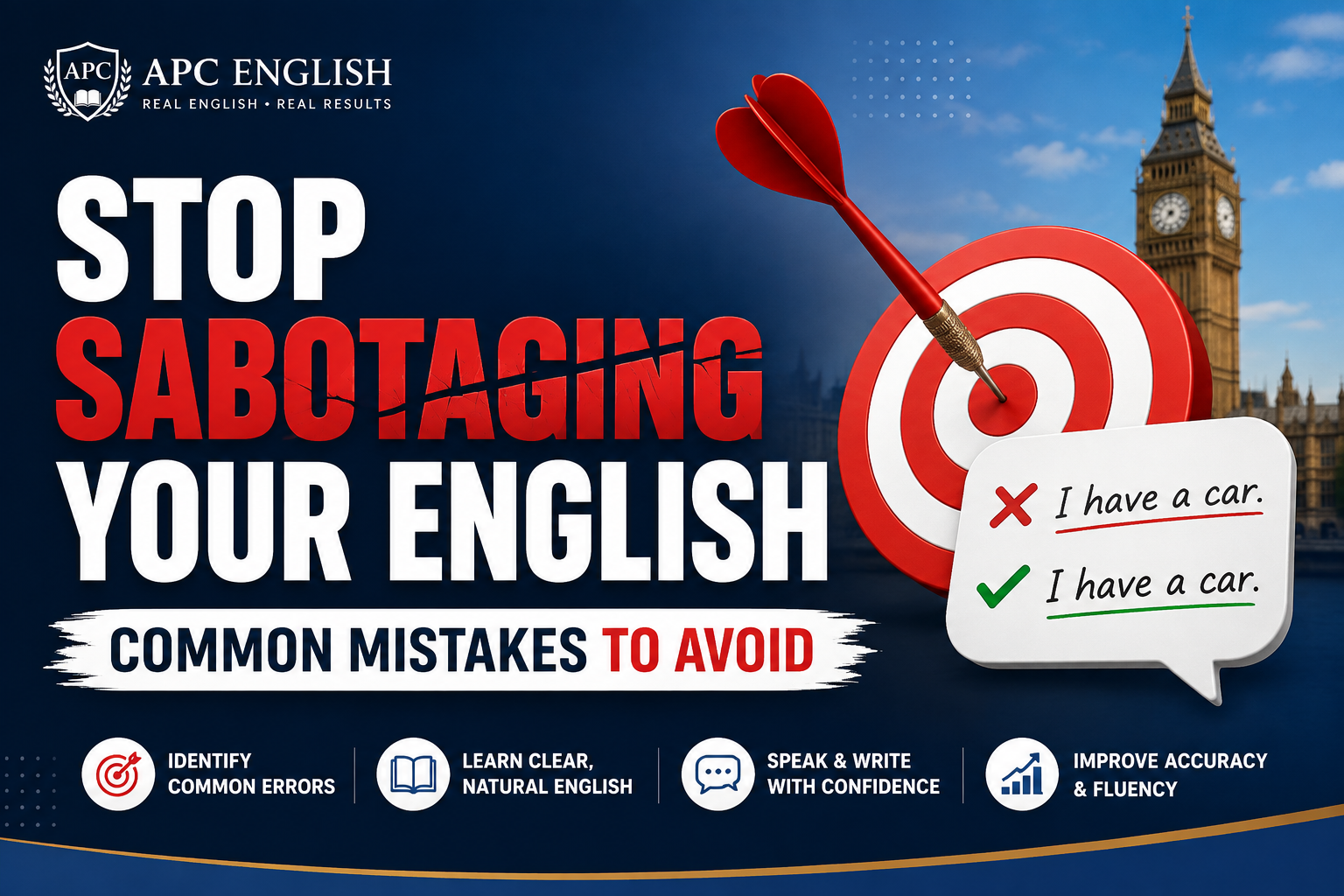
Stop Sabotaging Your English: Common English Mistakes to Avoid and Speak More Naturally
35. Common Mistakes in Email and Messaging
Emails and messages are some of the most common forms of written communication. The language you use should match the relationship, purpose, and level of formality of the situation.
A message can be grammatically correct but still sound too direct, too formal, incomplete, or unnatural.
Greetings
The greeting should match the situation and the person you are contacting.
Informal:
Hi John,
Neutral:
Hello John,
Formal:
Dear Mr. Smith,
Avoid using the same greeting for every situation. Consider the relationship and the purpose of the message.
Requests
Requests should be clear and appropriately polite.
Too direct:
Send me the document.
More polite:
Could you send me the document, please?
Formal:
Could you please send me the document?
Thanks
English offers several natural ways to express thanks depending on the context.
Thanks.
Thank you.
Thanks for your help.
Thank you for your time.
Endings
Your ending should match the level of formality of the message.
Informal:
See you,
Take care,
Neutral:
Best,
Best regards,
Formal:
Kind regards,
Sincerely,
Overly Direct Language
Messages are often shorter than spoken conversations, but being concise does not mean being unnecessarily direct.
Too direct:
I need this today.
More appropriate:
Could you send this to me today, please?
Unnatural Translations
Directly translating messages from another language can produce expressions that are understandable but unusual in English.
❌ I wait your response.
✅ I look forward to your response.
❌ I make you a message.
✅ I'm sending you a message.
Common Abbreviations
Messaging often includes abbreviations, but they should be used carefully.
ASAP — as soon as possible
FYI — for your information
BTW — by the way
LOL — laugh out loud
Abbreviations such as these may be appropriate in informal messages, but they are usually not suitable for formal or professional emails.
Formal vs. Informal Messages
Informal:
Hi Sarah,
Can you send me the file? Thanks!
See you,
Formal:
Dear Sarah,
Could you please send me the file?
Thank you for your help.
Kind regards,
Common Email Mistakes
❌ Send me the information.
✅ Could you please send me the information?
❌ I wait for your answer.
✅ I look forward to your response.
❌ Thanks you for your help.
✅ Thank you for your help.
Choose the Right Tone
Before sending an email or message, ask yourself whether the tone matches the situation.
Who am I writing to?
Why am I writing?
How formal does this situation require me to be?
A Simple Email Structure
Greeting
Hello James,
Purpose
I'm writing to ask about the meeting tomorrow.
Request or information
Could you please confirm the time?
Thanks
Thank you for your help.
Ending
Best regards,
Messages Should Be Natural, Not Complicated
Good communication does not require complicated vocabulary. A clear, natural, and appropriately polite message is usually more effective than a message filled with unnecessary formal language.
Next Step
You have now seen how English mistakes can appear in everyday situations, writing, emails, and messages.
The next section will bring these ideas together by examining some of the most common mistakes made by beginner English learners.
36. The Most Common “Beginner” Mistakes
Beginners often make the same mistakes repeatedly because they translate directly from their native language, apply a grammar rule too widely, or use a familiar structure in the wrong context.
The good news is that many of these mistakes are easy to correct once you recognize the pattern.
“I Am Agree” vs. “I Agree”
❌ I am agree.
✅ I agree.
Agree is a verb, so it does not need am in this sentence.
“I Have Hungry” vs. “I Am Hungry”
❌ I have hungry.
✅ I am hungry.
Hungry is an adjective, so English uses be to describe this physical state.
“She Don't Know” vs. “She Doesn't Know”
❌ She don't know.
✅ She doesn't know.
With he, she, and it, use doesn't in the present simple negative.
“I Can to Speak” vs. “I Can Speak”
❌ I can to speak English.
✅ I can speak English.
A modal verb such as can is followed directly by the base form of the main verb.
“I Am Here Since Two Years” vs. “I Have Been Here for Two Years”
❌ I am here since two years.
✅ I have been here for two years.
When a situation began in the past and continues into the present, English commonly uses the present perfect with for to express a duration.
More Common Beginner Mistakes
❌ He don't like it.
✅ He doesn't like it.
❌ I didn't went there.
✅ I didn't go there.
❌ She can to help me.
✅ She can help me.
❌ I have 20 years.
✅ I am 20 years old.
What These Mistakes Have in Common
Many beginner mistakes come from a small number of underlying problems:
direct translation
wrong auxiliary
incorrect verb form
incorrect tense
missing or unnecessary words
Learn the Correct Pattern
Do not focus only on memorizing the incorrect form. Learn the complete correct structure and reuse it in new sentences.
I agree.
I am hungry.
She doesn't know.
I can speak English.
Next Step
These beginner mistakes are important, but they are not limited to people at an elementary level. Even intermediate learners can continue making mistakes with more complex structures.
Next, we will look at the most common intermediate-level mistakes.
37. The Most Common “Intermediate” Mistakes
As your English improves, the mistakes you make often become less obvious. You may be able to communicate successfully while still using the wrong tense, article, preposition, collocation, or sentence pattern.
These mistakes are important because they often affect the naturalness and precision of your English rather than simply making the sentence impossible to understand.
Tense Selection
Intermediate learners may know the main tenses but still choose the wrong one for a particular context.
❌ I have seen him yesterday.
✅ I saw him yesterday.
❌ I am living here since 2021.
✅ I have lived here since 2021.
Articles
Intermediate learners often know the basic article rules but still omit or add a, an, or the in more complex situations.
❌ She is teacher.
✅ She is a teacher.
❌ The life is not always easy.
✅ Life is not always easy.
Prepositions
Prepositions often remain difficult even after a learner has studied the main grammar rules.
❌ It depends of the situation.
✅ It depends on the situation.
❌ I am interested by this topic.
✅ I am interested in this topic.
Collocations
Intermediate learners often choose a grammatically possible combination that is not the normal English collocation.
❌ make a research
✅ do research
❌ strong rain
✅ heavy rain
Natural Word Choice
At an intermediate level, the problem is often not whether a word is grammatically correct, but whether it is the most natural word for the context.
❌ I did a photo.
✅ I took a photo.
❌ I made a question.
✅ I asked a question.
Word Order
Intermediate learners may produce longer sentences with correct vocabulary but unnatural word order.
❌ I don't know where is the station.
✅ I don't know where the station is.
❌ She explained me the problem.
✅ She explained the problem to me.
Advanced False Friends
Some words remain confusing even at an intermediate level because they look familiar or have meanings that are easy to misinterpret.
actually → in fact
eventually → finally / in the end
sensible → practical / reasonable
sensitive → easily affected or responsive
Unnatural Sentence Patterns
Intermediate learners sometimes create sentences that are grammatically understandable but still do not sound like natural English.
❌ According to me, this is wrong.
✅ In my opinion, this is wrong.
❌ I am agree with you.
✅ I agree with you.
The Main Difference from Beginner Mistakes
Beginner mistakes often involve basic grammar structures. Intermediate mistakes more often involve choosing between structures that are already grammatically possible.
Beginner: Is the sentence grammatically correct?
Intermediate: Is this the most natural way to express the idea?
Focus on Precision and Naturalness
At the intermediate level, progress comes from noticing small differences in meaning, usage, word combinations, and sentence structure.
This is where exposure to real English becomes increasingly important.
Next Step
Recognizing mistakes is important, but noticing an error should not make you afraid to speak.
Next, we will look at how to correct repeated mistakes while keeping your confidence.
38. How to Fix a Mistake Without Losing Confidence
Improving your English requires noticing mistakes, but constant self-correction can make speaking stressful and slow.
The goal is not to interrupt every sentence you say. The goal is to recognize repeated patterns, correct them, and gradually make the correct form automatic.
Don't Stop Every Sentence to Self-Correct
If you stop after every small mistake, you may lose your train of thought and become afraid of speaking.
When communication is still clear, continue speaking and make a mental note of mistakes that you want to review later.
Notice Repeated Errors
Pay special attention to mistakes that appear again and again. Repeated errors are usually more important than occasional slips.
Repeated mistake → identify the pattern → learn the correct form → reuse it
Keep an Error List
A simple personal error list can help you identify your most common problems.
My mistake: I am agree.
Correct form: I agree.
My mistake: She don't know.
Correct form: She doesn't know.
Correct One Category at a Time
Do not try to fix every possible English mistake at once. Concentrate on one category and build a stronger habit before moving to the next.
Week 1 → verb forms
Week 2 → articles
Week 3 → prepositions
Week 4 → pronunciation
Reuse the Corrected Sentence
When you learn a correction, do not simply read it once. Use the corrected structure in several new sentences.
I agree.
I agree with you.
I completely agree with your idea.
Practice in Context
A corrected sentence becomes easier to remember when you use it in meaningful communication.
Practice the structure in conversations, messages, writing, or situations that are relevant to your daily life.
Do Not Confuse Accuracy with Perfection
Speaking well does not mean speaking without ever making a mistake. Effective communication and continuous improvement are more important than trying to achieve perfect accuracy in every sentence.
A Healthy Correction Cycle
Notice → Correct → Reuse → Review → Improve
Keep Speaking
Confidence grows when you continue communicating even while you are improving.
Make corrections part of your learning process, not a reason to avoid speaking.
Next Step
Now that you have a strategy for correcting repeated mistakes, the next step is to create a simple checklist that you can use before and after speaking.
39. Personal Error Checklist
A personal error checklist can help you become more aware of the mistakes you make most often.
You do not need to check everything every time you speak. Focus on the areas that are most relevant to your current level and your personal difficulties.
Before Speaking
Is my tense correct?
Is my verb form correct?
Is my word order natural?
Am I translating directly?
Am I using the correct preposition?
After Speaking
What mistake did I repeat?
What should I say next time?
Build Your Own Error Log
Your checklist becomes more useful when you turn repeated mistakes into a personal error log.
| My Mistake | Correct Form | Category |
|---|---|---|
| I am agree. | I agree. | verb usage |
| She don't know. | She doesn't know. | present simple |
| in Monday | on Monday | preposition |
Review Your Most Frequent Errors
Review your error log regularly and choose a small number of mistakes to focus on at one time.
Identify the mistake → learn the correction → use the correction repeatedly
Turn Awareness into Habit
The ultimate goal of the checklist is not to make you think about grammar forever. It is to help you become aware of repeated mistakes until the correct forms become increasingly automatic.
Next Step
You now have a practical system for identifying and correcting your personal English mistakes.
The final step is to put everything you have learned into active practice by recognizing, correcting, completing, and rewriting sentences in different ways.
ℹ️ Acerca de este curso

Mr Ray
- 🌍 Idioma English
- 👥 Estudiantes 0
- 👁 Visualizaciones 218
- 📚 Recursos 2
- 📄 PDF 1
- 🎥 Videos 0
- 📝 Cuestionarios 1
- 🔗 Enlaces 0
- 🕒 Lectura 94 min
- 📅 Actualizado August 31, 2026