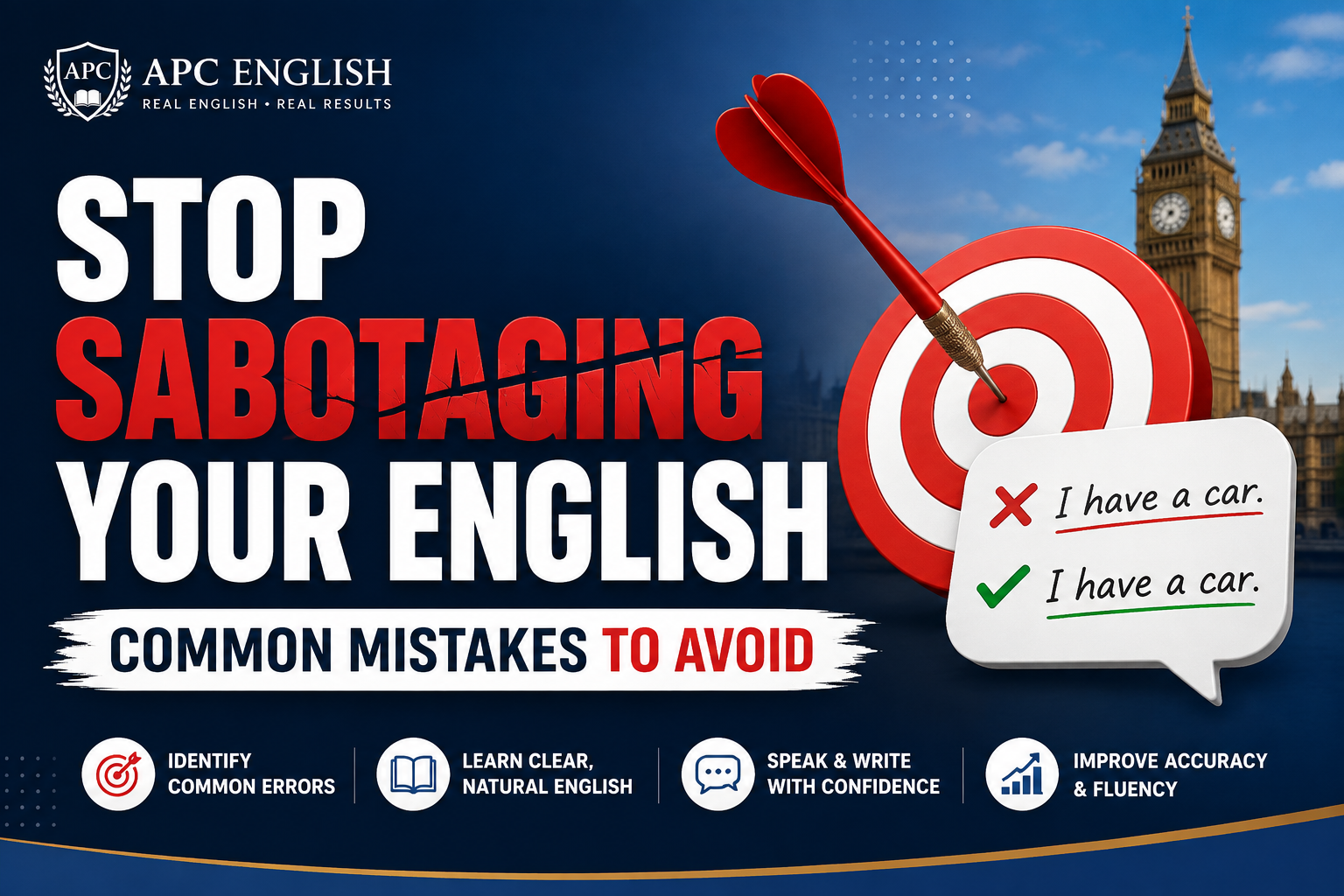
Stop Sabotaging Your English: Common English Mistakes to Avoid and Speak More Naturally
40. Practice Lab
This practice section is designed to prepare you for the course quizzes and help you actively use what you have learned.
The goal is not simply to recognize correct English. You should also be able to identify mistakes, choose natural alternatives, complete sentences, and apply the structures in new contexts.
Identify the Mistake
Read the sentence and identify what is wrong.
She don't like coffee.
The problem is the agreement between the subject and the auxiliary verb.
Correct: She doesn't like coffee.
Choose the Natural Sentence
Choose the sentence that sounds correct and natural.
A. I am agree with you.
B. I agree with you.
C. I am agreeing with you.
D. I do agree you.
Correct the Sentence
Rewrite the sentence using natural English.
❌ Did you went to work yesterday?
✅ Did you go to work yesterday?
Complete the Sentence
Choose the correct form to complete the sentence.
She ______ English every day.
speak / speaks / is speak / speaking
Choose the Correct Word
Choose the word or expression that naturally fits the context.
I need to ______ a decision.
do / make / take / get
Translate Naturally
Do not translate word for word. Express the idea using natural English.
Idea: The speaker wants to say that they are 25 years old.
Natural English: I am 25 years old.
Choose the Correct Pronunciation
Identify the correct pronunciation pattern.
worked → /t/
played → /d/
wanted → /ɪd/
Rewrite a Sentence Naturally
Sometimes more than one correction is possible. Focus on producing English that sounds natural and fits the meaning.
❌ I very like this book.
✅ I really like this book.
❌ She speaks very well English.
✅ She speaks English very well.
Practice Different Skills
Strong improvement comes from practicing several skills rather than repeating only one type of exercise.
Recognition → identify mistakes.
Selection → choose the natural option.
Correction → fix incorrect sentences.
Production → create your own natural sentences.
From Practice to Real Communication
The purpose of these activities is not simply to get the right answer on an exercise. The real goal is to make correct and natural English easier to recognize and use during real communication.
Keep returning to the mistakes that are most difficult for you. Repeated exposure and repeated use will gradually turn corrections into stronger habits.
Next Step
You have now completed the main learning sections of this course.
The next step is active review: use the course quizzes to test how well you can recognize mistakes, choose natural English, understand sentence patterns, and apply what you have learned in context.
41. Mini Conversations — Before and After
One of the best ways to recognize unnatural English is to compare the way a learner might naturally translate an idea with the way the same idea would normally be expressed in English.
The following mini conversations show how small changes in grammar, vocabulary, sentence structure, and tone can make English sound clearer and more natural.
Version 1 — Unnatural English
A: Hello. How are you?
B: I have hungry. And you?
A: I am good. What you do today?
B: I am work at home. After, I will go to the shop because I need buy some things.
A: Can you to buy me some water?
B: Yes, no problem. I make it.
Version 2 — Natural English
A: Hi. How are you?
B: I'm hungry. How about you?
A: I'm good. What are you doing today?
B: I'm working at home. Afterwards, I'm going to the shop because I need to buy a few things.
A: Could you buy me some water?
B: Sure, no problem. I'll get it.
What Changed?
I have hungry.
→ I'm hungry.
What you do today?
→ What are you doing today?
I am work at home.
→ I'm working at home.
I need buy...
→ I need to buy...
Can you to buy...?
→ Could you buy...?
I make it.
→ I'll get it.
The Important Lesson
Notice that the natural version does not necessarily use more complicated grammar. In many cases, it simply uses the correct English structure and a more natural combination of words.
This is an important principle throughout the course: natural English is not always more complicated English.
Another Example
Version 1 — Unnatural English
A: Where you are going?
B: I go to the bank. Do you want come with me?
A: No, I can't to go. I have much work.
Version 2 — Natural English
A: Where are you going?
B: I'm going to the bank. Do you want to come with me?
A: No, I can't go. I have a lot of work.
Patterns to Notice
Where are you going?
Do you want to come?
I can't go.
I have a lot of work.
When you compare the two versions, focus on the structure rather than simply memorizing the corrected sentences.
Next Step
You have now seen how several common mistakes can appear together in real communication.
The next section brings together many of the most important mistakes from the course for a final review.
42. Final Review — The 50 Mistakes to Remember
This final review brings together many of the most common mistakes discussed throughout the course.
Do not try to memorize all of them at once. Use the list to identify the mistakes that you personally make most often and return to those examples regularly.
| Mistake | Correct English | Why? |
|---|---|---|
| I am agree. | I agree. | Agree is a verb. |
| I have hungry. | I am hungry. | Use be with this physical state. |
| She don't know. | She doesn't know. | Third-person singular requires doesn't. |
| Did you went? | Did you go? | Did is followed by the base verb. |
| I can to swim. | I can swim. | Modal verbs are followed by the base verb. |
| I have 20 years. | I am 20 years old. | Age is expressed with be. |
| I very like it. | I really like it. | Use a natural adverb with like. |
| She speaks very well English. | She speaks English very well. | Natural word order. |
| Where you live? | Where do you live? | Present simple questions require do. |
| What you are doing? | What are you doing? | Correct auxiliary placement. |
| She said me the truth. | She told me the truth. | Tell takes the person directly. |
| He told that he was tired. | He said that he was tired. | Use say before that + clause. |
| I told hello. | I said hello. | Common expression with say. |
| Nice to know you. | Nice to meet you. | Meet is used for an introduction. |
| I know to swim. | I know how to swim. | Use know how to + verb. |
| I meet him for five years. | I have known him for five years. | Use know for an ongoing relationship. |
| She is a teacher. | She is a teacher. | Singular countable nouns need a determiner. |
| I bought car. | I bought a car. | Singular countable noun needs a determiner. |
| I saw dog. | I saw a dog. | Use a for first mention. |
| I saw a dog. Dog was friendly. | I saw a dog. The dog was friendly. | Use the for known information. |
| much books | many books | Books are countable. |
| many information | much information | Information is uncountable. |
| few time | little time | Time is uncountable. |
| little students | few students | Students are countable. |
| an advice | some advice | Advice is uncountable. |
| two advices | two pieces of advice | Advice is uncountable. |
| in Monday | on Monday | Days use on. |
| on July | in July | Months use in. |
| in night | at night | Common expression. |
| on a car | in a car | Common transportation expression. |
| She speaks English good. | She speaks English well. | Well modifies the action. |
| He played badly. | He played badly. | Badly is the adverb form. |
| I am boring. | I am bored. | Describes the person's feeling. |
| The movie is bored. | The movie is boring. | Describes the cause of the feeling. |
| I am interesting in history. | I am interested in history. | Interested describes the person's feeling. |
| The instructions are confused. | The instructions are confusing. | Confusing describes the cause. |
| One people | One person | Person is singular. |
| Two persons are waiting. | Two people are waiting. | People is the normal everyday plural. |
| Three mans | Three men | Irregular plural of man. |
| Two womans | Two women | Irregular plural of woman. |
| I didn't went. | I didn't go. | Didn't takes the base verb. |
| I have seen him yesterday. | I saw him yesterday. | Finished past time uses past simple. |
| I have lived here since five years. | I have lived here for five years. | For introduces duration. |
| I have lived here for 2021. | I have lived here since 2021. | Since introduces a starting point. |
| I don't know nothing. | I don't know anything. | Avoid double negatives in standard English. |
| She can to help me. | She can help me. | Modal + base verb. |
| You don't must go. | You don't have to go. | Different negative meaning. |
| You mustn't go. | You mustn't go. | Indicates prohibition. |
| Can you to help me? | Can you help me? | Modal + base verb. |
| I am work now. | I am working now. | Present continuous requires verb-ing. |
| I work now. | I am working now. | Action happening now uses continuous form. |
| She is knowing the answer. | She knows the answer. | Know is normally a stative verb. |
How to Use This Review
Do not treat this table as a list that you must memorize from beginning to end.
Instead, identify the mistakes that appear in your own English. Those are the mistakes that deserve the most attention and repeated practice.
Notice → Understand → Correct → Reuse
Next Step
You have reviewed many of the mistakes covered throughout the course. Now it is time to test yourself without looking at the corrections first.
The next section presents a final challenge designed to see whether you can catch common mistakes in context.
43. Final Challenge
Can you catch the mistakes?
Read the following conversation carefully. Several sentences contain mistakes involving grammar, vocabulary, word order, prepositions, and natural English.
Can You Catch the Mistakes?
A: Hi! How are you today?
B: I'm good, but I have very hungry.
A: What you are doing now?
B: I am go to a restaurant with my friend.
A: Nice! Did you went there before?
B: Yes, I have went there last week.
A: How was the food?
B: It was very good. The waiter was very kind and he explained me everything.
A: Do you know if they have some vegetarian food?
B: I don't know nothing about it.
A: Can you to ask the waiter?
B: Yes, I can ask him when we arrive at the restaurant.
One Possible Correction
A: Hi! How are you today?
B: I'm good, but I'm very hungry.
A: What are you doing now?
B: I'm going to a restaurant with my friend.
A: Nice! Did you go there before?
B: Yes, I went there last week.
A: How was the food?
B: It was very good. The waiter was very kind and he explained everything to me.
A: Do you know if they have any vegetarian food?
B: I don't know anything about it.
A: Can you ask the waiter?
B: Yes, I can ask him when we arrive at the restaurant.
What Did You Notice?
The mistakes in the original conversation involved several topics from this course:
Present simple vs. present continuous
Past simple
Present perfect
Modal verbs
Double negatives
Natural word order
Verb patterns
Quantifiers
The Real Challenge
The most important skill is not simply recognizing an error after someone points it out. The real goal is to notice it yourself and naturally produce the correct form the next time you speak or write.
Notice the mistake → identify the pattern → produce the correct form
Next Step
You have reached the end of the main course content.
Before moving on, remember that making mistakes is a normal part of language learning. What matters most is recognizing your repeated mistakes and gradually replacing them with stronger English habits.
44. Course Conclusion
Learning English is not about speaking perfectly from the beginning. It is about becoming more accurate, more natural, and more confident over time.
Throughout this course, you have seen how relatively small mistakes can affect grammar, vocabulary, pronunciation, word order, and everyday communication.
You have also learned that correcting these mistakes does not require learning everything at once. The most effective approach is to identify the mistakes you repeat, understand why they happen, learn the correct pattern, and use it repeatedly.
The Main Idea
You do not need perfect English to communicate well. But fixing the mistakes you repeat most often can make your English clearer, more natural, and more confident.
Keep Improving
Do not be afraid of making mistakes. Use them as information about what you need to improve next.
Pay attention to the English you hear, notice useful expressions, compare natural sentence patterns, and continue using English in real situations.
Most importantly, keep speaking. Confidence grows through use, reflection, correction, and repetition.
What Comes Next?
The next step is active review. Use the course quizzes to test how well you can recognize mistakes, choose natural English, correct sentences, understand common patterns, and apply what you have learned in context.
Well Done!
You have completed Stop Sabotaging Your English — Common Mistakes to Avoid.
Keep using English, keep noticing patterns, and keep improving one mistake at a time.
45. Continue Learning with APC
Your English learning journey does not end with this course. Continue reviewing what you have learned and explore new lessons as they become available.
Visit APC Community Academy regularly to discover new and updated learning content:
https://apcenglish.com/community/academy/index.php
New lessons and updated resources will be added to the Academy very soon. Coming back regularly will help you discover new content as the learning platform continues to grow.
You can also explore the other English lessons already available on APC English:
Review regularly.
Practice what you learn.
Notice your recurring mistakes.
Keep building natural English patterns.
Keep learning. Keep practicing. Keep improving.
ℹ️ इस पाठ्यक्रम के बारे में

Mr Ray
- 🌍 भाषा English
- 👥 छात्र 0
- 👁 दृश्य 255
- 📚 संसाधन 2
- 📄 PDF 1
- 🎥 वीडियो 0
- 📝 क्विज़ 1
- 🔗 लिंक 0
- 🕒 पढ़ना 94 min
- 📅 अपडेट किया गया August 31, 2026