NUOVI CONTENUTI PUBBLICATI

Scopri le novità di APC

Rimani aggiornato sugli ultimi corsi, risorse, lezioni, articoli di coaching, certificazioni e contenuti della community pubblicati su APC Community.

latest_posts

Scopri le ultime novità di APC Community.

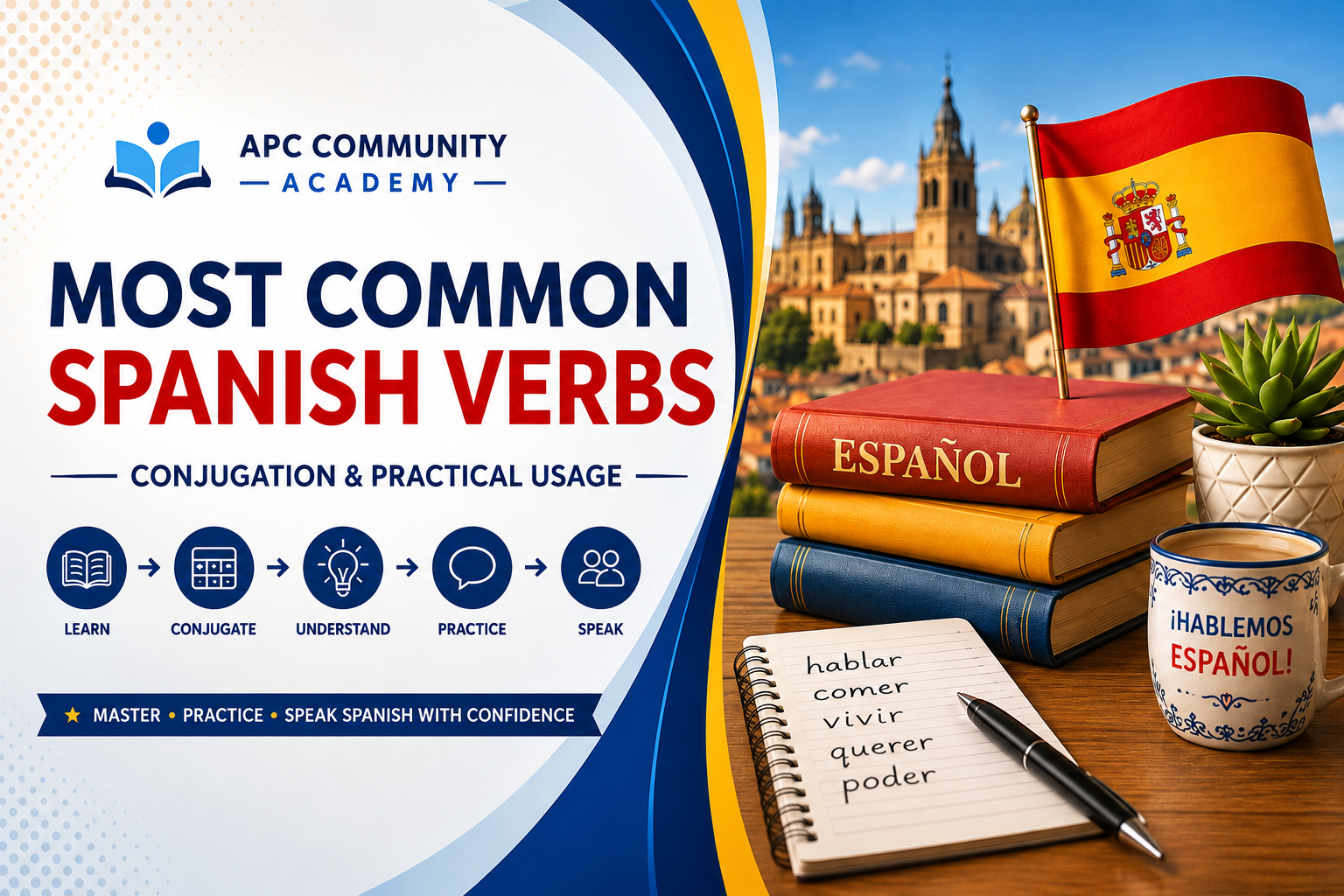
Most Common Spanish Verbs: Conjugation, Meaning & Practical Usage
Corso

Most Common Spanish Verbs: Conjugation, Meaning & Practical Usage

Most Common Spanish Verbs — Conjugation & Practical UsageCourse ObjectiveBy the end of this lesson, learners will be able to recognize, conjugate, and use some of the most common Spanish verbs in practical everyday situations.The goal is not simply to memorize conjugation tables. Learners will understand how and when each verb is used, with practical examples and reusable sentence patterns.Throughout this lesson, the focus will remain practical: learners will discover a verb, understand its conjugation, see how it is used, practice it, and finally use it in realistic communication.Course StructureIntroduction — Why These Verbs MatterSer — to beEstar — to beTener — to haveHacer — to do / to makeIr — to goPoder — can / to be able toDecir — to say / to tellQuerer — to want / to loveSaber — to knowVer — to see / to watchRegular High-Frequency VerbsSer vs. Estar — The Essential DifferenceHow to Conjugate Regular VerbsCommon MistakesPractice LabMini ConversationFinal ReviewLanguage SettingLearning language: EnglishTarget language: SpanishLanguage code: enHow This Lesson WorksThis lesson follows a clear and practical learning sequence:Verb → Conjugation → Usage → Examples → Practice → ConversationThis approach helps learners move beyond memorizing verb forms. The objective is to understand how Spanish verbs actually work in everyday communication.By the end of the lesson, learners should be able to recognize common verb forms, understand their meaning in context, and begin using them to create their own sentences.1. Introduction — Why These Verbs MatterVerbs are at the heart of communication. They allow us to talk about who we are, what we have, what we do, where we go, what we want, what we know, and what we can do.When learning Spanish, mastering a relatively small group of very common verbs can immediately make a learner more capable of understanding and producing useful sentences.For this reason, this lesson focuses on ten particularly useful verbs:ser — to beestar — to betener — to havehacer — to do / to makeir — to gopoder — can / to be able todecir — to say / to tellquerer — to want / to lovesaber — to knowver — to see / to watchThese verbs appear in many everyday situations and provide useful building blocks for creating sentences.Learning TipDo not try to memorize everything at once. Learn each verb through its meaning, its most useful forms, and several practical sentences.Your Learning PathAs you progress through the lesson, you will repeatedly follow the same pattern.VerbDiscover the meaning and basic role of the verb.ConjugationLearn the forms needed for practical communication.UsageUnderstand when and why the verb is used.ExamplesSee the verb inside complete Spanish sentences.PracticeTest your understanding through short exercises.ConversationUse several verbs together in realistic communication.The goal is simple: move from recognizing a verb to actually using it.What You Will LearnDuring this lesson, you will learn how to use essential Spanish verbs to express identity, location, possession, actions, movement, ability, information, desires, knowledge, and perception.You will also learn how regular Spanish verbs are conjugated and how to recognize common patterns in verbs ending in -AR, -ER, and -IR.Special attention will be given to the difference between ser and estar, since this is one of the most important distinctions for learners of Spanish.Let's BeginStart with the first essential verb: ser.Do not focus only on remembering its forms. Pay attention to the situations in which Spanish speakers use it and to the sentence patterns that you can reuse with other vocabulary.Step by step, these verbs will become tools you can use to build real Spanish sentences.2. Ser — to beThe verb ser is one of the most important verbs in Spanish. It is mainly used to identify people and things, describe essential characteristics, talk about origin and nationality, and state professions or roles.Learning ser well is essential because it appears constantly in everyday Spanish and is used to build many basic sentences.Present Tense ConjugationHere are the present-tense forms of ser:SubjectSpanishEnglishyosoyI amtúeresyou areél / ella / ustedeshe / she / you arenosotros / nosotrassomoswe arevosotros / vosotrassoisyou areellos / ellas / ustedessonthey / you areWhen Do We Use Ser?Ser is commonly used to talk about identity, origin, nationality, profession, relationships, and characteristics.1. IdentityUse ser to say who someone is or what something is.Soy María.I am María.2. Origin and NationalityUse ser to talk about where someone is from or their nationality.Soy de España.I am from Spain.3. Profession or RoleSer is also used to describe a person's profession, occupation, or role.Soy profesor.I am a teacher.4. CharacteristicsWe can use ser to describe characteristics or qualities.Ella es inteligente.She is intelligent.10 Practical Examples with SerStudy these examples carefully. Notice how the form of ser changes according to the subject.1. Soy estudiante.I am a student.2. Soy de Francia.I am from France.3. Tú eres mi amigo.You are my friend.4. Ella es profesora.She is a teacher.5. Él es español.He is Spanish.6. Nosotros somos estudiantes.We are students.7. Ustedes son mis amigos.You are my friends.8. Ellos son médicos.They are doctors.9. Madrid es una ciudad grande.Madrid is a large city.10. Este libro es interesante.This book is interesting.Common Sentence PatternsOne of the best ways to learn ser is to memorize useful sentence patterns rather than isolated conjugations.Subject + ser + identitySoy estudiante.I am a student.Subject + ser + originSoy de Francia.I am from France.Subject + ser + professionElla es profesora.She is a teacher.Subject + ser + characteristicÉl es inteligente.He is intelligent.PracticeComplete each sentence with the correct form of ser.Yo ______ estudiante.Tú ______ mi amigo.Ella ______ profesora.Nosotros ______ estudiantes.Ellos ______ médicos.AnswerssoyeresessomossonNext StepYou now know how ser works in basic Spanish. But Spanish has another essential verb that can also mean “to be”: estar.Understanding the difference between ser and estar is one of the most important steps toward speaking Spanish accurately.3. Estar — to beThe verb estar is another essential Spanish verb that means “to be”. It is used differently from ser and is especially important when talking about temporary states, conditions, feelings, and locations.Understanding estar is essential because choosing between ser and estar can change the meaning of a sentence.Present Tense ConjugationHere are the present-tense forms of estar:SubjectSpanishEnglishyoestoyI amtúestásyou areél / ella / ustedestáhe / she / you arenosotros / nosotrasestamoswe arevosotros / vosotrasestáisyou areellos / ellas / ustedesestánthey / you areWhen Do We Use Estar?Estar is mainly used for temporary states, conditions, feelings, and locations.1. Temporary States and ConditionsUse estar to describe how someone or something is at a particular moment.Estoy cansado.I am tired.2. Feelings and EmotionsEstar is commonly used with feelings and emotional states.Ella está feliz.She is happy.3. LocationUse estar to indicate where a person, place, or thing is located.Estoy en casa.I am at home.4. A Condition at a Particular MomentEstar can describe the current condition of something.La puerta está abierta.The door is open.10 Practical Examples with EstarStudy these examples carefully and observe how the form of estar changes according to the subject.1. Estoy cansado.I am tired.2. Estoy en casa.I am at home.3. Tú estás bien.You are well.4. Ella está feliz.She is happy.5. Él está enfermo.He is sick.6. Nosotros estamos en la escuela.We are at school.7. Ustedes están listos.You are ready.8. Ellos están ocupados.They are busy.9. Madrid está en España.Madrid is in Spain.10. La puerta está abierta.The door is open.Common Sentence PatternsLearning useful patterns makes it easier to use estar naturally.Subject + estar + temporary stateEstoy cansado.I am tired.Subject + estar + feelingElla está feliz.She is happy.Subject + estar + locationEstamos en casa.We are at home.Subject + estar + current conditionLa puerta está abierta.The door is open.Ser and Estar Are Not InterchangeableBoth ser and estar can be translated as “to be” in English, but they are not normally used in the same situations.Ser is commonly associated with identity, origin, profession, and characteristics, while estar is commonly associated with states, conditions, feelings, and location.Compare:Soy estudiante.I am a student.Estoy cansado.I am tired.The English translation uses “I am” in both sentences, but Spanish uses two different verbs because the meanings and contexts are different.Important Forms to RememberPay special attention to the accented forms:estás — you areestá — he / she / you areestáis — you areestán — they / you areNext StepNow that you know the two main Spanish verbs meaning “to be”, we can move to another extremely useful verb: tener — “to have”.4. Tener — to haveThe verb tener is one of the most useful verbs in Spanish. Its basic meaning is “to have”, but it is also used in several everyday expressions that learners need to recognize and use naturally.You can use tener to talk about possession, age, relationships, needs, obligations, and various common states or situations.Present Tense ConjugationHere are the present-tense forms of tener:SubjectSpanishEnglishyotengoI havetútienesyou haveél / ella / ustedtienehe / she / you havenosotros / nosotrastenemoswe havevosotros / vosotrastenéisyou haveellos / ellas / ustedestienenthey / you haveWhen Do We Use Tener?Tener is commonly used for possession, age, relationships, physical or personal states, and obligations.1. PossessionUse tener to say that someone owns or possesses something.Tengo un libro.I have a book.2. AgeIn Spanish, age is expressed with tener, not with ser or estar.Tengo veinte años.I am twenty years old.3. RelationshipsTener can be used to talk about family members, friends, and other relationships.Tengo dos hermanos.I have two brothers.4. Common States and ExpressionsSpanish frequently uses tener in expressions where English uses “to be”.Tengo hambre.I am hungry.5. Obligation — Tener queThe structure tener que + infinitive is used to express an obligation or something that someone has to do.Tengo que trabajar.I have to work.10 Practical Examples with TenerThese examples show some of the most useful ways to use tener in everyday Spanish.1. Tengo un libro.I have a book.2. Tienes una casa.You have a house.3. Ella tiene dos hermanos.She has two brothers.4. Él tiene veinte años.He is twenty years old.5. Tenemos mucho trabajo.We have a lot of work.6. Ellos tienen dos hijos.They have two children.7. Tengo hambre.I am hungry.8. Ella tiene sed.She is thirsty.9. Tenemos que estudiar.We have to study.10. Tienen tiempo.They have time.Common Sentence PatternsSeveral highly useful Spanish structures are built with tener.Subject + tener + possessionTengo un libro.I have a book.Subject + tener + ageTengo veinte años.I am twenty years old.Subject + tener + common expressionTengo hambre.I am hungry.Subject + tener que + infinitiveTengo que trabajar.I have to work.Tener vs. English “To Be”One important point for English-speaking learners is that some expressions using tener are translated with “to be” in English.For example:Tengo hambre.I am hungry.Tengo sed.I am thirsty.Tengo veinte años.I am twenty years old.This is an important difference between the two languages. Instead of translating word for word, learn these expressions as complete Spanish patterns.Tener Que + InfinitiveThe structure tener que + infinitive is especially useful because it allows you to express obligations very easily.Tengo que estudiar.I have to study.Tenemos que salir.We have to leave.Ellos tienen que trabajar.They have to work.Important Forms to RememberPay particular attention to the irregular first-person form:yo tengoThe other forms follow different vowel patterns that should be learned through repeated exposure and use.Next StepYou now know how tener is used for possession, age, common expressions, relationships, and obligations.The next essential verb is hacer — “to do” or “to make”, a verb used constantly to describe actions and activities.5. Hacer — to do / to makeThe verb hacer is one of the most useful verbs in Spanish. Its basic meanings are “to do” and “to make”, but it is also used in many common expressions and everyday situations.You will use hacer to talk about actions, activities, tasks, things you create or make, and several expressions that are very common in spoken Spanish.Present Tense ConjugationHere are the present-tense forms of hacer:SubjectSpanishEnglishyohagoI do / I maketúhacesyou do / you makeél / ella / ustedhacehe / she / you do / makenosotros / nosotrashacemoswe do / we makevosotros / vosotrashacéisyou do / you makeellos / ellas / ustedeshacenthey / you do / makeWhen Do We Use Hacer?Hacer can be used in several important situations. Its exact meaning depends on the context.1. To Talk About ActionsUse hacer when talking about something someone does or performs.Hago ejercicio.I exercise.2. To Talk About ActivitiesHacer is commonly used with activities and regular actions.Hacemos deporte.We do sports.3. To Make SomethingHacer can also mean “to make” when someone creates or prepares something.Ella hace una comida.She makes a meal.4. Tasks and WorkThe verb is also useful for talking about tasks, work, and things that need to be completed.Hago mi trabajo.I do my work.5. Common Everyday ExpressionsHacer appears in many fixed or very common expressions that learners should recognize as complete patterns.Hace calor.It is hot.10 Practical Examples with HacerThese examples show how hacer can be used for everyday actions, activities, tasks, and expressions.1. Hago ejercicio todos los días.I exercise every day.2. Hago mi trabajo por la mañana.I do my work in the morning.3. ¿Qué haces?What are you doing?4. Ella hace la comida.She makes the meal.5. Él hace muchas cosas.He does many things.6. Nosotros hacemos deporte.We do sports.7. Ustedes hacen un buen trabajo.You do a good job.8. Ellos hacen una casa.They build a house.9. Hace calor hoy.It is hot today.10. Hacemos planes para el fin de semana.We make plans for the weekend.Common Sentence PatternsLearning common structures with hacer makes it easier to create new sentences.Subject + hacer + activityHago ejercicio.I exercise.Subject + hacer + taskHago mi trabajo.I do my work.Subject + hacer + thingElla hace la comida.She makes the meal.Subject + hacer + plansHacemos planes.We make plans.Hacer in Common ExpressionsSome expressions with hacer should be learned as complete expressions rather than translated word by word.Hace calor.It is hot.Hace frío.It is cold.Hacer una pregunta.To ask a question.Hacer planes.To make plans.A Very Important Irregular FormThe first-person singular form of hacer is irregular:yo hagoThis form should be learned as a complete unit because it does not follow the regular pattern you might expect from the infinitive.Hacer and the Meaning of “Do” or “Make”English uses two different verbs, “do” and “make”, while Spanish can use hacer for both.Hago mi trabajo.I do my work.Hacemos planes.We make plans.Ella hace la comida.She makes the meal.The meaning is determined by the context and by the words that follow the verb.Next StepYou now know how hacer is used to talk about actions, activities, tasks, creations, and common expressions.The next essential verb is ir — “to go”, which will allow you to talk about movement, destinations, and future plans.6. Ir — to goThe verb ir is one of the most useful verbs in Spanish. Its basic meaning is “to go”, and it is essential for talking about movement, destinations, places, plans, and future actions.Although ir is an irregular verb, its most common present-tense forms are very useful and should become familiar through repeated use.Present Tense ConjugationHere are the present-tense forms of ir:SubjectSpanishEnglishyovoyI go / I am goingtúvasyou go / you are goingél / ella / ustedvahe / she / you go / are goingnosotros / nosotrasvamoswe go / we are goingvosotros / vosotrasvaisyou go / you are goingellos / ellas / ustedesvanthey / you go / are goingWhen Do We Use Ir?Ir is mainly used to talk about movement from one place to another, destinations, and planned or future actions.1. Going to a PlaceUse ir when saying where someone is going.Voy a Madrid.I am going to Madrid.2. Going to a Person or PlaceThe verb is commonly followed by a when introducing a destination.Vamos a la escuela.We are going to school.3. Talking About MovementIr can describe everyday movement and travel.Ellos van al trabajo.They are going to work.4. Ir a + InfinitiveOne of the most useful structures with ir is ir a + infinitive. It is commonly used to talk about an action that is going to happen.Voy a estudiar.I am going to study.5. Talking About PlansThe structure ir a + infinitive is especially useful for expressing plans and intentions.Vamos a viajar mañana.We are going to travel tomorrow.10 Practical Examples with IrThese examples show how ir can be used to talk about destinations, movement, plans, and future actions.1. Voy a casa.I am going home.2. Vas a la escuela.You are going to school.3. Ella va al trabajo.She is going to work.4. Él va a Madrid.He is going to Madrid.5. Vamos al supermercado.We are going to the supermarket.6. Vais a la universidad.You are going to the university.7. Ellos van al parque.They are going to the park.8. Voy a estudiar esta noche.I am going to study tonight.9. Vamos a comer juntos.We are going to eat together.10. Van a viajar mañana.They are going to travel tomorrow.Common Sentence PatternsThe most useful structures with ir are simple and highly reusable.Subject + ir + a + destinationVoy a Madrid.I am going to Madrid.Subject + ir + a + placeVamos a la escuela.We are going to school.Subject + ir + a + infinitiveVoy a estudiar.I am going to study.Subject + ir + a + infinitive + time expressionVan a viajar mañana.They are going to travel tomorrow.Ir + a + InfinitiveThis structure is particularly important for beginners because it allows you to talk about future actions without learning a separate future-tense conjugation at this stage.Voy a trabajar.I am going to work.Vas a estudiar.You are going to study.Vamos a salir.We are going to go out.Ellos van a viajar.They are going to travel.The Irregular First-Person FormThe first-person singular form of ir is highly irregular:yo voyThis form should be learned as a complete expression because it does not resemble the infinitive ir.Ir in Everyday CommunicationBecause ir can describe both movement and future plans, it appears frequently in everyday conversations.¿Adónde vas?Where are you going?Voy a casa.I am going home.¿Qué vas a hacer?What are you going to do?Voy a estudiar.I am going to study.Important Forms to RememberThe six present-tense forms of ir are:voy, vas, va, vamos, vais, vanPay particular attention to voy, which is the first-person singular form.Next StepYou now know how ir is used to talk about destinations, movement, plans, and future actions.The next essential verb is poder — “can” or “to be able to”, which allows you to express ability, possibility, and simple requests.7. Poder — can / to be able toThe verb poder is one of the most useful Spanish verbs for everyday communication. It is generally translated as “can” or “to be able to”.It allows you to talk about ability, possibility, permission, and situations in which someone is able to do something.Present Tense ConjugationHere are the present-tense forms of poder:SubjectSpanishEnglishyopuedoI can / I am able totúpuedesyou can / you are able toél / ella / ustedpuedehe / she / you can / are able tonosotros / nosotraspodemoswe can / we are able tovosotros / vosotraspodéisyou can / you are able toellos / ellas / ustedespuedenthey / you can / are able toWhen Do We Use Poder?Poder is commonly followed by an infinitive and allows you to express what someone can or cannot do.1. AbilityUse poder + infinitive to talk about a person's ability to perform an action.Puedo nadar.I can swim.2. PossibilityPoder can also express that something is possible.Podemos ir mañana.We can go tomorrow.3. Asking for PermissionIn everyday Spanish, poder can be used to ask whether something is allowed or possible.¿Puedo entrar?Can I come in?4. Making a Polite RequestA question with poder can be used to make a simple and polite request.¿Puedes ayudarme?Can you help me?10 Practical Examples with PoderThese examples show how poder is used to express ability, possibility, permission, and requests.1. Puedo hablar español.I can speak Spanish.2. Puedes venir mañana.You can come tomorrow.3. Ella puede cocinar.She can cook.4. Él puede ayudarme.He can help me.5. Podemos estudiar juntos.We can study together.6. Podéis esperar aquí.You can wait here.7. Ellos pueden venir esta tarde.They can come this afternoon.8. ¿Puedo entrar?Can I come in?9. ¿Puedes ayudarme?Can you help me?10. No puedo ir hoy.I cannot go today.Common Sentence PatternOne of the most useful structures with poder is:Subject + poder + infinitivePuedo estudiar.I can study.The second verb remains in the infinitive form. It is poder that changes according to the subject.Poder + InfinitiveThis pattern can be combined with many different verbs.Puedo hablar.I can speak.Puedes venir.You can come.Ella puede estudiar.She can study.Podemos trabajar.We can work.Expressing “Cannot”To express inability or impossibility, place no before the conjugated form of poder.No puedo.I cannot. / I am not able to.No puedo ir.I cannot go.No podemos trabajar hoy.We cannot work today.An Important Conjugation PatternNotice that the vowel changes in several forms of poder:puedo, puedes, puede, puedenThe first-person plural and second-person plural forms keep the vowel of the verb stem:podemos, podéisPoder in QuestionsPoder is especially useful in questions because it allows you to ask about ability, permission, or possibility.¿Puedo entrar?Can I come in?¿Puedes ayudarme?Can you help me?¿Puede repetir?Can you repeat?Important Forms to RememberThe six present-tense forms of poder are:puedo, puedes, puede, podemos, podéis, puedenNext StepYou now know how poder is used to express ability, possibility, permission, and requests.The next essential verb is decir — “to say” or “to tell”, which is especially useful when communicating information and reporting what someone says.8. Decir — to say / to tellThe verb decir is one of the most useful verbs in Spanish for communicating information. Its basic meanings are “to say” and “to tell”.You use decir when expressing what someone says, giving information, telling someone something, or asking what another person said.Present Tense ConjugationHere are the present-tense forms of decir:SubjectSpanishEnglishyodigoI say / I telltúdicesyou say / you tellél / ella / usteddicehe / she / you say / tellnosotros / nosotrasdecimoswe say / we tellvosotros / vosotrasdecísyou say / you tellellos / ellas / ustedesdicenthey / you say / tellWhen Do We Use Decir?Decir is used mainly to communicate words, information, opinions, instructions, or messages.1. Saying SomethingUse decir when someone says or expresses something.Él dice la verdad.He tells the truth.2. Telling Someone SomethingDecir can be used when giving information to another person.Te digo la verdad.I tell you the truth.3. Asking What Someone SaysThe verb is also useful for asking what someone said or is saying.¿Qué dices?What are you saying?4. Expressing InformationDecir can introduce facts, opinions, or information.Ella dice que está cansada.She says that she is tired.10 Practical Examples with DecirThese examples show how decir is used in everyday communication.1. Digo la verdad.I tell the truth.2. ¿Qué dices?What are you saying?3. Él dice la verdad.He tells the truth.4. Ella dice que está cansada.She says that she is tired.5. Decimos la verdad.We tell the truth.6. ¿Qué dice el profesor?What does the teacher say?7. Dicen que es importante.They say that it is important.8. Te digo algo importante.I am telling you something important.9. No sé qué decir.I do not know what to say.10. ¿Puedes decirlo otra vez?Can you say it again?Common Sentence PatternsSeveral useful structures can help you use decir more naturally.Subject + decir + informationDigo la verdad.I tell the truth.¿Qué + decir?¿Qué dices?What are you saying?Subject + decir + que + sentenceElla dice que está cansada.She says that she is tired.decir + object + informationTe digo la verdad.I tell you the truth.Decir + QueA very common structure is decir que + sentence. It allows you to report information, opinions, or what another person says.Dice que está ocupado.He says that he is busy.Ella dice que es importante.She says that it is important.Dicen que es difícil.They say that it is difficult.Decir in QuestionsDecir is particularly useful when asking someone to repeat or clarify information.¿Qué dices?What are you saying?¿Qué dice?What does he / she / formal you say?¿Puedes decirlo otra vez?Can you say it again?Important Irregular FormsTwo forms deserve particular attention when learning decir.yo digotú dicesThe stem changes in several present-tense forms, while nosotros decimos and vosotros decís keep the basic vowel of the verb.Decir and the English Verbs “Say” and “Tell”English distinguishes between “say” and “tell”, while Spanish often uses the single verb decir for both meanings.Ella dice la verdad.She tells the truth.Ella dice que está cansada.She says that she is tired.Te digo la verdad.I tell you the truth.The surrounding words and the context help determine the most natural English translation.Useful Expressions with DecirSome expressions with decir are especially useful for everyday communication.decir la verdadto tell the truthdecir algoto say somethingdecir que...to say that...¿Qué dices?What are you saying?Important Forms to RememberThe six present-tense forms of decir are:digo, dices, dice, decimos, decís, dicenNext StepYou now know how decir is used to communicate information, report what someone says, and ask or clarify information.The next essential verb is querer — “to want” or “to love”, which is especially useful for expressing desires, intentions, and preferences.9. Querer — to want / to loveThe verb querer is an essential Spanish verb for expressing desires, wishes, intentions, and affection.Depending on the context, querer can mean “to want” or “to love”. It is especially useful because it allows learners to express what they want to do, what they would like, and how they feel about people or things.Present Tense ConjugationHere are the present-tense forms of querer:SubjectSpanishEnglishyoquieroI want / I lovetúquieresyou want / you loveél / ella / ustedquierehe / she / you want / lovenosotros / nosotrasqueremoswe want / we lovevosotros / vosotrasqueréisyou want / you loveellos / ellas / ustedesquierenthey / you want / loveWhen Do We Use Querer?Querer has several important uses in everyday Spanish. The meaning depends on what follows the verb and on the context.1. Expressing DesireUse querer to say that you want something.Quiero un café.I want a coffee.2. Querer + InfinitiveOne of the most useful structures is querer + infinitive. It allows you to say what you want to do.Quiero estudiar.I want to study.3. Expressing IntentionsQuerer + infinitive can also express an intention or a desired action.Queremos viajar.We want to travel.4. Expressing AffectionDepending on the context, querer can also mean “to love” or “to care about”.Quiero a mi familia.I love my family.5. Expressing a WishQuerer can be used to express a wish or something someone would like to have or do.Quiero aprender español.I want to learn Spanish.10 Practical Examples with QuererThese examples illustrate how querer is used to express desires, intentions, and affection.1. Quiero un café.I want a coffee.2. Quieres agua.You want water.3. Ella quiere estudiar.She wants to study.4. Él quiere viajar.He wants to travel.5. Queremos aprender español.We want to learn Spanish.6. Queréis comer ahora.You want to eat now.7. Ellos quieren descansar.They want to rest.8. Quiero a mi familia.I love my family.9. ¿Qué quieres hacer?What do you want to do?10. No quiero salir hoy.I do not want to go out today.Common Sentence PatternsThe most useful structures with querer are easy to reuse with different vocabulary.Subject + querer + nounQuiero un café.I want a coffee.Subject + querer + infinitiveQuiero estudiar.I want to study.Subject + querer + infinitive + time expressionQueremos viajar mañana.We want to travel tomorrow.Subject + querer + personQuiero a mi familia.I love my family.Querer + InfinitiveThis is one of the most useful patterns to remember because it allows you to express many different intentions with a single structure.Quiero estudiar.I want to study.Quieres aprender.You want to learn.Ella quiere trabajar.She wants to work.Queremos viajar.We want to travel.Expressing “Do Not Want”To express that someone does not want something or does not want to do something, place no before the conjugated form of querer.No quiero.I do not want to.No quiero trabajar hoy.I do not want to work today.Querer as “To Love”When querer is used with a person as its object, it can express affection or love.Quiero a mi madre.I love my mother.Ella quiere a sus hijos.She loves her children.Queremos a nuestros amigos.We love our friends.Querer in QuestionsQuerer is very useful when asking someone about their wishes, preferences, or intentions.¿Qué quieres?What do you want?¿Qué quieres hacer?What do you want to do?¿Quieres venir?Do you want to come?An Important Conjugation PatternNotice the vowel change in several present-tense forms:quiero, quieres, quiere, quierenThe first-person plural and second-person plural forms keep e in the stem:queremos, queréisImportant Forms to RememberThe six present-tense forms of querer are:quiero, quieres, quiere, queremos, queréis, quierenNext StepYou now know how querer is used to express wants, wishes, intentions, and affection.The next essential verb is saber — “to know”, which is used to talk about knowledge, information, and knowing how to do something.[[NEW_PAGE]]10. Saber — to knowThe verb saber is an essential Spanish verb used to talk about knowledge, information, and knowing how to do something.It is especially useful when you want to say that you know a fact, know information about something, or know how to perform an action.Present Tense ConjugationHere are the present-tense forms of saber:SubjectSpanishEnglishyoséI knowtúsabesyou knowél / ella / ustedsabehe / she / you knownosotros / nosotrassabemoswe knowvosotros / vosotrassabéisyou knowellos / ellas / ustedessabenthey / you knowWhen Do We Use Saber?Saber is mainly used when talking about facts, information, answers, or learned knowledge.1. Knowing a Fact or InformationUse saber when you know a piece of information or a fact.Sé la respuesta.I know the answer.2. Knowing Information About SomethingSaber can be used when someone has information about a subject, situation, or event.Ella sabe la verdad.She knows the truth.3. Saber + InfinitiveOne of the most useful structures is saber + infinitive. It is used to say that someone knows how to do something.Sé nadar.I know how to swim.4. Asking Whether Someone KnowsSaber is commonly used in questions when asking whether someone knows a fact or has information.¿Sabes la respuesta?Do you know the answer?10 Practical Examples with SaberThese examples show the most useful everyday uses of saber.1. Sé la respuesta.I know the answer.2. ¿Sabes mi nombre?Do you know my name?3. Ella sabe la verdad.She knows the truth.4. Él sabe dónde está.He knows where it is.5. Sabemos la respuesta.We know the answer.6. ¿Sabéis hablar español?Do you know how to speak Spanish?7. Ellos saben mucho.They know a lot.8. Sé cocinar.I know how to cook.9. No sé qué hacer.I do not know what to do.10. ¿Sabes dónde está Madrid?Do you know where Madrid is?Common Sentence PatternsThe following structures are especially useful when learning saber.Subject + saber + informationSé la respuesta.I know the answer.Subject + saber + nounElla sabe la verdad.She knows the truth.Subject + saber + infinitiveSé cocinar.I know how to cook.Subject + saber + question word + sentenceÉl sabe dónde está.He knows where it is.Saber + InfinitiveThis structure is very important because it expresses the idea of knowing how to perform an action.Sé nadar.I know how to swim.Sabe cocinar.He / She knows how to cook.Sabemos hablar español.We know how to speak Spanish.Ellos saben conducir.They know how to drive.Saber vs. ConocerEnglish usually uses the verb “to know” for several different meanings. Spanish distinguishes between saber and conocer.Saber is generally used for facts, information, and knowing how to do something.Conocer is generally used for knowing or being familiar with people, places, or things.Sé la respuesta.I know the answer.Conozco Madrid.I know Madrid. / I am familiar with Madrid.Expressing “I Don't Know”One of the most useful expressions with saber is:No sé.I don't know.No sé la respuesta.I don't know the answer.No sé qué hacer.I don't know what to do.Saber in QuestionsSaber is frequently used in questions that ask whether someone has information or knows how to do something.¿Sabes la respuesta?Do you know the answer?¿Sabes dónde está?Do you know where it is?¿Sabes nadar?Do you know how to swim?An Important Irregular FormThe first-person singular form of saber is irregular:yo séNotice the accent mark. It is important because it distinguishes this form from other words with similar spelling.Important Forms to RememberThe six present-tense forms of saber are:sé, sabes, sabe, sabemos, sabéis, sabenNext StepYou now know how saber is used to express knowledge, information, and the ability to do something.The next essential verb is ver — “to see” or “to watch”, which is useful for talking about what we see, watch, or observe.11. Ver — to see / to watchThe verb ver is an essential Spanish verb used to talk about seeing, watching, looking at, and noticing people, objects, places, events, and images.It is a very common verb in everyday communication and can be used with people, things, television, films, places, and many other situations.Present Tense ConjugationHere are the present-tense forms of ver:SubjectSpanishEnglishyoveoI see / I watchtúvesyou see / you watchél / ella / ustedvehe / she / you see / watchnosotros / nosotrasvemoswe see / we watchvosotros / vosotrasveisyou see / you watchellos / ellas / ustedesventhey / you see / watchWhen Do We Use Ver?Ver is generally used when referring to visual perception or watching something.1. Seeing a Person or ThingUse ver when you see a person, object, or place.Veo a María.I see María.2. Watching Television or a FilmVer is also commonly used when talking about watching television, films, videos, or other visual content.Veo una película.I am watching a film.3. Seeing Something at a Particular MomentUse ver to describe what someone can see at a particular moment.Vemos el mar.We see the sea.4. Asking What Someone SeesVer is useful when asking another person what they can see.¿Qué ves?What do you see?5. Seeing Someone AgainThe verb can also be used when talking about seeing or meeting someone again.Nos vemos mañana.See you tomorrow.10 Practical Examples with VerThese examples show common ways to use ver in everyday Spanish.1. Veo a mi amigo.I see my friend.2. Ves la casa.You see the house.3. Ella ve una película.She is watching a film.4. Él ve la televisión.He watches television.5. Vemos el mar.We see the sea.6. Veis el coche.You see the car.7. Ellos ven un partido.They are watching a match.8. ¿Qué ves?What do you see?9. Nos vemos mañana.See you tomorrow.10. No veo nada.I do not see anything.Common Sentence PatternsSeveral simple patterns can help you use ver naturally in everyday situations.Subject + ver + personVeo a María.I see María.Subject + ver + objectVemos el mar.We see the sea.Subject + ver + visual contentElla ve una película.She is watching a film.¿Qué + ver?¿Qué ves?What do you see?Ver with PeopleWhen ver is used with a person as a direct object, Spanish commonly uses the personal a.Veo a María.I see María.Vemos a nuestros amigos.We see our friends.¿Ves a Juan?Do you see Juan?Ver and WatchingEnglish often distinguishes between “see” and “watch”, while Spanish commonly uses ver for both meanings.Veo a mi amigo.I see my friend.Veo una película.I watch a film.Veo la televisión.I watch television.The context determines whether the most natural English translation is “see” or “watch”.Useful Expression: Nos VemosOne very common expression with ver is nos vemos.Nos vemos mañana.See you tomorrow.Nos vemos pronto.See you soon.An Important Irregular FormThe first-person singular form of ver is:yo veoAlthough most present-tense forms are short and easy to recognize, veo should be learned as an important form in its own right.Ver in QuestionsVer is very useful for asking what another person sees or is watching.¿Qué ves?What do you see?¿Ves la película?Are you watching the film?¿Ves a Juan?Do you see Juan?Important Forms to RememberThe six present-tense forms of ver are:veo, ves, ve, vemos, veis, venNext StepYou have now learned the ten core verbs introduced in this lesson: ser, estar, tener, hacer, ir, poder, decir, querer, saber and ver.The next section will expand your vocabulary with additional high-frequency regular verbs such as hablar, trabajar, vivir, comer, llegar, creer, and llevar.12. Regular High-Frequency VerbsNot all Spanish verbs are irregular. A large number of useful verbs follow regular conjugation patterns.Learning these patterns is important because once you understand how one regular verb works, you can apply the same structure to many other verbs.Some useful high-frequency regular verbs include:hablar — to speak / to talktrabajar — to workcomer — to eatvivir — to livellegar — to arrivecreer — to believe / to thinkllevar — to carry / to wear / to takeThree Main Verb GroupsSpanish infinitive verbs generally end in one of three endings:-ARhablar — to speak-ERcomer — to eat-IRvivir — to liveThe ending tells you which conjugation pattern the verb follows.Hablar — to speakSubjectSpanishEnglishyohabloI speaktúhablasyou speakél / ella / ustedhablahe / she / you speaknosotros / nosotrashablamoswe speakvosotros / vosotrashabláisyou speakellos / ellas / ustedeshablanthey / you speakComer — to eatSubjectSpanishEnglishyocomoI eattúcomesyou eatél / ella / ustedcomehe / she / you eatnosotros / nosotrascomemoswe eatvosotros / vosotrascoméisyou eatellos / ellas / ustedescomenthey / you eatVivir — to liveSubjectSpanishEnglishyovivoI livetúvivesyou liveél / ella / ustedvivehe / she / you livenosotros / nosotrasvivimoswe livevosotros / vosotrasvivísyou liveellos / ellas / ustedesviventhey / you livePractical ExamplesHablo español.I speak Spanish.Trabajamos juntos.We work together.Como en casa.I eat at home.Vivimos en Madrid.We live in Madrid.Llegan tarde.They arrive late.Creo que sí.I think so.Llevo una mochila.I am carrying a backpack.What Regular Verbs Have in CommonRegular verbs follow predictable endings once the verb stem is identified.This makes them easier to learn in groups rather than one verb at a time.For example, if you already understand the present-tense pattern of hablar, you can use the same basic pattern with many other regular -AR verbs.[[NEW_PAGE]]13. Ser vs. Estar — The Essential DifferenceOne of the most important distinctions in Spanish is the difference between ser and estar.Both verbs are often translated as “to be” in English, but Spanish uses them in different situations.Ser — Identity and CharacteristicsSer is commonly used for identity, origin, profession, nationality, and characteristics.Soy estudiante.I am a student.Ella es española.She is Spanish.Él es médico.He is a doctor.Estar — States, Conditions and LocationEstar is commonly used for states, feelings, conditions, and locations.Estoy cansado.I am tired.Ella está feliz.She is happy.Estamos en casa.We are at home.Compare the MeaningEs aburrido.It is boring.Está aburrido.He / She is bored.The choice of verb can therefore change the meaning of the sentence, even when English uses the same verb “to be”.A Useful Way to Think About the DifferenceAs a beginner, think of ser as being associated with identity or characteristics, while estar is commonly associated with states, conditions, and location.This is a useful starting framework, although the complete distinction becomes more detailed as your Spanish develops.14. How to Conjugate Regular VerbsRegular Spanish verbs become easier to conjugate once you understand their three main infinitive groups: -AR, -ER, and -IR.Step 1 — Identify the Infinitive EndingLook at the final letters of the infinitive.habl-ar → -ARcom-er → -ERviv-ir → -IRStep 2 — Remove the Infinitive EndingRemove -ar, -er, or -ir to find the stem.hablar → habl-comer → com-vivir → viv-Step 3 — Add the Correct EndingThe ending changes according to the subject.Subject-AR-ER-IRyo-o-o-otú-as-es-esél / ella / usted-a-e-enosotros / nosotras-amos-emos-imosvosotros / vosotras-áis-éis-ísellos / ellas / ustedes-an-en-enExample: HablarThe stem is habl-. Add the appropriate -AR endings.hablo — I speakhablas — you speakhabla — he / she speakshablamos — we speakhabláis — you speakhablan — they speakExample: ComerThe stem is com-. Add the appropriate -ER endings.como — I eatcomes — you eatcome — he / she eatscomemos — we eatcoméis — you eatcomen — they eatExample: VivirThe stem is viv-. Add the appropriate -IR endings.vivo — I livevives — you livevive — he / she livesvivimos — we livevivís — you liveviven — they liveWhat Makes Regular Verbs Useful?Once you understand the three regular patterns, you can recognize and build many verb forms without learning every verb separately.This is one of the most useful shortcuts for developing a strong Spanish vocabulary and grammar foundation.15. Common MistakesLearning common verbs is easier when you know which mistakes to avoid.1. Translating “To Be” Automatically as SerEnglish uses “to be” in many situations, but Spanish may require either ser or estar.Soy profesor.I am a teacher.Estoy cansado.I am tired.2. Using the Infinitive Instead of the Conjugated VerbSpanish sentences normally require the verb to agree with the subject.For example, do not keep hablar unchanged when the subject is “I”.Yo hablo español.3. Forgetting Irregular First-Person FormsSome very common verbs have special first-person forms.tener → tengohacer → hagodecir → digoir → voysaber → sé4. Translating Word for WordSome Spanish expressions do not correspond directly to English word by word.Tengo hambre.I am hungry.Tengo veinte años.I am twenty years old.[[NEW_PAGE]]5. Forgetting the Subject-Verb RelationshipThe form of the verb tells you who performs the action. Pay attention to the relationship between the subject and the conjugated verb.Compare:Yo vivo aquí.I live here.Ellos viven aquí.They live here.6. Learning Tables Without ContextConjugation tables are useful, but memorizing isolated forms is not enough.A verb becomes much easier to remember when you repeatedly see it in meaningful sentences and everyday communication.16. Practice LabThe Practice Lab is designed to help you turn passive knowledge into active use.At this stage, focus on recognizing verb forms, identifying the subject, understanding the meaning, and noticing how the verb functions inside a sentence.What You Should Be Able to Recognizethe infinitive form of a verb;the subject of a sentence;the correct conjugated form;whether the verb is regular or irregular;the main meaning of the sentence;the role of the verb in context.Build Sentences from PatternsInstead of memorizing complete sentences only, learn reusable patterns.Subject + verb + objectYo hablo español.Subject + verb + placeVivo en Madrid.Subject + querer + infinitiveQuiero estudiar.Subject + poder + infinitivePuedo hablar.From Recognition to ProductionThe goal of this lesson is to move through several stages:Recognize the verb.Understand its basic meaning.Recognize its conjugated form.Understand its role in the sentence.Reuse the same structure with new vocabulary.The detailed exercises and assessment activities associated with this lesson can be completed through the course quizzes.17. Mini ConversationThe following conversation brings several of the verbs studied in this lesson together in one realistic exchange.ConversationA: Hola, ¿cómo estás?B: Estoy bien, gracias. ¿Y tú?A: Estoy muy bien. ¿Qué haces hoy?B: Trabajo por la mañana y estudio por la tarde.A: ¿Dónde vives?B: Vivo en Madrid.A: ¿Quieres comer juntos?B: Sí, quiero comer. También puedo ayudarte después.A: Perfecto. Nos vemos más tarde.English TranslationA: Hi, how are you?B: I am fine, thank you. And you?A: I am very well. What are you doing today?B: I work in the morning and study in the afternoon.A: Where do you live?B: I live in Madrid.A: Do you want to eat together?B: Yes, I want to eat. I can also help you later.A: Perfect. See you later.Verbs Used in the Conversationestar — to behacer — to do / to maketrabajar — to workestudiar — to studyvivir — to livequerer — to wantcomer — to eatpoder — can / to be able tover — to see18. Final ReviewYou have now studied a group of Spanish verbs that can be used to express some of the most important ideas in everyday communication.The Ten Core VerbsVerbMeaningKey Useserto beidentity, origin, profession, characteristicsestarto bestates, feelings, conditions, locationtenerto havepossession, age, expressions, obligationhacerto do / to makeactions, activities, common expressionsirto gomovement, destinations, future planspodercan / to be able toability, possibility, requestsdecirto say / to tellinformation, statements, reportingquererto want / to lovedesires, intentions, affectionsaberto knowfacts, information, knowing howverto see / to watchseeing, watching, observingRegular Verb GroupsRemember the three main regular infinitive groups:-AR → hablar, trabajar-ER → comer, creer-IR → vivirEssential Structures to RememberSer + identity / characteristicSoy estudiante.Estar + state / locationEstoy cansado.Tener que + infinitiveTengo que trabajar.Ir a + infinitiveVoy a estudiar.Poder + infinitivePuedo hablar.Querer + infinitiveQuiero aprender español.Saber + infinitiveSé cocinar.The Main GoalThe objective of learning these verbs is not to memorize isolated conjugation tables. It is to recognize useful patterns and use them to build meaningful sentences.Start with the most common forms, understand the context, and gradually expand the vocabulary you place around each verb.With regular practice, these verbs become the building blocks for more complex Spanish communication.Lesson CompleteYou have now completed this introduction to the most common Spanish verbs and their practical usage.Continue Learning with APCThe next step is active review. Use the course quizzes to test how well you can recognize conjugations, choose the correct verb, understand sentence meaning, and apply these structures in context.Your learning does not stop with this lesson. Come back to APC Community Academy from time to time: https://apcenglish.com/community/academy/index.phpNew Spanish lessons and learning resources will be added and updated very soon. Returning regularly will help you discover new content as the learning path continues to grow.You can also continue learning Spanish right now through our existing lessons on the main APC English platform: Explore the available Spanish lessonsKeep learning, keep reviewing, and come back regularly to discover what is new.

French English
Esplora
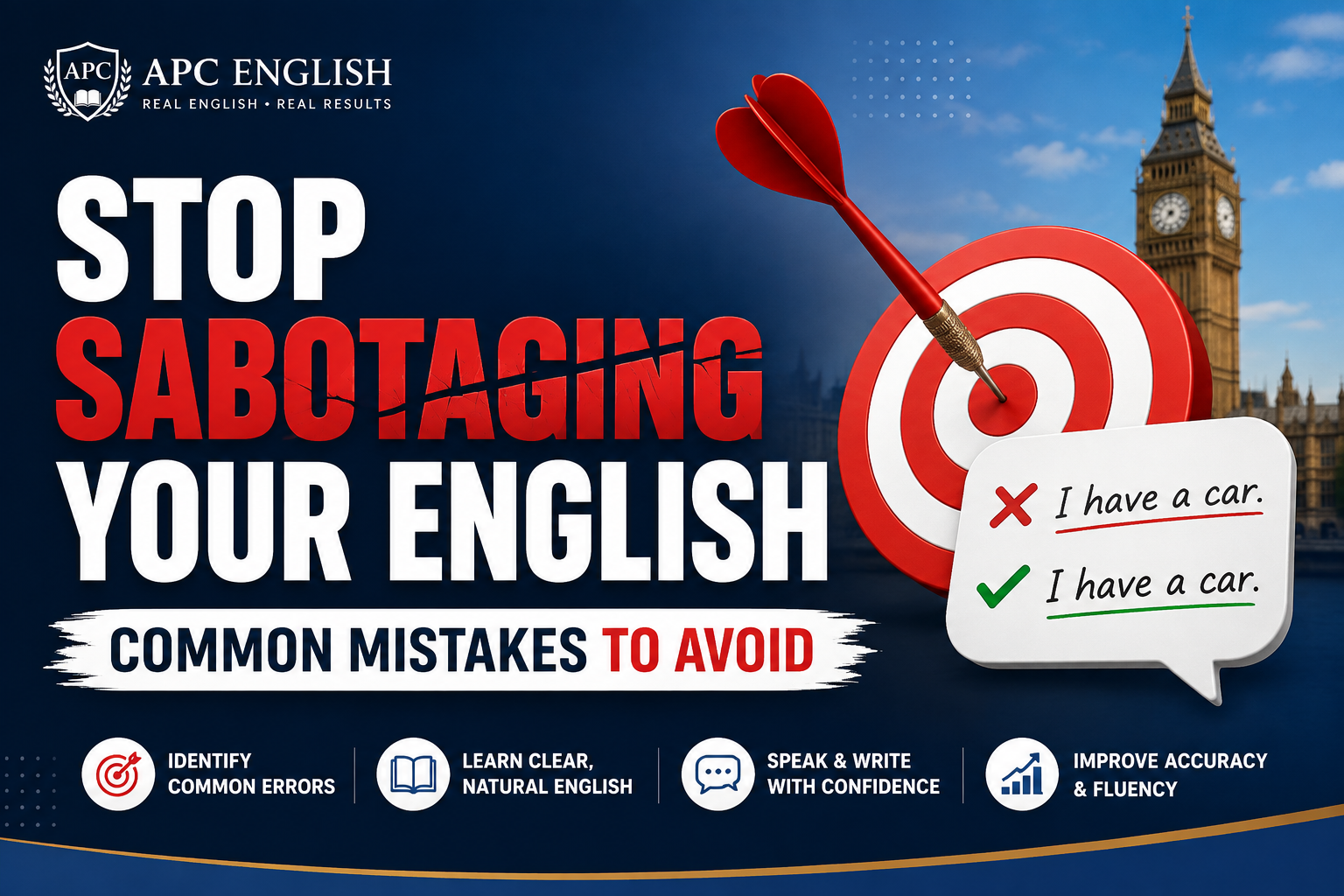
Stop Sabotaging Your English: Common English Mistakes to Avoid and Speak More Naturally
Corso

Stop Sabotaging Your English: Common English Mistakes to Avoid and Speak More Naturally

Stop Sabotaging Your English — Common Mistakes to AvoidImprove your English by identifying and fixing the most common mistakes that make your speaking and writing sound unnatural, unclear, or less confident.Course ObjectiveBy the end of this course, learners will be able to:identify common mistakes that make English sound unnatural or unclear;recognize the difference between incorrect and natural English;avoid common grammar, vocabulary, pronunciation, and sentence-structure mistakes;improve the accuracy and naturalness of their spoken and written English;become more confident when communicating in everyday situations.Course StructureIntroduction — What Is Sabotaging Your English?Translating Directly from Your Native LanguageConfusing “Do” and “Make”Confusing “Say”, “Tell”, “Speak” and “Talk”Misusing “Have” and “Be”Articles — “A”, “An” and “The”Countable and Uncountable NounsConfusing “Much”, “Many”, “A Lot”, “Few” and “Little”Prepositions — The Small Words That Cause Big ProblemsWord Order — Building Natural English SentencesQuestions — Stop Asking Questions the Wrong WayNegatives — “Don’t”, “Doesn’t”, “Didn’t” and MorePresent Simple vs. Present ContinuousPast Simple — Common MistakesPresent Perfect vs. Past Simple“For” vs. “Since”Modal Verbs — Can, Could, Should, Must, Have to“Must” vs. “Have to”“Can”, “Could” and Polite EnglishFalse Friends — Words That Look Familiar but Mislead YouVocabulary Mistakes — Choosing the Wrong WordPronunciation MistakesThe “-ED” Pronunciation TrapThe “TH” SoundPronunciation vs. Accent“Very”, “Really”, “So” and “Too”Common Adjective MistakesCommon Mistakes with “People”, “Person”, “Man” and “Human”Common Mistakes with “Good”, “Well”, “Bad” and “Badly”Common Mistakes with “Know”, “Know How”, “Meet” and “Know Someone”Common Conversation MistakesStop Speaking English Like a TranslationCommon Mistakes in Everyday SituationsWriting Mistakes That Also Affect SpeakingCommon Mistakes in Email and MessagingThe Most Common “Beginner” MistakesThe Most Common “Intermediate” MistakesHow to Fix a Mistake Without Losing ConfidencePersonal Error ChecklistCourse ConclusionContinue Learning with APC1. Introduction — What Is Sabotaging Your English?Making mistakes is a normal part of learning a language. The problem is not making mistakes. The problem is repeating the same mistakes so often that they begin to affect the way your English sounds.Some mistakes are small and may not prevent people from understanding you. However, when they are repeated frequently, they can make your English sound unnatural, unclear, or less confident.This course focuses on the mistakes that learners are most likely to repeat and the practical changes that can make their English clearer and more natural.Why Small Mistakes MatterA small grammatical or vocabulary mistake may seem unimportant when it happens once. But repeated mistakes become part of your speaking habits.The goal is therefore not to eliminate every possible mistake immediately. Instead, the goal is to identify the mistakes that affect your communication most and gradually replace them with correct and natural patterns.Accuracy vs. Natural EnglishCorrect English and natural English are closely related, but they are not always exactly the same.A sentence can sometimes be understandable and technically possible, while still sounding unusual to a native or proficient English speaker.This course therefore focuses on both:AccuracyUsing the correct grammar, vocabulary, pronunciation, and sentence structure.Natural EnglishExpressing the same idea in a way that sounds normal and appropriate in real communication.Mistakes Are Part of LearningMaking mistakes does not mean that you are failing. Mistakes show you where your current knowledge is still developing.The important thing is to notice repeated mistakes, understand why they happen, and learn a better way to express the same idea.The purpose of this course is therefore not to make you afraid of making mistakes. It is to help you become more aware of them and more confident about correcting them.Which Mistakes Should You Prioritize?Not every mistake deserves the same amount of attention.Prioritize mistakes that:you repeat frequently;change or confuse the meaning of your sentence;make your English sound noticeably unnatural;appear in everyday conversations;continue even after you have learned the correct form.Correcting a small number of repeated mistakes can often make a much bigger difference than trying to memorize hundreds of isolated grammar rules.How to Use This CourseEach section focuses on a specific type of mistake. You will see the incorrect form, the correct form, an explanation, and practical examples.Pay particular attention to mistakes that you recognize in your own English. These are the ones that will give you the greatest benefit when corrected.As you progress through the course, try to notice the same patterns in your own speaking and writing. The goal is not only to recognize mistakes in the lesson, but also to stop repeating them in real communication.Next StepOne of the biggest sources of English mistakes is translating directly from another language.In the next section, we will look at why word-for-word translation often produces English that is understandable but unnatural.2. Translating Directly from Your Native LanguageOne of the most common sources of English mistakes is translating directly from your native language.When learners build an English sentence by translating each word separately from another language, the result may be understandable but still sound unnatural or incorrect.This happens because languages do not always organize ideas in the same way. A sentence that is perfectly natural in one language may require a completely different structure in English.Why Word-for-Word Translation Causes ProblemsWord-for-word translation can lead to mistakes in grammar, vocabulary, sentence structure, prepositions, and common expressions.The main problem is that learners translate the words first instead of thinking about how the idea is normally expressed in English.English has its own patterns, combinations, and expressions. Learning these patterns directly is much more effective than trying to reproduce the structure of another language in English.English Sentence Patterns vs. Other Language PatternsLearners often make mistakes because their native language and English express the same idea in different ways.A learner may know the meaning of every individual English word but still produce a sentence that does not follow a natural English structure.The solution is not to translate faster. The solution is to learn common English expressions and sentence patterns as complete units.Expressions That Cannot Be Translated LiterallyMany everyday English expressions cannot be translated word for word. English may use a completely different verb, structure, or combination of words to express the same idea.This is especially common with expressions related to age, activities, physical states, daily routines, and social interaction.Common Literal Translation — Talking About Age❌ I have 20 years.✅ I am 20 years old.In natural English, age is normally expressed with the verb be, not have.The same structure can be used with different ages:I am 18 years old.She is 30 years old.They are 25 years old.Common Literal Translation — Talking About Sports❌ I make sport.✅ I play sports.✅ I exercise every morning.English uses different expressions depending on what you mean. The verb make is not normally used to express the general idea of doing or playing sports.Learn Ideas, Not Individual TranslationsInstead of memorizing isolated translations, learn the complete English expression that communicates the idea.❌ I have 20 years.✅ I am 20 years old.❌ I make sport.✅ I play sports.Learning complete expressions makes your English more natural and reduces the need to translate every sentence in your head.How to Think in English InsteadThinking directly in English does not mean that you must stop using your native language immediately. It means gradually learning common English structures so that you can recall them directly.A useful progression is:Understand the idea.Learn the natural English expression.Notice the sentence pattern.Reuse the pattern with new vocabulary.Build Expressions as Complete UnitsInstead of learning only individual words, learn combinations that naturally occur together.be + ageI am 20 years old.play + sportsI play sports.Why This Is ImportantThe more natural English patterns you learn, the less you need to translate sentence by sentence.Over time, common expressions become easier to recall automatically. This makes your speaking faster, clearer, and more natural.Next StepDirect translation is not the only source of unnatural English. Another major problem is choosing between words that seem similar but are used in different ways.One of the most important examples is the difference between do and make.3. Confusing “Do” and “Make”Do and make are two of the most common verbs in English, but learners often confuse them because they can express similar general ideas in other languages.The difficulty is that English uses do and make in different combinations. Learning these combinations is essential for sounding natural.Do vs. MakeAs a general guideline, do is often associated with activities, tasks, work, or actions, while make is often associated with creating, producing, preparing, or causing something.These are useful general patterns, but they are not absolute rules. Many expressions simply need to be learned as natural word combinations.Common Expressions with DoHere are some common expressions using do:do homeworkdo exercisedo the dishesDo HomeworkEnglish uses do with homework.I do my homework every evening.This is the standard expression. The verb make is not used in this combination.Do ExerciseEnglish can use do when referring to exercise as a physical activity.I do exercise every morning.In everyday English, the shorter form is often more natural:I exercise every morning.Do the DishesThe common household expression is:I do the dishes after dinner.This combination should be learned as a complete English expression.Common Expressions with MakeHere are some common expressions using make:make a mistakemake a decisionmake a planMake a MistakeEnglish uses make when talking about making a mistake.I made a mistake.Make a DecisionThe standard expression is:We need to make a decision.Make a PlanEnglish also uses make with plans.Let's make a plan.Expressions Learners Often Translate IncorrectlyLearners may try to use the same English verb in different expressions because their native language may use one verb where English uses several different combinations.do your homeworkdo exercisemake a mistakemake a decisionmake a planCompare the Patternsdo + activity / taskdo homeworkdo exercisedo the dishesmake + result / creation / decisionmake a mistakemake a decisionmake a planDo and Make in Complete SentencesI do my homework after school.I exercise every morning.We do the dishes after dinner.He made a mistake.They made a decision yesterday.We need to make a plan.Do or Make?When you are unsure, do not translate the verb directly from your native language. Instead, ask yourself which English expression normally goes with the noun or activity.Learning common word combinations, also known as collocations, is one of the best ways to avoid these mistakes.Learn the whole expression:do homeworkmake a mistakemake a decisionAvoid Word-for-Word TranslationThe safest approach is to learn common combinations as natural English units rather than trying to translate a verb every time.Instead of asking: “What verb should I translate here?”ask: “Which English expression is normally used here?”Next StepYou have now seen why direct translation can create unnatural English and why do and make cannot always be used interchangeably.Next, we will look at another group of verbs that learners frequently confuse: say, tell, speak and talk.4. Confusing “Say”, “Tell”, “Speak” and “Talk”Say, tell, speak, and talk are all common English verbs related to communication. However, they are not normally used in exactly the same way.Learners often confuse these verbs because they can all be translated with words related to speaking in other languages. The key is to learn the structures that normally accompany each verb.SaySay focuses mainly on the words or information that someone produces.say + somethingShe said hello.We commonly use say when the thing being said is important or when we want to report someone's words.What did he say?She said that she was tired.He said hello.TellTell usually focuses on giving information to a person. It is normally followed directly by the person receiving the information.tell + person + somethingTell me the truth.Tell me your name.She told me the truth.He told his friend the news.SpeakSpeak is commonly used when referring to the ability to use a language, to address someone in a formal context, or to refer to the act of speaking.speak + languageI speak English.She speaks Spanish.Can I speak to the manager?He spoke to the students.TalkTalk is commonly used for conversations and communication between people. It is especially common in informal everyday English.talk to / talk with + personI talked to my friend.We talked about the movie.She is talking to her brother.They talked for an hour.Compare the Four VerbsVerbCommon PatternTypical Usesaysay + somethingfocus on the words or informationtelltell + person + somethinggive information to someonespeakspeak + language / speak tolanguage, formal communication, speakingtalktalk to / talk aboutconversation and informal communicationCommon Learner ErrorsOne of the most common mistakes is using the wrong structure after the verb.❌ She said me the truth.✅ She told me the truth.❌ He told that he was tired.✅ He said that he was tired.❌ I told hello.✅ I said hello.Say vs. TellA useful distinction is:say + somethingShe said something interesting.tell + someone + somethingShe told me something interesting.Speak vs. TalkSpeak is often used for languages and can sound more formal in certain situations. Talk is very common when referring to everyday conversation.I speak English.I talked to my friend yesterday.She spoke to the manager.We talked about the problem.Useful Structures to Remembersay + somethingsay hellosay somethingsay that...tell + someone + somethingtell metell hertell themspeak + language / speak to + personspeak Englishspeak to the teachertalk to / talk abouttalk to my friendtalk about workNext StepThe difference between say, tell, speak, and talk becomes much easier once you learn their common sentence patterns.Next, we will look at another major source of mistakes: confusing have and be.[[NEW_PAGE]]5. Misusing “Have” and “Be”Have and be are two of the most important verbs in English, but learners sometimes use one when English requires the other.This is especially common when another language expresses an idea differently from English. Learning the English structure directly can prevent many repeated mistakes.Have vs. BeAs a general rule, have is commonly used for possession and certain fixed expressions, while be is commonly used for identity, age, feelings, conditions, and descriptions.Talking About AgeIn English, age is expressed with the verb be.❌ I have 25 years.✅ I am 25 years old.The same structure is used with other subjects:She is 18 years old.He is 40 years old.They are 30 years old.Talking About Feelings and Physical StatesEnglish commonly uses be for many feelings and physical states.✅ I am hungry.✅ I am thirsty.✅ I am tired.✅ I am cold.These expressions use be rather than have.Talking About PossessionUse have to talk about possession, relationships, or things that someone possesses.I have a car.She has a new phone.We have two children.Common Expressions with BeMany common English expressions use forms of be.I am hungry.I am thirsty.I am tired.She is afraid.They are ready.Common Expressions with HaveEnglish also uses have in many fixed expressions. These combinations should be learned as complete expressions.have a carhave breakfasthave a showerhave a problemhave a questionCompare the Two PatternsBe + feeling / stateI am hungry.Have + possessionI have a car.Common Learner Errors❌ I have hungry.✅ I am hungry.❌ I have 25 years.✅ I am 25 years old.❌ I am a car.✅ I have a car.Three Ideas to RememberAge → beI am 25 years old.Feelings and physical states → beI am hungry.Possession → haveI have a car.Do Not Translate the Structure DirectlyWhen learning an expression, focus on the English structure rather than choosing the verb by translating it word for word from another language.Ask yourself: “How is this idea normally expressed in English?”Useful Sentence PatternsSubject + be + adjectiveI am tired.Subject + be + ageI am 25 years old.Subject + have + nounI have a car.Subject + have + common expressionI have breakfast at 8 o'clock.Build Natural English HabitsThe best way to avoid confusing have and be is to learn common expressions as complete patterns and reuse them regularly.I am hungry.I am tired.I am 25 years old.I have a car.I have a question.Next StepYou have now seen why have and be cannot always be chosen by translating directly from another language.Next, we will examine another major area of English mistakes: a, an, and the.6. Articles — “A”, “An” and “The”Articles are small words, but they are one of the most common sources of mistakes for English learners.English mainly uses three articles: a, an, and the. In some situations, no article is used at all.Learning when to use each form is essential for producing clear and natural English.“A”Use a before a singular countable noun when you are referring to one non-specific person or thing.a + singular countable nouna booka cara teacherFor example:I bought a book.“An”Use an instead of a before a singular countable noun when the following word begins with a vowel sound.an + singular countable nounan applean orangean interesting bookThe important point is the sound, not simply the spelling of the word.“The”Use the when the person or thing is specific or already known to the listener or reader.the + specific nounthe bookthe carthe teacherFirst Mention vs. Known InformationOne of the most useful ways to understand the difference between a and the is to look at whether something is being mentioned for the first time or is already known.I saw a dog.The dog was very friendly.The first sentence introduces the dog, so a is used. Once the dog is identified, the can be used because both people know which dog is being discussed.Singular Countable NounsA singular countable noun generally needs a determiner such as a, an, or the when used in a normal sentence.✅ I bought a car.✅ The car is new.✅ My car is outside.❌ I bought car.No ArticleEnglish sometimes uses no article when speaking about things in a general sense, especially with plural countable nouns and many uncountable nouns.Books are useful.Water is important.Students need practice.The meaning changes when the reference becomes specific.Books are useful.The books on this table are useful.Common MistakesLearners often forget an article, use the wrong article, or use a or an when the noun is specific.❌ I bought car.✅ I bought a car.❌ She is teacher.✅ She is a teacher.❌ I saw dog. Dog was friendly.✅ I saw a dog. The dog was friendly.Useful Patterns to Remembera + singular countable nouna studentan + singular countable noun beginning with a vowel soundan applethe + specific or already known nounthe studentno article + general plural or uncountable nounStudents need practice.A Simple Decision ProcessWhen you are unsure which article to use, ask yourself a few questions:Is the noun singular and countable?Am I talking about one non-specific thing?Is the thing specific or already known?Am I speaking about something in general?These questions can help you choose between a, an, the, and no article.Next StepArticles are closely connected to another important topic: whether a noun can be counted or not.Next, we will examine countable and uncountable nouns, including much, many, few, little, some, and any.7. Countable and Uncountable NounsUnderstanding whether a noun is countable or uncountable is essential for choosing the correct words around it.This distinction affects which determiners and quantifiers you can use, including many, much, few, little, some, and any.Countable NounsCountable nouns refer to things that can be counted as separate units. They have singular and plural forms.one book → two booksone car → three carsone student → many studentsA singular countable noun can normally be used with a, an, or another determiner.a bookan applethe studentUncountable NounsUncountable nouns refer to substances, concepts, information, materials, or things that are not normally treated as separate individual units.informationadvicewatermoneyThese nouns are generally not used with a or an when referring to the substance or concept in general.ManyUse many with plural countable nouns.many + plural countable nounmany booksmany studentsmany questionsMuchUse much with uncountable nouns.much + uncountable nounmuch informationmuch moneymuch timeFew and A FewUse few and a few with plural countable nouns.few booksvery small number of booksa few bookssome books; a small number of booksLittle and A LittleUse little and a little with uncountable nouns.little timealmost no timea little timesome timeSomeSome can be used with both plural countable nouns and uncountable nouns.some bookssome informationsome adviceAnyAny is commonly used in questions and negative sentences with plural countable and uncountable nouns.Do you have any questions?I don't have any money.We don't have any information.Common Vocabulary MistakesSome nouns that may look countable to learners are normally uncountable in English.A very common example is advice.❌ an advice❌ advices✅ some advice✅ a piece of adviceSome Advice vs. A Piece of AdviceAdvice is normally uncountable, so we do not usually say an advice or two advices.some adviceShe gave me some advice.a piece of adviceHe gave me a useful piece of advice.Many BooksBooks are countable, so use many with them.many booksI have many books.Much InformationInformation is uncountable, so use much when the context requires it.much informationWe don't have much information.Some Advicesome adviceCan you give me some advice?A Piece of Advicea piece of adviceLet me give you a piece of advice.Quick ComparisonExpressionTypeExamplemanyplural countablemany booksmuchuncountablemuch informationfewplural countablefew bookslittleuncountablelittle timesomecountable plural / uncountablesome adviceanycountable plural / uncountableany informationA Simple Rule to RememberAsk yourself whether the noun can normally be counted as separate units.Countable:one book → two books → many booksUncountable:information → much informationOnce you identify the noun type, choosing words such as many, much, few, and little becomes much easier.Next StepNow that you understand the difference between countable and uncountable nouns, we can look more closely at one of the most common areas of confusion: much, many, a lot, few, and little.8. Confusing “Much”, “Many”, “A Lot”, “Few” and “Little”Words such as much, many, a lot of, few, and little are used to talk about quantity.The main difficulty is knowing which expressions can be used with countable nouns and which ones are used with uncountable nouns. The meaning can also change depending on whether the quantity is presented as large, small, sufficient, or insufficient.Many + Countable NounsUse many with plural countable nouns.many + plural countable nounmany booksmany studentsmany questionsFor example:There are many students in the classroom.Much + Uncountable NounsUse much with uncountable nouns.much + uncountable nounmuch informationmuch moneymuch timeFor example:We don't have much time.A Lot ofA lot of can be used with both plural countable nouns and uncountable nouns.a lot of booksa lot of informationa lot of peoplea lot of moneyIt is especially common in everyday English.She has a lot of friends.We have a lot of work.Few vs. A FewUse few and a few with plural countable nouns.few booksalmost no books; a very small numbera few bookssome books; a small numberThe presence of a changes the meaning and tone. Few often suggests that the number is smaller than expected or insufficient, while a few usually presents the small number more positively or neutrally.FewFew people came to the meeting.This suggests that the number was very small.A FewA few people came to the meeting.This means that some people came, even though the number was small.Little vs. A LittleUse little and a little with uncountable nouns.little timealmost no time; not enough timea little timesome time; a small amount of timeLittleWe have little time.This suggests that there is almost no time available.A LittleWe have a little time.This means that some time is available, even though the amount is small.Difference in MeaningThe difference between few and a few, or between little and a little, is not simply grammatical. It also changes the meaning of the sentence.Few students passed the exam.Almost no students passed.A few students passed the exam.Some students passed.There is little water left.Almost no water is left.There is a little water left.Some water is still available.Quick ComparisonExpressionNoun TypeGeneral Meaningmanyplural countablea large numbermuchuncountablea large amounta lot ofcountable / uncountablea large quantityfewplural countablealmost none / very small numbera fewplural countablesome / small numberlittleuncountablealmost none / very small amounta littleuncountablesome / small amountCommon Mistakes❌ much books✅ many books❌ many information✅ much information❌ little students✅ few students❌ few time✅ little timeLearn the Noun Type FirstBefore choosing a quantity expression, first identify whether the noun is countable or uncountable.Countable: books → many books / a few booksUncountable: information → much information / a little informationNext StepQuantity words become much easier when you recognize the type of noun and understand the difference in meaning between similar expressions.Next, we will examine another small group of words that causes many mistakes: prepositions.9. Prepositions — The Small Words That Cause Big ProblemsPrepositions are short words, but they are responsible for many common English mistakes.Words such as in, on, at, to, for, from, by, and with may look simple, but their correct use depends heavily on context and common expressions.The best way to learn many prepositions is to study them in complete phrases rather than trying to memorize one translation for each word.InIn is commonly used with enclosed spaces, areas, months, years, and longer periods of time.in a carin the housein Julyin 2026OnOn is commonly used with days and dates and with certain surfaces and forms of transportation.on Mondayon July 5on the tableon a busAtAt is commonly used for specific points in time and certain locations or situations.at nightat 8 o'clockat homeat schoolToTo is commonly used to indicate movement toward a destination or another person.go to schoolgo to workgive it to meForFor can express purpose, duration, or the intended recipient of something.a gift for youfor two hourssomething for workFromFrom commonly indicates origin, starting point, or source.I am from Spain.The train comes from London.from Monday to FridayByBy has several uses. It can indicate the method of transportation, the person responsible for an action, or a deadline.by busby traina book by Shakespeareby tomorrowWithWith commonly indicates accompaniment, a tool, or a person or thing involved in an action.with my friendwrite with a pencoffee with milkPrepositions of TimeEnglish commonly uses at, on, and in differently when talking about time.PrepositionTypical UseExampleatspecific time / certain expressionsat 8 o'clock / at nightondays / dateson Mondayinmonths / years / longer periodsin July / in 2026Prepositions of PlaceIn, on, and at can also describe location, but the correct choice depends on the relationship between the person or object and the place.in the roomon the tableat homePrepositions of MovementTo is commonly used to indicate movement toward a destination.go + to + destinationI go to school every morning.Notice that the preposition is part of the complete expression.Prepositions and TransportationEnglish uses different prepositions depending on the type of transportation.in a carin a taxion a buson a trainCommon Expressions with PrepositionsSome combinations should be learned as complete expressions because their prepositions cannot always be predicted from another language.at nighton Mondayin Julyat homein a caron a busCommon Learner Mistakes❌ in Monday✅ on Monday❌ on July✅ in July❌ in night✅ at night❌ on a car✅ in a carDo Not Translate Prepositions Word for WordOne of the most important lessons about prepositions is that a preposition in one language does not always correspond to the same preposition in English.Instead of memorizing isolated translations, learn common combinations as complete English expressions.Learn the whole expression:at nighton Mondayin Julyat homein a caron a busA Practical Learning StrategyWhen you encounter a new preposition, learn it together with the words around it.Instead of learning only: atlearn: at night, at home, at school.Instead of learning only: onlearn: on Monday, on a bus, on the table.Next StepPrepositions may be small words, but using them correctly makes a major difference to the naturalness of your English.Next, we will examine another important source of unnatural English: word order and how to build natural English sentences.[[NEW_PAGE]]10. Word Order — Building Natural English SentencesEnglish word order is relatively structured. The position of words in a sentence helps communicate who is performing an action, what is happening, and what information is being emphasized.Learners often make mistakes when they transfer the word order of their native language directly into English. A sentence may contain the correct words but still sound unnatural because those words are placed in the wrong positions.Basic English Sentence StructureA very common English sentence pattern is:Subject + Verb + ObjectShe speaks English.This structure appears in a large number of everyday English sentences.I read books.They play football.We study English.Adjective PlacementIn English, adjectives generally come before the noun they describe.adjective + nouna beautiful housean interesting booka new carThis is an important pattern to recognize when building sentences.She has a beautiful house.He bought a new car.It is an interesting book.Adverb PlacementAdverbs can appear in different positions depending on what they modify. Their position is therefore important for natural English.With many common adverbs, placing the adverb in the wrong position can make a sentence sound unnatural.❌ I very like English.✅ I really like English.The problem is not simply the word very. The sentence needs a natural adverb structure. In this context, really is the natural choice.Adverbs with VerbsMany adverbs can appear after the verb or after the object, depending on the sentence.She speaks English very well.He works very quickly.They speak English fluently.Common Word-Order Error❌ She speaks very well English.✅ She speaks English very well.The object English normally comes directly after the verb, while very well comes after the object in this sentence.Question StructureEnglish questions often require an auxiliary verb before the subject. The exact structure depends on the verb and the tense.Common auxiliary and helping verbs include: do, does, did, am, is, are, have, has, and modal verbs.Questions with Do and DoesDo / Does + subject + base verb?Do you like English?Does she work here?Questions with DidDid + subject + base verb?Did you go yesterday?Questions with BeAm / Is / Are + subject + ...?Are you ready?Is she at home?Questions with Have and HasHave / Has + subject + ...?Have you finished?Has he arrived?Questions with Modal VerbsModal + subject + base verb?Can you help me?Should we leave now?Question-Word OrderWhen a question begins with a question word such as what, where, when, why, or how, the auxiliary or helping verb normally comes before the subject.Question word + auxiliary + subject + verb?Where do you live?Negative SentencesNegative sentences also follow specific word-order patterns. Auxiliary verbs such as do, does, and did usually appear before not when they are needed.I do not understand.She does not work here.They did not come yesterday.Common Word-Order ErrorsHere are some mistakes that can make otherwise understandable English sound unnatural.❌ I very like English.✅ I really like English.❌ She speaks very well English.✅ She speaks English very well.❌ Where you live?✅ Where do you live?❌ What you are doing?✅ What are you doing?A Simple Word-Order ChecklistWhen building an English sentence, check the basic structure first.Who is the subject?What is the main verb?Do I need an object?Do I need an auxiliary or modal verb?Where should the adverb go?Is the sentence in the correct question or negative structure?Build Sentences Step by StepStart with the basic structure and then add more information.Subject + verbShe works.Subject + verb + objectShe speaks English.Subject + verb + object + adverbShe speaks English very well.Think in Patterns, Not Individual WordsNatural English comes from learning how words work together. Instead of memorizing isolated words and trying to arrange them later, learn common sentence patterns as complete structures.I really like English.She speaks English very well.Where do you live?What are you doing?Next StepCorrect word order is especially important when asking questions. Even when all the individual words are correct, placing them in the wrong order can make the question sound unnatural or incorrect.Next, we will focus specifically on question formation and the most common mistakes with do, does, did, be, have, and modal verbs.11. Questions — Stop Asking Questions the Wrong WayQuestions are essential for real communication. We use them to get information, start conversations, clarify ideas, ask for help, and keep a conversation going.Many learners know the words they want to use but put them in the wrong order. English question structures are therefore worth learning as complete patterns.Questions with DoUse do with the subjects I, you, we, and they in many present simple questions.Do + subject + base verb?Do you like English?Do they work here?Questions with DoesUse does with he, she, and it in many present simple questions.Does + subject + base verb?Does she speak English?Does he live here?Notice that the main verb returns to its base form after does.She speaks English.Does she speak English?Questions with DidUse did for many past simple questions.Did + subject + base verb?Did you go yesterday?Did she call you?After did, the main verb remains in its base form.❌ Did you went?✅ Did you go?Questions with Am, Is and AreWhen be is the main verb or helping verb, it moves before the subject in many questions.Are you ready?Is she at home?Are they working?Questions with Have and HasHave and has can function as auxiliary verbs in questions, especially with the present perfect.Have you finished?Has he arrived?Have they eaten?Questions with Modal VerbsModal verbs such as can, could, should, must, and might come before the subject in questions.Modal + subject + base verb?Can you help me?Could you repeat that?Should we leave now?Question-Word OrderCommon question words include: what, where, when, why, who, and how.When an auxiliary or helping verb is required, the usual pattern is:Question word + auxiliary + subject + main verb?Where do you live?Common Question Mistakes❌ You like English?✅ Do you like English?❌ Where you are going?✅ Where are you going?❌ What you do?✅ What do you do?❌ Why she is tired?✅ Why is she tired?Do Not Add an Extra AuxiliaryWhen be is already functioning as the auxiliary, do not add do or does.❌ Do you are ready?✅ Are you ready?❌ Does she is working?✅ Is she working?Questions in Everyday ConversationCorrect question formation is especially important in everyday communication because questions appear in almost every conversation.What do you do?Where do you live?What are you doing?Did you enjoy it?Can you help me?A Simple Question ChecklistBefore asking a question, identify which structure you need.Is the main verb be?Do I need do or does?Am I asking about the past and need did?Do I need have or has?Am I using a modal verb?Where does the question word go?Learn Questions as Complete PatternsInstead of memorizing isolated question words, learn complete structures that you can immediately reuse.Do you + verb...?Do you speak English?Where do you + verb...?Where do you live?What are you + verb-ing...?What are you doing?Can you + base verb...?Can you help me?Next StepYou now know the main structures used to form English questions with do, does, did, be, have, has, and modal verbs.Next, we will examine negative sentences and the common mistakes learners make with don't, doesn't, didn't, isn't, aren't, and other negative forms.12. Negatives — “Don’t”, “Doesn’t”, “Didn’t” and MoreNegative sentences are essential for everyday English. We use them to say that something is not true, that something does not happen, that something did not happen, or that someone is not able or willing to do something.English uses different negative forms depending on the subject, tense, and auxiliary or helping verb. Using the wrong negative form can make a sentence incorrect or unclear.Don'tUse don't with I, you, we, and they in many present simple negative sentences.Subject + don't + base verbI don't understand.They don't work here.Doesn'tUse doesn't with he, she, and it in many present simple negative sentences.Subject + doesn't + base verbShe doesn't like coffee.He doesn't work here.Notice that the main verb stays in its base form after doesn't.She likes coffee.She doesn't like coffee.Didn'tUse didn't for many past simple negative sentences.Subject + didn't + base verbI didn't go yesterday.They didn't call me.As with doesn't, the main verb remains in the base form after didn't.❌ I didn't went.✅ I didn't go.Isn'tIsn't is the contracted form of is not. It is used with he, she, and it, and with singular nouns when be is required.He isn't ready.She isn't at home.The door isn't open.Aren'tAren't is the contracted form of are not. It is used with you, we, and they, as well as plural nouns.You aren't late.We aren't ready.They aren't at home.Wasn'tWasn't is the contracted form of was not.I wasn't tired.She wasn't at school.He wasn't ready.Weren'tWeren't is the contracted form of were not.We weren't late.They weren't tired.You weren't there.Haven'tHaven't is the contracted form of have not. It is commonly used with the present perfect.I haven't finished.We haven't seen him.They haven't arrived yet.Can'tCan't is the contracted form of cannot. It is commonly used to express inability, lack of possibility, or lack of permission depending on context.I can't swim.She can't come today.We can't park here.Shouldn'tShouldn't is the contracted form of should not. It is commonly used to give advice about something that is not recommended.You shouldn't worry.He shouldn't drive so fast.We shouldn't be late.Common Negative StructuresNegative FormCommon UseExampledon'tpresent simpleI don't know.doesn'tpresent simple, third person singularShe doesn't know.didn'tpast simpleThey didn't come.isn'tbe, singularHe isn't ready.aren'tbe, plural / youThey aren't ready.wasn'tpast be, singularShe wasn't there.weren'tpast be, plural / youWe weren't there.haven'tpresent perfectI haven't finished.can'tability / possibility / permissionI can't come.shouldn'tadviceYou shouldn't worry.Common Errors — Wrong AuxiliaryOne of the most common mistakes is using the wrong auxiliary verb for the sentence structure.❌ She don't like coffee.✅ She doesn't like coffee.❌ He don't understand.✅ He doesn't understand.❌ They doesn't work here.✅ They don't work here.Common Errors — Wrong Verb FormAfter don't, doesn't, or didn't, the main verb remains in the base form.❌ She doesn't likes English.✅ She doesn't like English.❌ He didn't went home.✅ He didn't go home.Common Errors — Wrong TenseThe negative form must match the time being discussed.Present:I don't work on Sundays.Past:I didn't work yesterday.Double NegativesStandard English generally avoids using two negative elements in the same clause to express a single negative meaning.❌ I don't know nothing.✅ I don't know anything.❌ She didn't see nobody.✅ She didn't see anybody.In some varieties of English, double negatives can have different functions or meanings, but for standard English learning, it is safer to avoid them.Negative Questions and StatementsNegative forms can also appear in questions.Don't you like English?Doesn't she work here?Didn't they call you?Isn't he ready?Learn Negative Forms as PatternsInstead of memorizing the negative words separately, learn the complete sentence structures.Subject + don't + base verbI don't understand.Subject + doesn't + base verbShe doesn't understand.Subject + didn't + base verbThey didn't understand.Subject + be + notHe isn't ready.Subject + modal + not + base verbYou shouldn't worry.Next StepNegative sentences become much easier when you identify the correct auxiliary, tense, and subject before choosing the negative form.Next, we will examine one of the most important distinctions in English: the difference between the present simple and the present continuous.13. Present Simple vs. Present ContinuousThe present simple and the present continuous are two of the most important verb forms in English.Learners often confuse them because both can describe situations happening around the present. The key is to understand whether you are talking about a habit, a general fact, a temporary situation, or something happening now.Present SimpleThe present simple is commonly used for habits, routines, general facts, repeated actions, and situations that are generally true.Habits and RoutinesI work every day.This describes a regular activity or routine.She goes to school every morning.We play football on Saturdays.He usually drinks coffee in the morning.Facts and General TruthsThe present simple is also used for facts, general truths, and situations that are not limited to the current moment.Water boils at 100°C.The Earth goes around the Sun.She lives in London.Present ContinuousThe present continuous is commonly used for actions happening now, around the current moment, and for temporary situations.Subject + am / is / are + verb-ingI am working.She is studying.They are talking.Actions Happening NowI am working now.She is talking on the phone.They are studying at the moment.Temporary SituationsThe present continuous can also describe situations that are temporary rather than permanent or habitual.I am staying with my friend this week.She is working in Paris this month.Compare the Two TensesI work every day.This describes a routine or habit.I am working now.This describes an action happening at the present moment.Another Useful ComparisonShe works in a bank.This is a general fact about her job.She is working now.This describes what she is doing at the moment.Stative VerbsSome verbs normally describe states rather than actions. These verbs are often not used in the continuous form when they describe a current state.Common examples include: know, like, want, need, and understand.✅ I know the answer.❌ I am knowing the answer.✅ I like this book.❌ I am liking this book.Common Mistakes❌ I am work every day.✅ I work every day.❌ I work now.✅ I am working now.❌ She is knowing the answer.✅ She knows the answer.Time ExpressionsCertain time expressions can help you recognize which tense is appropriate, although the context is always more important than the word itself.Present Simpleevery day, usually, often, always, sometimesPresent Continuousnow, at the moment, currently, todayA Simple Decision ProcessAsk whether the action is a habit or general fact.Ask whether the action is happening now.Ask whether the situation is temporary.Check whether the verb normally describes a state.Compare the Main PatternsPresent SimpleSubject + base verbI work every day.Present ContinuousSubject + am / is / are + verb-ingI am working now.The Key DifferenceI work every day.Habit or routine.I am working now.Action happening now.Learning this difference will help you describe everyday activities, current actions, routines, temporary situations, and general facts much more accurately.Next StepYou now know how to distinguish routines and general facts from actions happening now and temporary situations.Next, we will examine the past simple and the mistakes learners commonly make when talking about past events.14. Past Simple — Common MistakesThe past simple is one of the most important verb forms for talking about completed actions and events in the past.Learners often make mistakes with the past simple because regular and irregular verbs follow different patterns, and because the auxiliary did changes the form used in questions and negative sentences.Regular VerbsRegular verbs usually form the past simple by adding -ed to the base form.work → workedplay → playedwatch → watchedFor example:I worked yesterday.Irregular VerbsIrregular verbs do not follow the regular -ed pattern. Their past forms must be learned individually.go → wentsee → sawhave → hadeat → atetake → tookDid + Base VerbOne of the most important rules to remember is that after did, the main verb returns to its base form.Did + subject + base verb?Did you go?Do not use the past form of the main verb after did.❌ Did you went?✅ Did you go?Past Simple QuestionsFor many past simple questions, use did + subject + base verb.Did you work yesterday?Did she call you?Did they arrive on time?Past Simple NegativesNegative past simple sentences commonly use did not or the contraction didn't.Subject + didn't + base verbI didn't go.❌ She didn't went home.✅ She didn't go home.❌ They didn't saw him.✅ They didn't see him.Time ExpressionsThe past simple is often used with expressions that clearly refer to a completed past time.yesterdaylast weeklast yeartwo days agoin 2020Common Mistakes with Regular VerbsA common mistake is using did together with the past form of a regular verb.❌ Did you worked yesterday?✅ Did you work yesterday?Common Mistakes with Irregular VerbsLearners sometimes use the infinitive after a normal affirmative past-tense sentence or use the past form after did.❌ Yesterday I go to work.✅ Yesterday I went to work.❌ Did you went to work?✅ Did you go to work?Affirmative vs. QuestionAffirmative:I went to school.Question:Did you go to school?Notice that went changes back to go after did.Affirmative vs. NegativeAffirmative:She saw him.Negative:She didn't see him.A Simple Past Simple PatternAffirmative:Subject + past verbI worked yesterday.Question:Did + subject + base verb?Did you work yesterday?Negative:Subject + didn't + base verbI didn't work yesterday.Common Learner Errors❌ Did you went?✅ Did you go?❌ I didn't saw him.✅ I didn't see him.❌ Did she worked yesterday?✅ Did she work yesterday?❌ Yesterday I go home.✅ Yesterday I went home.Next StepThe past simple is mainly used for completed past events. However, English also has another important past-related form: the present perfect.Next, we will compare the present perfect and the past simple and learn when each one should be used.[[NEW_PAGE]]15. Present Perfect vs. Past SimpleThe present perfect and the past simple can both refer to past events, but they do not always communicate the same idea.Understanding the difference is important because learners often choose the tense by translating directly from another language instead of considering the relationship between the past event and the present.Past Simple — Completed Past EventsUse the past simple when talking about a completed event at a finished or specific time in the past.I visited London last year.She finished the book yesterday.They moved here in 2020.Present Perfect — Connection with the PresentThe present perfect is commonly used when a past event has a connection with the present, when the exact past time is not the focus, or when talking about experiences.have / has + past participleI have visited London.She has finished the book.Life ExperiencesThe present perfect is commonly used to talk about experiences without focusing on a specific completed time.I have visited Spain.She has never tried sushi.Have you ever been to London?The focus is on whether the experience has happened, not on exactly when it happened.Finished Time vs. Unfinished TimeThe choice of tense can depend on whether the time period is finished or still connected to the present.I saw him yesterday.“Yesterday” is a finished time period.I have seen him today.“Today” is still connected to the present.Recent EventsThe present perfect is often used for recent events when the result or current relevance is important.I have just finished my work.She has just arrived.Ever and NeverEver and never are commonly used with the present perfect when talking about life experiences.Have / Has + subject + ever + past participle?Have you ever visited Spain?Subject + have / has + never + past participleI have never visited Spain.Already, Yet and JustThese words frequently appear with the present perfect.I have already finished.Have you finished yet?She has just arrived.Since and ForSince and for are commonly used with the present perfect to describe situations that began in the past and continue to the present.since 2021starting pointfor five yearsdurationCompare Present Perfect and Past SimpleI visited Spain in 2022.Specific completed past time.I have visited Spain.Life experience; no specific finished time is given.Common Mistakes❌ I have seen him yesterday.✅ I saw him yesterday.❌ I went to Spain several times.✅ I have been to Spain several times.The important question is not simply “Is the action in the past?” Both tenses can refer to the past. The important question is how the speaker connects the event to the present and whether a specific finished time is given.A Useful Decision ProcessIs the event connected to a specific finished past time?Is the event a life experience without a specific time?Is the result or relevance connected to the present?Is the time period finished or still continuing?Next StepThe difference between the present perfect and the past simple becomes even clearer when talking about duration.Next, we will focus specifically on for and since.16. “For” vs. “Since”For and since are both commonly used to describe how long a situation has continued, especially with the present perfect.The main difference is simple: for introduces a duration, while since introduces a starting point.For + DurationUse for when you mention the length of time.for + period of timefor five yearsfor two hoursfor three weeksFor example:I have lived here for five years.Since + Starting PointUse since when you mention the point at which the situation began.since + starting pointsince 2021since Mondaysince last yearFor example:I have lived here since 2021.Compare For and SinceI have lived here for five years.Five years = duration.I have lived here since 2021.2021 = starting point.More Examples with ForI have worked here for three years.She has studied English for two years.We have been friends for a long time.More Examples with SinceI have worked here since 2023.She has studied English since January.We have been friends since school.Common Mistakes❌ I have lived here since five years.✅ I have lived here for five years.❌ I have lived here for 2021.✅ I have lived here since 2021.A Simple Rule to RememberFOR → How long?for five yearsSINCE → Since when?since 2021For and Since with the Present PerfectThese expressions are especially common when a situation started in the past and continues into the present.I have lived here for five years.I have lived here since 2021.She has worked here for ten years.She has worked here since 2016.Think in Duration vs. Starting PointBefore choosing the preposition, ask yourself what information you are giving.Duration:five years → for five yearsStarting point:2021 → since 2021Next StepYou now know how to distinguish a duration introduced by for from a starting point introduced by since.Next, we will study modal verbs such as can, could, should, must, have to, may, and might.17. Modal Verbs — Can, Could, Should, Must, Have toModal verbs are essential for expressing ability, permission, obligation, advice, possibility, and other meanings in everyday English.Common modal verbs and modal expressions include can, could, should, must, have to, may, and might.One important characteristic of modal verbs is that they are usually followed by the base form of another verb.CanCan is commonly used to express ability, permission, and possibility.I can swim.Ability.Can I come in?Permission.We can meet tomorrow.Possibility.CouldCould can be used to talk about past ability, possibility, and polite requests.I could swim when I was five.Past ability.It could rain later.Possibility.Could you help me?Polite request.ShouldShould is commonly used to give advice, make recommendations, or say what is considered appropriate.You should study more.She should see a doctor.We should leave now.MustMust is commonly used to express strong obligation, necessity, or a rule.You must wear a seat belt.I must finish this today.Visitors must show identification.Have toHave to is also used to express obligation or necessity.I have to work tomorrow.She has to leave early.We have to wear uniforms.MayMay can express possibility and, in more formal situations, permission.It may rain tonight.Possibility.May I come in?Formal permission.MightMight commonly expresses possibility.I might go tomorrow.She might be late.Modal Verbs and Their Main UsesModalMain UseExamplecanability, permission, possibilityI can swim.couldpast ability, possibility, polite requestsCould you help me?shouldadvice, recommendationYou should study.muststrong obligation, necessityYou must stop.have toobligation, necessityI have to work.maypossibility, formal permissionIt may rain.mightpossibilityShe might come.The Basic Modal StructureAfter a modal verb, use the base form of the main verb.Subject + modal + base verbI can speak English.She should study.They might come.Do not add to after the modal in this structure.❌ I can to swim.✅ I can swim.PermissionSeveral modal verbs can be used to ask for permission, but their level of formality can differ.Can I leave early?Could I leave early?May I leave early?ObligationMust and have to are both commonly used to express obligation.You must finish this today.You have to finish this today.AdviceShould is the most common modal verb for giving advice.You should + base verbYou should rest.PossibilityMay and might are commonly used to express possibility.It may rain.It might rain.Common Learner Errors❌ She can to speak English.✅ She can speak English.❌ You should to study.✅ You should study.❌ He must to leave.✅ He must leave.Learn Modal Verbs as StructuresThe easiest way to use modal verbs correctly is to learn their complete sentence pattern.can + base verbI can help you.should + base verbYou should try again.must + base verbWe must leave now.might + base verbShe might come later.Next StepThe modal verbs must and have to both express obligation, but there are important differences in how they are used and understood.Next, we will examine must vs. have to, including rules, personal necessity, negative forms, and common mistakes.18. “Must” vs. “Have to”Must and have to are both commonly used to express obligation or necessity.In many situations, they can communicate a similar idea, but the source and meaning of the obligation can be different.Must — Strong ObligationMust is often used when the speaker presents an obligation as strong, necessary, or important.You must be careful.I must finish this work today.You must follow the rules.Have to — External Requirement or NecessityHave to is commonly used when an obligation comes from a rule, requirement, schedule, situation, or external authority.I have to wear a uniform at work.We have to pay before Friday.She has to take the exam.Rules and RequirementsHave to is especially common when describing requirements imposed by a situation or institution.Students have to wear uniforms.Employees have to arrive on time.Personal NecessityMust can be used when the speaker personally expresses a strong sense of necessity.I must study tonight.The speaker presents studying as a personal necessity.Must vs. Have to in Similar SituationsI must leave now.Strong necessity expressed by the speaker.I have to leave now.The situation or circumstances require the speaker to leave.In everyday English, the distinction is sometimes less strict, and have to is extremely common for ordinary obligations.Negative FormsThe negative forms of must and have to are especially important because they do not mean exactly the same thing.Mustn'tMustn't means that something is prohibited or not allowed.You mustn't smoke here.Visitors mustn't enter this room.Don't Have toDon't have to means that something is not necessary. It does not mean that the action is prohibited.You don't have to come early.You can come later if you want.Mustn't vs. Don't Have toYou mustn't touch that.It is prohibited.You don't have to touch that.It is not necessary.Common Mistakes❌ You must to leave.✅ You must leave.❌ You mustn't to go.✅ You mustn't go.❌ You don't must go.✅ You don't have to go.Sentence Patternsmust + base verbYou must study.have to + base verbYou have to study.mustn't + base verbYou mustn't smoke here.don't / doesn't have to + base verbYou don't have to stay.Next StepYou now know the main difference between must and have to, including obligation, external requirements, personal necessity, prohibition, and lack of necessity.Next, we will focus on can and could, especially their use for ability, permission, requests, and polite English.19. “Can”, “Could” and Polite EnglishCan and could are among the most useful modal verbs in everyday English.They can express ability and permission, and they are also frequently used when making requests. The choice between them can affect the level of politeness or formality.Can — AbilityUse can to talk about someone's ability to do something.can + base verbI can swim.She can speak English.He can drive.They can help us.Can — PermissionCan is commonly used in everyday English to ask for or give permission.Can I use your phone?Can I sit here?Can we leave now?Can — RequestsCan you...? is one of the most common structures for making everyday requests.Can you + base verb?Can you help me?Can you open the door?Can you repeat that?Can you wait a moment?Could — Polite RequestsCould is commonly used to make requests in a more polite or less direct way.Could you + base verb?Could you help me?Could you open the window?Could you repeat that, please?Could you wait a moment?Can You Help Me? vs. Could You Help Me?Can you help me?Common and natural in everyday situations.Could you help me?More polite or slightly more formal.Both questions are correct. The difference is mainly one of tone, politeness, and context.Formal and Informal UsageCan is extremely common in everyday conversation. Could can make a request sound more polite, especially when speaking to someone you do not know well.Can you help me?Could you help me?In both cases, the speaker is asking for help. The second form simply creates a slightly softer request.Could for Past AbilityCould can also describe a general ability in the past.I could swim when I was six.She could read English at a young age.Could for PossibilityCould can also express possibility.It could rain later.We could go tomorrow.Common Learner Errors❌ Can you to help me?✅ Can you help me?❌ Could you to repeat that?✅ Could you repeat that?❌ I can speaking English.✅ I can speak English.Basic Patterns to Remembercan + base verbI can help you.Can + subject + base verb?Can you help me?could + base verbI could swim when I was six.Could + subject + base verb?Could you help me?Polite English in Everyday SituationsUsing could can be useful when you want a request to sound softer without making the sentence unnecessarily complicated.Can you send me the file?Could you send me the file, please?Can you repeat that?Could you repeat that, please?Key IdeaThe most important point is not to think of could as simply a “more correct” version of can. Both are correct, but they can communicate different meanings depending on context.For everyday requests, both Can you...? and Could you...? are natural. The second one generally sounds more polite or less direct.Next StepYou have now learned how modal verbs can express ability, permission, obligation, advice, possibility, and polite requests.Keep these structures in mind as you continue through the course, especially the rule that modal verbs are normally followed by the base form of the main verb.[[NEW_PAGE]]20. False Friends — Words That Look Familiar but Mislead YouFalse friends are words that look or sound familiar because they resemble words from another language, but their meanings are different.These words can be especially confusing for learners who speak another European language because the spelling may create a false sense of familiarity.The safest approach is to learn the English meaning, the common context, and an example instead of relying on the word's appearance.ActuallyEnglish word: actuallyCommon wrong interpretation: currentlyCorrect meaning: in fact / reallyExample: I actually like this movie.EventuallyEnglish word: eventuallyCommon wrong interpretation: possibly / eventually in the sense of “possibly”Correct meaning: in the end / finallyExample: We eventually found the right address.LibraryEnglish word: libraryCommon wrong interpretation: a place associated with books that is confused with a bookstoreCorrect meaning: a place where books and other resources can be borrowed or usedExample: I borrowed this book from the library.SensibleEnglish word: sensibleCommon wrong interpretation: sensitiveCorrect meaning: practical, reasonable, or showing good judgmentExample: That sounds like a sensible decision.CurrentEnglish word: currentCommon wrong interpretation: something related only to movement or flowCorrect meaning: present or happening now, depending on contextExample: What is your current address?AttendEnglish word: attendCommon wrong interpretation: assist / helpCorrect meaning: to go to or be present at an event, class, or placeExample: I attend English classes every week.ResumeEnglish word: resumeCommon wrong interpretation: a general summary or a school document, depending on the learner's native languageCorrect meaning: in the verb form, to continue again; as a noun, résumé can mean a document describing someone's education and work experienceExample: We will resume the meeting at two o'clock.AssistEnglish word: assistCommon wrong interpretation: attendCorrect meaning: to helpExample: Can you assist me with this problem?Sensible vs. Sensitivesensible → practical and reasonablesensitive → easily affected, emotionally responsive, or delicateThat was a sensible decision.She is very sensitive to criticism.OpportunityEnglish word: opportunityCommon wrong interpretation: a situation that is guaranteed to produce a resultCorrect meaning: a favorable situation or chance to do somethingExample: This is a great opportunity to improve your English.A Simple False-Friend StrategyWhen a word looks familiar, do not automatically trust the similarity.Check the actual English meaning.Look at the context.Learn a complete example sentence.Reuse the word in a natural English expression.English word → possible wrong interpretation → correct meaning → exampleThis pattern helps you build a more reliable vocabulary.Learn the Meaning Through ContextA word becomes easier to remember when you associate it with complete expressions rather than with a single translation.actually → in factI actually understand the problem.attend → be present atI attend classes every week.assist → helpCan you assist me?opportunity → favorable chanceThis is a great opportunity.Next StepFalse friends are only one part of vocabulary problems. Even when two words are completely different, learners may still choose the wrong word because several English words seem similar.Next, we will look at vocabulary mistakes and how to choose the most natural word for a particular context.21. Vocabulary Mistakes — Choosing the Wrong WordKnowing many English words is useful, but choosing the correct word for the context is just as important.Learners often choose a word that seems logically correct because it has a similar meaning to the word they have in mind. However, natural English depends heavily on context, word combinations, register, and common usage.Similar WordsSome English words have similar meanings but cannot always replace one another.job — a position or employmentwork — activity involving effort or employment in a general sensejob: I have a new job.work: I have a lot of work today.Confusing VerbsVerbs with related meanings can require different objects, prepositions, or sentence structures.say somethingtell someone somethingspeak to someonetalk to someoneChoosing the right verb is not only about understanding the basic meaning. You must also learn how the verb behaves in a sentence.Confusing AdjectivesAdjectives can also be easily confused, especially when they have related meanings.bored — describes how a person feelsboring — describes something that causes boredomI am bored.The movie is boring.Common CollocationsA collocation is a combination of words that commonly occurs together in natural English.Learning collocations can prevent many vocabulary mistakes because you learn which words naturally belong together.make a decisionmake a mistaketake a breakhave a conversationWords That Sound Natural in Translation but Not in EnglishSometimes a direct translation produces a word that seems logical but is not normally used by English speakers in that context.This is why learning complete phrases is often more useful than learning isolated vocabulary.Learn: make a decisionNot simply: make = faireChoose the Word from the ContextWhen two words seem similar, look at the entire sentence rather than translating a single word.Meaning + context + common combination = natural word choiceUseful Vocabulary HabitsLearn words in complete phrases.Notice which nouns and verbs commonly occur together.Pay attention to examples rather than translations alone.Review words in different contexts.Next StepChoosing the correct word is only part of communicating clearly. Even when your grammar and vocabulary are correct, pronunciation problems can make your English difficult to understand.Next, we will examine some of the most common pronunciation mistakes English learners make.22. Pronunciation MistakesGood pronunciation is not about losing your accent or sounding exactly like a native speaker. The main goal is to make your speech clear and easy to understand.Many pronunciation problems come from a small number of repeated patterns. Learning these patterns can make a significant difference to your spoken English.Silent LettersSome English words contain letters that are written but not pronounced.know — the k is silentwrite — the w is silentlisten — the t is silenthour — the h is silentDo not assume that every written letter must be pronounced. Learning the pronunciation of common words as complete units is often more effective.Final ConsonantsLearners sometimes weaken or omit final consonant sounds, especially when those sounds are less prominent in their native language.workneedhelpfastKeeping final consonants clear can help listeners distinguish one word from another.Vowel ConfusionEnglish has several vowel sounds that may be difficult to distinguish for learners.A small difference in vowel pronunciation can sometimes change the meaning of a word.ship vs. sheeplive vs. leavefull vs. foolWord StressEnglish words usually have one syllable that receives greater stress than the others.Incorrect word stress can make a familiar word more difficult for a listener to recognize.When learning a new word, learn both its meaning and its pronunciation.Commonly Mispronounced WordsSome everyday English words are frequently pronounced incorrectly by learners.comfortablevegetableinterestingFebruaryThese words are best learned by listening to and repeating their natural pronunciation rather than trying to pronounce every written letter separately.ContractionsContractions are extremely common in spoken English.I am → I'myou are → you'rehe is → he'sdo not → don'tcannot → can'tLearning contractions helps learners recognize natural connected speech and can make their own speech sound more natural.The Pronunciation of “-ed”The -ed ending of regular past-tense verbs does not always have the same pronunciation.It is commonly pronounced in three ways:/t/watched/d/played/ɪd/wantedThe pronunciation depends on the final sound of the verb stem. It is therefore useful to learn past-tense forms together with their pronunciation.The Pronunciation of “-s”The final -s in English can also have different pronunciations depending on the sound before it./s/books/z/dogs/ɪz/watchesPronunciation Is More Than Individual SoundsClear pronunciation also involves rhythm, stress, connected speech, and the relative importance of words in a sentence.You do not need perfect pronunciation to communicate successfully. Focus first on the sounds and pronunciation patterns that regularly affect understanding.Common Pronunciation Habits to AvoidDo not pronounce every written letter automatically.Do not ignore final consonants.Do not pronounce every English vowel exactly like a vowel in your native language.Do not give every syllable equal stress.Learn Words with Their PronunciationWhenever you learn a new word, connect three things:Spelling + Meaning + PronunciationThis creates a stronger memory and reduces the risk of learning a word correctly in writing but incorrectly in speech.Next StepYou have now seen several pronunciation patterns that can affect clarity, including silent letters, final consonants, vowel sounds, word stress, contractions, and the pronunciation of -ed and -s.Next, we will look more closely at the pronunciation of -ed, one of the most common pronunciation difficulties for English learners.23. The “-ED” Pronunciation TrapThe -ed ending is commonly added to regular English verbs to form the past simple and past participle. However, the ending does not always have the same pronunciation.There are three main pronunciations of -ed: /t/, /d/, and /ɪd/.Learning these three patterns will help you pronounce regular past tense verbs more naturally and avoid adding an unnecessary extra syllable./t/ — The “-ED” Ending Sounds Like /t/The -ed ending is commonly pronounced /t/ when the verb stem ends in a voiceless sound such as /p/, /k/, /f/, /s/, /ʃ/, or /tʃ/.work → workedwatch → watchedlaugh → laughedhelp → helpedIn these words, the -ed ending does not create an additional syllable./d/ — The “-ED” Ending Sounds Like /d/The -ed ending is commonly pronounced /d/ when the verb stem ends in a voiced sound, except the /d/ sound itself.play → playedclean → cleanedcall → calledopen → openedJust like the /t/ pronunciation, this ending normally does not add a new syllable./ɪd/ — The “-ED” Ending Adds a SyllableThe -ed ending is pronounced /ɪd/ when the verb stem ends in the /t/ or /d/ sound.want → wantedneed → neededstart → starteddecide → decidedHere, the ending creates an additional syllable.Compare the Three PronunciationsPronunciationExampleResult/t/workedno extra syllable/d/playedno extra syllable/ɪd/wantedextra syllableCommon Learner MistakeOne common mistake is pronouncing every -ed ending as /ɪd/.❌ work-ed✅ worked❌ play-ed✅ played✅ wantedRemember that only some verbs use the /ɪd/ pronunciation.A Simple Way to Remember/t/ → worked, watched, helped/d/ → played, called, cleaned/ɪd/ → wanted, needed, startedWhy the Difference MattersPronouncing -ed correctly helps your speech sound more natural and makes your rhythm easier to follow.It also helps you avoid adding an unnecessary syllable to words such as worked, played, and watched.Next StepThe -ed ending is only one pronunciation pattern that frequently causes difficulties.Next, we will examine the “TH” sound, including its voiced and unvoiced forms and some of the substitutions learners commonly make.24. The “TH” SoundThe English “th” sound can be difficult for learners because English uses two different sounds that are written with the same two letters.The two main sounds are the voiceless “th” and the voiced “th”.Voiceless “TH”The voiceless “th” is produced without vibration of the vocal cords.Common examples include:thinkthreethankthirtyVoiced “TH”The voiced “th” is produced with vibration of the vocal cords.Common examples include:thisthatthesethoseCommon “TH” SubstitutionsLearners may replace the English “th” sound with another sound that exists in their native language.Common substitutions include sounds similar to /t/, /d/, /s/, or /z/.think → sometimes pronounced too much like “tink” or “sink”this → sometimes pronounced too much like “dis” or “zis”The goal is to produce the appropriate English sound rather than replacing it automatically with a familiar sound from another language.How to Produce the “TH” SoundFor both forms of “th”, the tongue is placed gently between or against the teeth while air passes through.The main difference is whether the vocal cords vibrate.Voiceless: think, threeVoiced: this, thatPractice Wordsthinkthreethisthatthree thingsthis thingWords Frequently MispronouncedSome high-frequency words deserve extra attention because the “th” sound occurs in common expressions.thinkthreethisthatthesethoseVoiceless vs. Voiced “TH”TypeExamplesVoiceless “th”think, three, thankVoiced “th”this, that, these, thosePractice in Short PhrasesThink about it.Three things.This is good.That is right.Focus on ClarityThe goal is not to exaggerate the “th” sound. Produce it clearly enough that listeners can distinguish it from other consonant sounds.Next StepPronunciation is important, but having an accent does not automatically mean that your English is incorrect.Next, we will look at the important difference between pronunciation and accent, and why intelligibility and confidence matter more than trying to sound exactly like a native speaker.[[NEW_PAGE]]25. Pronunciation vs. AccentOne of the most important things to understand when improving your spoken English is that having an accent is not the same as speaking incorrectly.English is spoken by people from many countries and communities, and speakers may have different accents while still communicating clearly and naturally.Having an Accent Is Not the Same as Speaking IncorrectlyAn accent reflects aspects of a speaker's linguistic background, pronunciation habits, rhythm, and speech patterns.You do not need to eliminate your accent in order to speak good English.The most useful goal is to make your pronunciation clear enough that other people can understand you easily.Intelligibility MattersIntelligibility means how easily other people can understand what you are saying.A speaker can have a noticeable accent and still be highly intelligible.On the other hand, even a speaker with a relatively familiar accent can be difficult to understand if certain sounds, word endings, stress patterns, or words are consistently pronounced incorrectly.Pronunciation Errors That Actually Affect UnderstandingSome pronunciation differences have little effect on communication. Others can make one word sound like another or make a sentence difficult to understand.Confusing important vowel sounds.Dropping final consonants.Mispronouncing important word endings.Placing stress on the wrong syllable in a frequently used word.Replacing sounds in a way that changes the word listeners hear.StressEnglish uses stress to highlight particular syllables in words and particular words in sentences.Incorrect stress can sometimes make a familiar word harder for listeners to recognize.When learning new vocabulary, pay attention not only to spelling and meaning, but also to which syllable receives the main stress.RhythmEnglish speech also has a characteristic rhythm. Important words tend to receive more emphasis, while less important words are often pronounced more quickly and with less stress.Developing a natural rhythm can make your speech easier to follow, even when you still have a noticeable accent.Pronunciation vs. AccentAccentThe overall way your pronunciation reflects your linguistic background.PronunciationHow you produce individual sounds, words, stress patterns, and connected speech.IntelligibilityHow easily other people understand what you are saying.What Should You Focus On?Focus your pronunciation practice on the areas that have the greatest effect on communication.Sounds that frequently cause misunderstandings.Important word endings.Word and sentence stress.Clear final consonants.Natural rhythm and connected speech.Do Not Try to Sound PerfectTrying to eliminate every trace of an accent can make speaking stressful and can take attention away from effective communication.A much more useful goal is:Clear pronunciation + natural rhythm + confidenceConfidence MattersGood communication is not only about pronunciation accuracy. Confidence also affects how clearly and effectively you communicate.Do not stop speaking every time you notice a small pronunciation difference. Continue communicating, notice recurring problems, and work on them gradually.Build Better Pronunciation Without Losing ConfidenceA healthy approach to pronunciation is to improve clarity while accepting that your accent may remain part of your speech.Do: work on sounds that affect understanding.Do: practice stress and rhythm.Do: listen to clear English and imitate useful patterns.Do: keep communicating while you improve.Do not: believe that having an accent means your English is wrong.The Main GoalThe goal of pronunciation practice is not to erase your identity or imitate one particular accent.The goal is to make your English clear, understandable, natural, and comfortable for you to use.Next StepYou have now learned why pronunciation, stress, rhythm, and intelligibility matter more than trying to completely eliminate your accent.The next sections will return to vocabulary and language use, focusing on small word choices that can make a big difference to how natural your English sounds.26. “Very”, “Really”, “So” and “Too”Very, really, so, too, and enough are commonly used to modify adjectives and describe degree or intensity.These words can look similar in meaning, but they do not always communicate the same idea. Choosing the wrong one can change the meaning of a sentence or make it sound unnatural.VeryVery is commonly used to make an adjective or adverb stronger.very + adjectivevery importantvery difficultvery tiredThe lesson is very useful.She is very tired.ReallyReally is also used to intensify adjectives and adverbs. It is very common in everyday English.really interestingreally difficultreally wellI really like this book.She speaks English really well.Very vs. ReallyIn many situations, very and really can both make an adjective stronger. However, really is especially common in informal everyday speech and can also modify verbs.very interestingreally interestingI really like it.SoSo can intensify an adjective or adverb, often expressing a strong reaction or degree.It is so beautiful.She is so tired.He speaks so quickly.So is particularly common when the speaker is emphasizing a strong reaction.TooToo usually means that something is more than is desirable, necessary, or possible.It is too expensive.She is too tired to work.This box is too heavy.Notice that too often has a negative or problematic implication: the degree is excessive.EnoughEnough means that there is as much as is necessary or sufficient.The room is warm enough.I have enough time.She is old enough to drive.Too vs. EnoughIt is too expensive.The price is higher than acceptable or affordable.It is cheap enough.The price is sufficiently low.So vs. TooThe bag is so heavy.The bag is very heavy.The bag is too heavy.The bag is heavier than is acceptable or manageable.Common Mistakes❌ I very like English.✅ I really like English.❌ It is too beautiful.✅ It is so beautiful.❌ She is enough tired.✅ She is tired enough.Notice that enough usually comes after an adjective or adverb: good enough, fast enough, old enough.Quick ComparisonWordMain MeaningExampleveryhigh degreevery difficultreallystrong emphasis / high degreereally interestingsostrong degree or reactionso beautifultoomore than desirable or necessarytoo expensiveenoughsufficient degree or amountgood enoughLearn the Difference Through Meaningvery / really → strong degreeso → strong degree or emotional emphasistoo → more than necessary or desirableenough → sufficientNext StepWords such as very, really, so, too, and enough can change the degree or meaning of an adjective.Next, we will look at another common source of mistakes: adjectives such as bored, boring, interested, and interesting.27. Common Adjective MistakesSome English adjectives come in pairs that are closely related but have different meanings and grammatical functions.These adjectives are especially easy to confuse because one form often describes how a person feels, while the other describes the person, thing, or situation that causes the feeling.Bored vs. BoringBored describes a person's feeling. Boring describes something that causes boredom.I am bored.The movie is boring.Interested vs. InterestingInterested describes how a person feels. Interesting describes something that creates interest.I am interested in history.History is interesting.Tired vs. TiringTired describes someone's condition or feeling. Tiring describes something that causes tiredness.I am tired.The journey was tiring.Excited vs. ExcitingExcited describes how someone feels. Exciting describes something that creates excitement.I am excited about the trip.The trip is exciting.Confused vs. ConfusingConfused describes a person's state of mind. Confusing describes something that causes confusion.I am confused.The instructions are confusing.The General PatternA useful way to understand many of these adjective pairs is:-ed → the person's feeling or state-ing → the thing or situation causing the feelingFeeling / StateCause / DescriptionboredboringinterestedinterestingtiredtiringexcitedexcitingconfusedconfusingCommon Mistakes❌ I am boring.✅ I am bored.❌ The movie is bored.✅ The movie is boring.❌ I am interesting in history.✅ I am interested in history.❌ The instructions are confused.✅ The instructions are confusing.Why the Difference MattersChoosing the wrong form can completely change the meaning of your sentence.I am bored.I feel bored.I am boring.I cause other people to feel bored.More Useful ExamplesThe lesson is interesting.The students are interested.The work is tiring.The workers are tired.The game is exciting.The children are excited.A Simple Question to Ask YourselfWhen choosing between these forms, ask:Am I describing the person's feeling?Use the -ed form.Am I describing the thing or situation that causes the feeling?Use the -ing form.Next StepUnderstanding the difference between -ed and -ing adjectives will help you describe feelings and situations much more accurately.Next, we will examine common mistakes involving people, person, man, woman, and human.28. Common Mistakes with “People”, “Person”, “Man” and “Human”Words such as person, people, man, woman, and human are often confused because they all refer to people in some way.However, each word has its own meaning and grammatical form. Understanding these differences will help you choose the correct word in everyday English.PersonPerson refers to one individual.one persontwo peopleThere is one person outside.I met a very friendly person.PeoplePeople is the most common plural form of person in everyday English.There are many people here.People learn in different ways.PersonsPersons is also a grammatical plural of person, but it is much less common in ordinary conversation.It is more likely to appear in formal, legal, administrative, or official language.Unauthorized persons are not allowed to enter.three personsManMan refers specifically to an adult male human.That man is my teacher.I saw a man outside.MenThe plural of man is men.Two men are waiting outside.Many men work in this building.WomanWoman refers specifically to an adult female human.That woman is my teacher.I spoke to a woman at the station.WomenThe plural of woman is women.Two women are waiting outside.Many women work in this company.HumanHuman refers to a person as a member of the human species. It is often used when making a distinction between humans and animals, machines, or other forms of life.Humans need water to survive.Every human being is different.HumansHumans is the plural form of human.Humans are social animals.Humans can learn from experience.Quick ComparisonWordMeaningPluralpersonone individualpeople / personspeoplemore than one person—manadult malemenwomanadult femalewomenhumanmember of the human specieshumansCommon Mistakes❌ Two persons are waiting.✅ Two people are waiting.❌ One people is outside.✅ One person is outside.❌ Three mans are working.✅ Three men are working.❌ Two womans are talking.✅ Two women are talking.Person vs. PeopleThe most important distinction to remember is:one persontwo peoplemany peopleMan vs. Menone mantwo menWoman vs. Womenone womantwo womenHuman vs. PersonPerson is usually the more natural word when simply referring to an individual in everyday conversation.Human is often used when discussing people as a species or contrasting humans with other beings or systems.There is a person at the door.Humans have created many different languages.A Useful Learning RuleLearn these words together with their grammatical number and meaning, rather than memorizing them as unrelated vocabulary items.person → peopleman → menwoman → womenhuman → humansNext StepUnderstanding these words will help you describe people more accurately and naturally.Next, we will examine another group of commonly confused words: good, well, bad, and badly.29. Common Mistakes with “Good”, “Well”, “Bad” and “Badly”Good, well, bad, and badly are commonly confused because they are related in meaning but do not always have the same grammatical function.The key distinction is usually between an adjective, which describes a person or thing, and an adverb, which describes how an action happens.Good — AdjectiveGood is an adjective. It normally describes a person, thing, situation, or result.She is a good student.That is a good idea.The food is good.Well — AdverbWell is commonly used as an adverb to describe how someone performs an action.She speaks English well.He works well under pressure.They played well.Bad — AdjectiveBad is an adjective and describes a person, thing, situation, or condition.It was a bad decision.He had a bad day.The weather is bad.Badly — AdverbBadly is an adverb and describes how an action is performed.He played badly.She performed badly in the test.Adjective vs. AdverbWordGrammatical RoleExamplegoodadjectiveShe is a good teacher.welladverbShe teaches well.badadjectiveIt was a bad experience.badlyadverbHe performed badly.Linking VerbsAfter a linking verb such as be, the word that describes the subject is normally an adjective rather than an adverb.She looks good.He feels bad.The food tastes good.In these sentences, looks, feels, and tastes function as linking verbs, so the adjective describes the subject.Common Spoken StructuresIn everyday English, speakers commonly use good after certain linking verbs.How are you?I'm good.How does the food taste?It tastes good.How do you feel?I feel good.Common Mistakes❌ She speaks English good.✅ She speaks English well.❌ He did bad on the test.✅ He did badly on the test.❌ She feels badly today.✅ She feels bad today.The third example is important: when feel is used as a linking verb, the adjective bad describes the person's condition.Compare the MeaningShe is good.Describes the person or her qualities.She works well.Describes how she performs the action.A Simple Rule to RememberAdjective → describes a person or thinggood, badAdverb → describes how an action happenswell, badlyNext StepChoosing between good, well, bad, and badly becomes easier once you identify whether the word describes a person or thing, or the way an action is performed.Next, we will examine another group of commonly confused expressions: know, know how to, meet, and know someone.[[NEW_PAGE]]30. Common Mistakes with “Know”, “Know How”, “Meet” and “Know Someone”The verbs know and meet can be confusing because several different English expressions may be used when talking about people, information, or familiarity.Understanding the difference between these structures will help you describe knowledge, skills, relationships, and first encounters more accurately.Know — Have Information or KnowledgeUse know when you have information, facts, or knowledge about something or someone.I know the answer.She knows the city well.Do you know his name?Know How to — Have the Ability to Do SomethingUse know how to + base verb when you want to say that someone has learned how to perform an action.know how to + base verbI know how to drive.She knows how to cook.He knows how to use this computer.Do you know how to swim?Meet — First EncounterMeet is commonly used when two people come together, especially when they encounter each other for the first time.I met John yesterday.Nice to meet you.We met at school.Know Someone — Be Familiar with a PersonUse know someone when you are familiar with the person or have a relationship or acquaintance with them.I know John.She knows my brother.Do you know Sarah?Meet vs. KnowA useful distinction is:meet someoneencounter or get introduced to someoneknow someonealready be familiar with that personCompare the MeaningI met Sarah yesterday.Yesterday was when I encountered or was introduced to her.I know Sarah.I am already familiar with her.First MeetingWhen you are introduced to someone for the first time, the natural expression is:Nice to meet you.After the relationship has been established, you can use know:I know her.Common Mistakes❌ Nice to know you.✅ Nice to meet you.❌ I meet him for five years.✅ I have known him for five years.❌ I know to drive.✅ I know how to drive.Know vs. Know How toI know the answer.I have the information.I know how to answer the question.I have the skill or knowledge needed to do it.Useful Sentence Patternsknow + noun / informationI know the answer.know how to + verbI know how to swim.meet + personI met her yesterday.know + personI know her.Get to KnowGet to know means to gradually become familiar with someone or something.I want to get to know her better.We are getting to know each other.This is different from simply know someone, because it emphasizes the process of becoming familiar with that person.Quick ComparisonExpressionMain MeaningExampleknowhave information or knowledgeI know the answer.know how tohave the skill to do somethingI know how to swim.meetencounter or be introduced to someoneI met her yesterday.know someonebe familiar with a personI know her.get to knowbecome familiar with someone or somethingI want to get to know him.Next StepThe difference between know, know how to, meet, and know someone becomes much clearer when each expression is learned in its natural structure.Next, we will move from individual grammar and vocabulary mistakes to a broader area: common mistakes in real conversations.31. Common Conversation MistakesGrammar and vocabulary are only part of speaking good English. A learner can produce grammatically correct sentences and still sound unnatural in a real conversation.Everyday communication also depends on choosing natural responses, using appropriate levels of formality, varying expressions, and responding naturally to what other people say.Answering with Unnatural PhrasesOne common problem is giving a grammatically possible answer that is not the response most English speakers would naturally use in that situation.A: How are you?B: I am fine, thank you.This answer is correct, but depending on the context, everyday English may also use shorter and more natural responses such as:I'm good, thanks.I'm doing well, thanks.Pretty good, thanks.Using Overly Formal EnglishFormal English is useful in appropriate contexts, but using formal expressions in every everyday conversation can make your speech sound distant or unnatural.More formal:I would like to request your assistance.Everyday:Can you help me?The goal is not to avoid formal English. The goal is to choose language that matches the situation.Repeating the Same ExpressionsLearners often rely on a small number of familiar expressions. Repetition is normal, but using the same phrase in every situation can make conversations sound limited.Instead of always saying: That's good.Try: That's great.That sounds good.That's interesting.That's nice.Forgetting Short Conversational ResponsesReal conversations contain many short responses that help show interest, agreement, surprise, or understanding.Really?Oh, I see.That makes sense.Exactly.Right.These expressions help conversations feel more interactive and natural.Poor Use of ContractionsContractions such as I'm, you're, don't, can't, and I've are extremely common in everyday spoken English.Avoiding contractions completely is not grammatically wrong, but using only full forms can sometimes make everyday speech sound unusually formal.I am going to work.I'm going to work.I do not know.I don't know.Translating Conversation Patterns from Another LanguageConversation patterns are often culturally and linguistically specific. Translating them word for word can produce English that sounds unusual even when the grammar is technically understandable.Instead of translating an entire response, learn common English conversation patterns as complete expressions.How are you?I'm good, thanks. How about you?Nice to meet you.See you later.Use the Situation to Choose Your ResponseNatural conversation depends on context. The best response is not always the longest or most grammatically complex one.Listen → understand → choose a natural response → continue the conversationKeep Your Responses NaturalA: Thanks!B: You're welcome.B: No problem.B: Sure.Several responses can be correct. The important thing is to choose one that fits the context and sounds natural for the situation.Build Conversational FlexibilityA strong speaker does not memorize only one response for every situation. Learn several natural alternatives and choose according to the context.Thanks.Thank you.Thanks a lot.Next StepNatural conversation requires more than correct grammar. It also requires natural expressions, appropriate responses, and the ability to use English patterns without translating everything in your head.Next, we will bring these ideas together and focus on how to stop speaking English like a translation.32. Stop Speaking English Like a TranslationOne of the biggest steps toward natural English is learning to move away from translating every sentence word by word.When you translate each sentence internally, you may choose words and structures that are understandable but unusual in English. Natural communication becomes easier when you begin to recall common English patterns directly.Natural Sentence PatternsEnglish speakers rely on many familiar sentence structures. Learning these structures gives you ready-made frameworks that you can adapt to new situations.I would like to + verbI would like to ask a question.I'm looking for + nounI'm looking for a hotel.Could you + base verb?Could you help me?Common ChunksA chunk is a group of words that is frequently used together and can be remembered as one unit.by the wayof coursefor exampleat the momentin my opinionLearning common chunks reduces the need to construct every sentence from individual words.CollocationsCollocations are combinations of words that naturally occur together. They are essential for sounding natural.make a decisionmake a mistaketake a breakhave a conversationdo your homeworkEveryday ExpressionsEveryday English contains many expressions that are easier to remember as complete units.How are you doing?Sounds good.That makes sense.I'll see you later.It depends.Thinking in Complete PhrasesInstead of thinking:individual word → translation → grammar → sentencegradually train yourself to think:idea → natural English phrase → meaningFrom Individual Words to Natural ExpressionsCompare the difference between memorizing isolated words and memorizing a useful expression.Individual vocabulary:make + decisionComplete expression:make a decisionThe complete expression is easier to use because the correct word combination is already stored in memory.Use Patterns with New VocabularyOnce you know a useful sentence pattern, replace part of it with new vocabulary.I'm looking for a hotel.I'm looking for a restaurant.I'm looking for a job.This lets you create new sentences without rebuilding the entire structure from scratch.Reduce Internal TranslationYou do not need to stop translating immediately. Instead, gradually build a larger collection of English expressions that you can recall without passing through your native language.The more familiar the pattern becomes, the faster you will be able to use it when speaking.A Practical MethodNotice a useful English expression.Understand its meaning in context.Memorize the complete expression.Replace one element with new vocabulary.Use the pattern repeatedly in real communication.Build an English Pattern BankKeep a personal collection of expressions that you hear and use frequently.Could you help me?I'm looking for...I'd like to...It depends.That makes sense.The Goal: Natural CommunicationSpeaking naturally does not mean knowing every English word or every grammar rule.It means having enough familiar patterns, expressions, collocations, and sentence structures to communicate without constantly building and translating every sentence word by word.Words give you vocabulary.Grammar gives you structure.Chunks and collocations help you sound natural.Practice turns these patterns into automatic habits.Next StepYou have now seen why direct translation can affect grammar, vocabulary, pronunciation, and conversation, and why learning complete English patterns can make communication more natural.The next sections will put these ideas into practical everyday situations and focus on the mistakes learners commonly make at school, at work, in shops, restaurants, on the phone, and when asking for help.33. Common Mistakes in Everyday SituationsEnglish mistakes become much easier to understand when you see them in real situations. In everyday communication, learners may know the correct grammar but still choose expressions that sound unnatural, too direct, too formal, or simply inappropriate for the situation.This section focuses on practical contexts where English learners communicate regularly. The goal is to recognize common mistakes, understand why they happen, and replace them with more natural expressions.At SchoolSchool situations often require simple questions, requests, explanations, and interactions with teachers or classmates.❌ Can you explain me this?✅ Can you explain this to me?❌ I don't understand nothing.✅ I don't understand anything.❌ I have a question for ask.✅ I have a question to ask.At WorkWorkplace English often requires clear and appropriate requests, updates, questions, and explanations.❌ I want that you send me the file.✅ I want you to send me the file.❌ I will explain you the problem.✅ I will explain the problem to you.❌ I have a meeting in Monday.✅ I have a meeting on Monday.In a ShopShopping situations require natural questions about prices, availability, sizes, and payment.❌ How much costs this?✅ How much does this cost?❌ I want to buy it. How much is it cost?✅ I want to buy it. How much does it cost?❌ Have you another size?✅ Do you have another size?At a RestaurantRestaurant conversations often involve requests, preferences, ordering, and asking for information.❌ I take the chicken.✅ I'll have the chicken.❌ Give me a glass of water.✅ Could I have a glass of water, please?❌ I want the bill.✅ Could I have the bill, please?On the PhoneTelephone conversations often require short, clear, and polite expressions.❌ Who is speaking there?✅ Who is speaking, please?❌ Give me John.✅ Could I speak to John, please?❌ I call for asking about my order.✅ I'm calling to ask about my order.Meeting SomeoneMeeting someone for the first time requires a few natural conversational patterns that learners should know automatically.❌ Nice to know you.✅ Nice to meet you.❌ What is your name called?✅ What's your name?❌ Where you are from?✅ Where are you from?Asking for HelpAsking for help is one of the most common reasons people use English. The way you phrase the request can make a significant difference to how natural and polite you sound.❌ Help me with this.✅ Could you help me with this, please?❌ Explain me this.✅ Could you explain this to me?❌ Give me your pen.✅ Could I borrow your pen, please?What These Situations Have in CommonAcross all these situations, the same problems appear repeatedly:incorrect question structuredirect translationincorrect prepositionsunnatural verb combinationsoverly direct requestsinappropriate conversational patternsLearn the Situation, Not Just the SentenceDo not memorize a sentence without understanding when it is used. Instead, connect the expression to the situation in which you would naturally use it.Situation → Purpose → Natural English expressionRestaurant → ask for something → Could I have...?School → ask for an explanation → Could you explain...?Meeting someone → introduce yourself → Nice to meet you.Choose the Right Level of PolitenessA sentence can be grammatically correct but still sound too direct for the situation.Give me a glass of water.Could I have a glass of water, please?The second sentence is usually more appropriate in a polite everyday interaction.Next StepEveryday situations show how grammar, vocabulary, sentence structure, and politeness work together in real communication.Next, we will look at mistakes in writing that can also affect the way you speak, especially punctuation, contractions, capitalization, sentence structure, and spelling.34. Writing Mistakes That Also Affect SpeakingWriting and speaking are different skills, but they influence each other. The way you write can affect how you understand sentence structure, punctuation, contractions, spelling, and pronunciation.Some writing mistakes also appear in speech because learners have internalized an incorrect structure or are unsure how a word is pronounced.PunctuationPunctuation helps organize written English and clarify the structure of a sentence.Incorrect:Let's eat grandma.Correct:Let's eat, Grandma.A comma can completely change how a written sentence is interpreted. Even though punctuation is mainly a writing feature, understanding sentence boundaries can also improve spoken communication.ContractionsContractions are standard and extremely common in everyday English.I am → I'myou are → you'redo not → don'tcannot → can'tI have → I'veLearners should recognize both the full and contracted forms, especially because contractions are extremely common in spoken English.CapitalizationCapitalization is mainly a writing issue, but regular exposure to correctly written English helps learners recognize proper names, sentence beginnings, countries, languages, and other forms correctly.EnglishSpanishMondayLondonSentence FragmentsA sentence fragment is an incomplete group of words presented as a complete sentence.❌ Because I was tired.✅ I went home because I was tired.❌ When I arrived at the station.✅ When I arrived at the station, the train had already left.Informal vs. Formal WritingEnglish changes according to context. The language you use in a text message may be different from the language you use in a formal email, an academic assignment, or a professional document.Informal:Thanks! See you soon.More formal:Thank you. I look forward to seeing you soon.Neither style is automatically better. The important skill is knowing which style is appropriate for the situation.Spelling Mistakes That Affect PronunciationEnglish spelling and pronunciation do not always correspond directly. A learner who relies entirely on spelling may pronounce a familiar word incorrectly.comfortablevegetableWednesdayFebruaryLearn difficult words together with their pronunciation rather than assuming that every written letter must be pronounced.Writing and Speaking Should Support Each OtherGood writing practice can reinforce good speaking habits by helping you notice sentence boundaries, verb forms, contractions, and common expressions.Read → notice structure → write → say it aloudNext StepWriting mistakes can affect the way you understand and produce English, but different types of writing also require different styles.Next, we will focus specifically on common mistakes in emails and messages, including greetings, requests, thanks, endings, and levels of formality.[[NEW_PAGE]]35. Common Mistakes in Email and MessagingEmails and messages are some of the most common forms of written communication. The language you use should match the relationship, purpose, and level of formality of the situation.A message can be grammatically correct but still sound too direct, too formal, incomplete, or unnatural.GreetingsThe greeting should match the situation and the person you are contacting.Informal:Hi John,Neutral:Hello John,Formal:Dear Mr. Smith,Avoid using the same greeting for every situation. Consider the relationship and the purpose of the message.RequestsRequests should be clear and appropriately polite.Too direct:Send me the document.More polite:Could you send me the document, please?Formal:Could you please send me the document?ThanksEnglish offers several natural ways to express thanks depending on the context.Thanks.Thank you.Thanks for your help.Thank you for your time.EndingsYour ending should match the level of formality of the message.Informal:See you,Take care,Neutral:Best,Best regards,Formal:Kind regards,Sincerely,Overly Direct LanguageMessages are often shorter than spoken conversations, but being concise does not mean being unnecessarily direct.Too direct:I need this today.More appropriate:Could you send this to me today, please?Unnatural TranslationsDirectly translating messages from another language can produce expressions that are understandable but unusual in English.❌ I wait your response.✅ I look forward to your response.❌ I make you a message.✅ I'm sending you a message.Common AbbreviationsMessaging often includes abbreviations, but they should be used carefully.ASAP — as soon as possibleFYI — for your informationBTW — by the wayLOL — laugh out loudAbbreviations such as these may be appropriate in informal messages, but they are usually not suitable for formal or professional emails.Formal vs. Informal MessagesInformal:Hi Sarah,Can you send me the file? Thanks!See you,Formal:Dear Sarah,Could you please send me the file?Thank you for your help.Kind regards,Common Email Mistakes❌ Send me the information.✅ Could you please send me the information?❌ I wait for your answer.✅ I look forward to your response.❌ Thanks you for your help.✅ Thank you for your help.Choose the Right ToneBefore sending an email or message, ask yourself whether the tone matches the situation.Who am I writing to?Why am I writing?How formal does this situation require me to be?A Simple Email StructureGreetingHello James,PurposeI'm writing to ask about the meeting tomorrow.Request or informationCould you please confirm the time?ThanksThank you for your help.EndingBest regards,Messages Should Be Natural, Not ComplicatedGood communication does not require complicated vocabulary. A clear, natural, and appropriately polite message is usually more effective than a message filled with unnecessary formal language.Next StepYou have now seen how English mistakes can appear in everyday situations, writing, emails, and messages.The next section will bring these ideas together by examining some of the most common mistakes made by beginner English learners.36. The Most Common “Beginner” MistakesBeginners often make the same mistakes repeatedly because they translate directly from their native language, apply a grammar rule too widely, or use a familiar structure in the wrong context.The good news is that many of these mistakes are easy to correct once you recognize the pattern.“I Am Agree” vs. “I Agree”❌ I am agree.✅ I agree.Agree is a verb, so it does not need am in this sentence.“I Have Hungry” vs. “I Am Hungry”❌ I have hungry.✅ I am hungry.Hungry is an adjective, so English uses be to describe this physical state.“She Don't Know” vs. “She Doesn't Know”❌ She don't know.✅ She doesn't know.With he, she, and it, use doesn't in the present simple negative.“I Can to Speak” vs. “I Can Speak”❌ I can to speak English.✅ I can speak English.A modal verb such as can is followed directly by the base form of the main verb.“I Am Here Since Two Years” vs. “I Have Been Here for Two Years”❌ I am here since two years.✅ I have been here for two years.When a situation began in the past and continues into the present, English commonly uses the present perfect with for to express a duration.More Common Beginner Mistakes❌ He don't like it.✅ He doesn't like it.❌ I didn't went there.✅ I didn't go there.❌ She can to help me.✅ She can help me.❌ I have 20 years.✅ I am 20 years old.What These Mistakes Have in CommonMany beginner mistakes come from a small number of underlying problems:direct translationwrong auxiliaryincorrect verb formincorrect tensemissing or unnecessary wordsLearn the Correct PatternDo not focus only on memorizing the incorrect form. Learn the complete correct structure and reuse it in new sentences.I agree.I am hungry.She doesn't know.I can speak English.Next StepThese beginner mistakes are important, but they are not limited to people at an elementary level. Even intermediate learners can continue making mistakes with more complex structures.Next, we will look at the most common intermediate-level mistakes.37. The Most Common “Intermediate” MistakesAs your English improves, the mistakes you make often become less obvious. You may be able to communicate successfully while still using the wrong tense, article, preposition, collocation, or sentence pattern.These mistakes are important because they often affect the naturalness and precision of your English rather than simply making the sentence impossible to understand.Tense SelectionIntermediate learners may know the main tenses but still choose the wrong one for a particular context.❌ I have seen him yesterday.✅ I saw him yesterday.❌ I am living here since 2021.✅ I have lived here since 2021.ArticlesIntermediate learners often know the basic article rules but still omit or add a, an, or the in more complex situations.❌ She is teacher.✅ She is a teacher.❌ The life is not always easy.✅ Life is not always easy.PrepositionsPrepositions often remain difficult even after a learner has studied the main grammar rules.❌ It depends of the situation.✅ It depends on the situation.❌ I am interested by this topic.✅ I am interested in this topic.CollocationsIntermediate learners often choose a grammatically possible combination that is not the normal English collocation.❌ make a research✅ do research❌ strong rain✅ heavy rainNatural Word ChoiceAt an intermediate level, the problem is often not whether a word is grammatically correct, but whether it is the most natural word for the context.❌ I did a photo.✅ I took a photo.❌ I made a question.✅ I asked a question.Word OrderIntermediate learners may produce longer sentences with correct vocabulary but unnatural word order.❌ I don't know where is the station.✅ I don't know where the station is.❌ She explained me the problem.✅ She explained the problem to me.Advanced False FriendsSome words remain confusing even at an intermediate level because they look familiar or have meanings that are easy to misinterpret.actually → in facteventually → finally / in the endsensible → practical / reasonablesensitive → easily affected or responsiveUnnatural Sentence PatternsIntermediate learners sometimes create sentences that are grammatically understandable but still do not sound like natural English.❌ According to me, this is wrong.✅ In my opinion, this is wrong.❌ I am agree with you.✅ I agree with you.The Main Difference from Beginner MistakesBeginner mistakes often involve basic grammar structures. Intermediate mistakes more often involve choosing between structures that are already grammatically possible.Beginner: Is the sentence grammatically correct?Intermediate: Is this the most natural way to express the idea?Focus on Precision and NaturalnessAt the intermediate level, progress comes from noticing small differences in meaning, usage, word combinations, and sentence structure.This is where exposure to real English becomes increasingly important.Next StepRecognizing mistakes is important, but noticing an error should not make you afraid to speak.Next, we will look at how to correct repeated mistakes while keeping your confidence.38. How to Fix a Mistake Without Losing ConfidenceImproving your English requires noticing mistakes, but constant self-correction can make speaking stressful and slow.The goal is not to interrupt every sentence you say. The goal is to recognize repeated patterns, correct them, and gradually make the correct form automatic.Don't Stop Every Sentence to Self-CorrectIf you stop after every small mistake, you may lose your train of thought and become afraid of speaking.When communication is still clear, continue speaking and make a mental note of mistakes that you want to review later.Notice Repeated ErrorsPay special attention to mistakes that appear again and again. Repeated errors are usually more important than occasional slips.Repeated mistake → identify the pattern → learn the correct form → reuse itKeep an Error ListA simple personal error list can help you identify your most common problems.My mistake: I am agree.Correct form: I agree.My mistake: She don't know.Correct form: She doesn't know.Correct One Category at a TimeDo not try to fix every possible English mistake at once. Concentrate on one category and build a stronger habit before moving to the next.Week 1 → verb formsWeek 2 → articlesWeek 3 → prepositionsWeek 4 → pronunciationReuse the Corrected SentenceWhen you learn a correction, do not simply read it once. Use the corrected structure in several new sentences.I agree.I agree with you.I completely agree with your idea.Practice in ContextA corrected sentence becomes easier to remember when you use it in meaningful communication.Practice the structure in conversations, messages, writing, or situations that are relevant to your daily life.Do Not Confuse Accuracy with PerfectionSpeaking well does not mean speaking without ever making a mistake. Effective communication and continuous improvement are more important than trying to achieve perfect accuracy in every sentence.A Healthy Correction CycleNotice → Correct → Reuse → Review → ImproveKeep SpeakingConfidence grows when you continue communicating even while you are improving.Make corrections part of your learning process, not a reason to avoid speaking.Next StepNow that you have a strategy for correcting repeated mistakes, the next step is to create a simple checklist that you can use before and after speaking.39. Personal Error ChecklistA personal error checklist can help you become more aware of the mistakes you make most often.You do not need to check everything every time you speak. Focus on the areas that are most relevant to your current level and your personal difficulties.Before SpeakingIs my tense correct?Is my verb form correct?Is my word order natural?Am I translating directly?Am I using the correct preposition?After SpeakingWhat mistake did I repeat?What should I say next time?Build Your Own Error LogYour checklist becomes more useful when you turn repeated mistakes into a personal error log.My MistakeCorrect FormCategoryI am agree.I agree.verb usageShe don't know.She doesn't know.present simplein Mondayon MondayprepositionReview Your Most Frequent ErrorsReview your error log regularly and choose a small number of mistakes to focus on at one time.Identify the mistake → learn the correction → use the correction repeatedlyTurn Awareness into HabitThe ultimate goal of the checklist is not to make you think about grammar forever. It is to help you become aware of repeated mistakes until the correct forms become increasingly automatic.Next StepYou now have a practical system for identifying and correcting your personal English mistakes.The final step is to put everything you have learned into active practice by recognizing, correcting, completing, and rewriting sentences in different ways.[[NEW_PAGE]]40. Practice LabThis practice section is designed to prepare you for the course quizzes and help you actively use what you have learned.The goal is not simply to recognize correct English. You should also be able to identify mistakes, choose natural alternatives, complete sentences, and apply the structures in new contexts.Identify the MistakeRead the sentence and identify what is wrong.She don't like coffee.The problem is the agreement between the subject and the auxiliary verb.Correct: She doesn't like coffee.Choose the Natural SentenceChoose the sentence that sounds correct and natural.A. I am agree with you.B. I agree with you.C. I am agreeing with you.D. I do agree you.Correct the SentenceRewrite the sentence using natural English.❌ Did you went to work yesterday?✅ Did you go to work yesterday?Complete the SentenceChoose the correct form to complete the sentence.She ______ English every day.speak / speaks / is speak / speakingChoose the Correct WordChoose the word or expression that naturally fits the context.I need to ______ a decision.do / make / take / getTranslate NaturallyDo not translate word for word. Express the idea using natural English.Idea: The speaker wants to say that they are 25 years old.Natural English: I am 25 years old.Choose the Correct PronunciationIdentify the correct pronunciation pattern.worked → /t/played → /d/wanted → /ɪd/Rewrite a Sentence NaturallySometimes more than one correction is possible. Focus on producing English that sounds natural and fits the meaning.❌ I very like this book.✅ I really like this book.❌ She speaks very well English.✅ She speaks English very well.Practice Different SkillsStrong improvement comes from practicing several skills rather than repeating only one type of exercise.Recognition → identify mistakes.Selection → choose the natural option.Correction → fix incorrect sentences.Production → create your own natural sentences.From Practice to Real CommunicationThe purpose of these activities is not simply to get the right answer on an exercise. The real goal is to make correct and natural English easier to recognize and use during real communication.Keep returning to the mistakes that are most difficult for you. Repeated exposure and repeated use will gradually turn corrections into stronger habits.Next StepYou have now completed the main learning sections of this course.The next step is active review: use the course quizzes to test how well you can recognize mistakes, choose natural English, understand sentence patterns, and apply what you have learned in context.41. Mini Conversations — Before and AfterOne of the best ways to recognize unnatural English is to compare the way a learner might naturally translate an idea with the way the same idea would normally be expressed in English.The following mini conversations show how small changes in grammar, vocabulary, sentence structure, and tone can make English sound clearer and more natural.Version 1 — Unnatural EnglishA: Hello. How are you?B: I have hungry. And you?A: I am good. What you do today?B: I am work at home. After, I will go to the shop because I need buy some things.A: Can you to buy me some water?B: Yes, no problem. I make it.Version 2 — Natural EnglishA: Hi. How are you?B: I'm hungry. How about you?A: I'm good. What are you doing today?B: I'm working at home. Afterwards, I'm going to the shop because I need to buy a few things.A: Could you buy me some water?B: Sure, no problem. I'll get it.What Changed?I have hungry.→ I'm hungry.What you do today?→ What are you doing today?I am work at home.→ I'm working at home.I need buy...→ I need to buy...Can you to buy...?→ Could you buy...?I make it.→ I'll get it.The Important LessonNotice that the natural version does not necessarily use more complicated grammar. In many cases, it simply uses the correct English structure and a more natural combination of words.This is an important principle throughout the course: natural English is not always more complicated English.Another ExampleVersion 1 — Unnatural EnglishA: Where you are going?B: I go to the bank. Do you want come with me?A: No, I can't to go. I have much work.Version 2 — Natural EnglishA: Where are you going?B: I'm going to the bank. Do you want to come with me?A: No, I can't go. I have a lot of work.Patterns to NoticeWhere are you going?Do you want to come?I can't go.I have a lot of work.When you compare the two versions, focus on the structure rather than simply memorizing the corrected sentences.Next StepYou have now seen how several common mistakes can appear together in real communication.The next section brings together many of the most important mistakes from the course for a final review.42. Final Review — The 50 Mistakes to RememberThis final review brings together many of the most common mistakes discussed throughout the course.Do not try to memorize all of them at once. Use the list to identify the mistakes that you personally make most often and return to those examples regularly.MistakeCorrect EnglishWhy?I am agree.I agree.Agree is a verb.I have hungry.I am hungry.Use be with this physical state.She don't know.She doesn't know.Third-person singular requires doesn't.Did you went?Did you go?Did is followed by the base verb.I can to swim.I can swim.Modal verbs are followed by the base verb.I have 20 years.I am 20 years old.Age is expressed with be.I very like it.I really like it.Use a natural adverb with like.She speaks very well English.She speaks English very well.Natural word order.Where you live?Where do you live?Present simple questions require do.What you are doing?What are you doing?Correct auxiliary placement.She said me the truth.She told me the truth.Tell takes the person directly.He told that he was tired.He said that he was tired.Use say before that + clause.I told hello.I said hello.Common expression with say.Nice to know you.Nice to meet you.Meet is used for an introduction.I know to swim.I know how to swim.Use know how to + verb.I meet him for five years.I have known him for five years.Use know for an ongoing relationship.She is a teacher.She is a teacher.Singular countable nouns need a determiner.I bought car.I bought a car.Singular countable noun needs a determiner.I saw dog.I saw a dog.Use a for first mention.I saw a dog. Dog was friendly.I saw a dog. The dog was friendly.Use the for known information.much booksmany booksBooks are countable.many informationmuch informationInformation is uncountable.few timelittle timeTime is uncountable.little studentsfew studentsStudents are countable.an advicesome adviceAdvice is uncountable.two advicestwo pieces of adviceAdvice is uncountable.in Mondayon MondayDays use on.on Julyin JulyMonths use in.in nightat nightCommon expression.on a carin a carCommon transportation expression.She speaks English good.She speaks English well.Well modifies the action.He played badly.He played badly.Badly is the adverb form.I am boring.I am bored.Describes the person's feeling.The movie is bored.The movie is boring.Describes the cause of the feeling.I am interesting in history.I am interested in history.Interested describes the person's feeling.The instructions are confused.The instructions are confusing.Confusing describes the cause.One peopleOne personPerson is singular.Two persons are waiting.Two people are waiting.People is the normal everyday plural.Three mansThree menIrregular plural of man.Two womansTwo womenIrregular plural of woman.I didn't went.I didn't go.Didn't takes the base verb.I have seen him yesterday.I saw him yesterday.Finished past time uses past simple.I have lived here since five years.I have lived here for five years.For introduces duration.I have lived here for 2021.I have lived here since 2021.Since introduces a starting point.I don't know nothing.I don't know anything.Avoid double negatives in standard English.She can to help me.She can help me.Modal + base verb.You don't must go.You don't have to go.Different negative meaning.You mustn't go.You mustn't go.Indicates prohibition.Can you to help me?Can you help me?Modal + base verb.I am work now.I am working now.Present continuous requires verb-ing.I work now.I am working now.Action happening now uses continuous form.She is knowing the answer.She knows the answer.Know is normally a stative verb.How to Use This ReviewDo not treat this table as a list that you must memorize from beginning to end.Instead, identify the mistakes that appear in your own English. Those are the mistakes that deserve the most attention and repeated practice.Notice → Understand → Correct → ReuseNext StepYou have reviewed many of the mistakes covered throughout the course. Now it is time to test yourself without looking at the corrections first.The next section presents a final challenge designed to see whether you can catch common mistakes in context.43. Final ChallengeCan you catch the mistakes?Read the following conversation carefully. Several sentences contain mistakes involving grammar, vocabulary, word order, prepositions, and natural English.Can You Catch the Mistakes?A: Hi! How are you today?B: I'm good, but I have very hungry.A: What you are doing now?B: I am go to a restaurant with my friend.A: Nice! Did you went there before?B: Yes, I have went there last week.A: How was the food?B: It was very good. The waiter was very kind and he explained me everything.A: Do you know if they have some vegetarian food?B: I don't know nothing about it.A: Can you to ask the waiter?B: Yes, I can ask him when we arrive at the restaurant.One Possible CorrectionA: Hi! How are you today?B: I'm good, but I'm very hungry.A: What are you doing now?B: I'm going to a restaurant with my friend.A: Nice! Did you go there before?B: Yes, I went there last week.A: How was the food?B: It was very good. The waiter was very kind and he explained everything to me.A: Do you know if they have any vegetarian food?B: I don't know anything about it.A: Can you ask the waiter?B: Yes, I can ask him when we arrive at the restaurant.What Did You Notice?The mistakes in the original conversation involved several topics from this course:Present simple vs. present continuousPast simplePresent perfectModal verbsDouble negativesNatural word orderVerb patternsQuantifiersThe Real ChallengeThe most important skill is not simply recognizing an error after someone points it out. The real goal is to notice it yourself and naturally produce the correct form the next time you speak or write.Notice the mistake → identify the pattern → produce the correct formNext StepYou have reached the end of the main course content.Before moving on, remember that making mistakes is a normal part of language learning. What matters most is recognizing your repeated mistakes and gradually replacing them with stronger English habits.44. Course ConclusionLearning English is not about speaking perfectly from the beginning. It is about becoming more accurate, more natural, and more confident over time.Throughout this course, you have seen how relatively small mistakes can affect grammar, vocabulary, pronunciation, word order, and everyday communication.You have also learned that correcting these mistakes does not require learning everything at once. The most effective approach is to identify the mistakes you repeat, understand why they happen, learn the correct pattern, and use it repeatedly.The Main IdeaYou do not need perfect English to communicate well. But fixing the mistakes you repeat most often can make your English clearer, more natural, and more confident.Keep ImprovingDo not be afraid of making mistakes. Use them as information about what you need to improve next.Pay attention to the English you hear, notice useful expressions, compare natural sentence patterns, and continue using English in real situations.Most importantly, keep speaking. Confidence grows through use, reflection, correction, and repetition.What Comes Next?The next step is active review. Use the course quizzes to test how well you can recognize mistakes, choose natural English, correct sentences, understand common patterns, and apply what you have learned in context.Well Done!You have completed Stop Sabotaging Your English — Common Mistakes to Avoid.Keep using English, keep noticing patterns, and keep improving one mistake at a time.45. Continue Learning with APCYour English learning journey does not end with this course. Continue reviewing what you have learned and explore new lessons as they become available.Visit APC Community Academy regularly to discover new and updated learning content:https://apcenglish.com/community/academy/index.phpNew lessons and updated resources will be added to the Academy very soon. Coming back regularly will help you discover new content as the learning platform continues to grow.You can also explore the other English lessons already available on APC English:Explore more English lessonsReview regularly.Practice what you learn.Notice your recurring mistakes.Keep building natural English patterns.Keep learning. Keep practicing. Keep improving.

Chinese French English
Esplora
Chinese Mandarin Course for Beginners — Learn Pinyin, Chinese Characters, Tones, Vocabulary & Basic Grammar
Corso

Chinese Mandarin Course for Beginners — Learn Pinyin, Chinese Characters, Tones, Vocabulary & Basic Grammar

Chapter 1 - Introduction to Chinese Lesson 1 - What Is Mandarin Chinese?When we say that we want to learn "Chinese," we generally mean Mandarin Chinese, called 普通话 (Pǔtōnghuà) in China.Mandarin is the most widely spoken variety of Chinese. It is the official language of the People's Republic of China and one of the official languages of several international organizations.Chinese is very different from English in its writing system, pronunciation, and the way sentences are constructed. However, it also has a very interesting feature: its basic grammar is often simpler than that of many European languages.💡 An Important IdeaMandarin is not written with an alphabet like A, B, C, D. It mainly uses Chinese characters.Some Words You Will Encounter Very Often中文Pinyin: ZhōngwénTranslation: Chinese language普通话Pinyin: PǔtōnghuàTranslation: Standard Mandarin中国Pinyin: ZhōngguóTranslation: China中国人Pinyin: Zhōngguó rénTranslation: Chinese person汉语Pinyin: HànyǔTranslation: Chinese languageAt the beginning, you do not need to memorize everything. The most important thing is to understand that you will gradually learn to listen to, pronounce, read, recognize, and use the Chinese language.Lesson 2 — Why Learn Chinese?Each person may have a different reason for learning Chinese. Some people want to travel, while others want to work with Chinese companies, study, discover a culture, or simply learn a new language.There is no single right reason to learn Chinese. Your personal goal can become your main source of motivation.Here Are Some Possible Reasons🌍 Communicate with Chinese people.✈️ Travel to China or Chinese-speaking regions.🎓 Study at a university.💼 Develop professional opportunities.📚 Read and discover Chinese culture.🎬 Understand Chinese films and content.🗣️ Develop your communication skills.🧠 Train your memory with Chinese characters.🤝 Communicate more effectively in an international environment.🚀 Learn a language that will be useful in the future.🎯 Your GoalAsk yourself: "Why do I want to learn Chinese?"Keep your answer in mind. It will help you keep going even when certain characters or pronunciations seem difficult.Lesson 3 — Chinese Around the WorldMandarin Chinese is spoken by a very large number of people. It plays an important role in communication, education, business, technology, and international exchanges.Chinese is used mainly in mainland China, but different varieties of Chinese are also spoken in many regions and communities around the world.Chinese Can Open Doors in Many Different FieldsFieldWhy Chinese Can Be Useful💼 WorkCommunicate in an international professional environment.🎓 EducationAccess programs, documents, and learning opportunities.✈️ TravelUnderstand information and communicate more easily.🤝 RelationshipsMeet and connect with new people.🎭 CultureDiscover literature, cinema, music, and traditions.💻 TechnologyBetter understand certain digital and international professional environments.Learning Chinese therefore does not simply mean learning words. It also means learning a new way of communicating and discovering a vast cultural world.Lesson 4 — Simplified and Traditional ChineseChinese characters mainly exist in two writing systems that you will often hear about: Simplified Chinese characters and Traditional Chinese characters.Simplified characters generally use a simpler written form. Traditional characters preserve more complex historical forms.ExamplesSimplified CharacterTraditional CharacterPinyinTranslation学學xuéto study / to learn国國guócountry书書shūbook车車chēcar门門méndoor东東dōngeast风風fēngwind鱼魚yúfish马馬mǎhorse鸟鳥niǎobird💡 In This BookWe will mainly use Simplified Chinese characters.You will be able to gradually discover Traditional Chinese characters later.Lesson 5 — Mandarin and Other Chinese LanguagesIt is important to understand that the word "Chinese" refers to a very broad linguistic reality.Mandarin is the variety that we will learn in this book. It is used as the standard language in education, many forms of media, and official communication.There are also other varieties spoken in different regions, sometimes with very different pronunciations.🎯 Our GoalIn this course, when we say "Chinese," we will mainly be referring to Standard Mandarin Chinese — 普通话.Some Names to Recognize普通话Pinyin: PǔtōnghuàTranslation: Standard Mandarin汉语Pinyin: HànyǔTranslation: Chinese language中文Pinyin: ZhōngwénTranslation: Chinese / Chinese languageLesson 6 — How to Use This BookThis book is designed to guide you step by step, from your very first contact with Chinese to increasingly natural communication.You do not need to learn everything at once. Move forward step by step.A Good Learning Method📖 Read the lesson carefully.🔊 Listen to and repeat the pronunciation.🧠 Learn the new vocabulary.🇨🇳 Observe the characters.🔤 Read the Pinyin.✍️ Write some important words again.💬 Repeat the sentences aloud.🗣️ Try to create your own sentences.🔄 Regularly review previous lessons.🚀 Use what you learn in real life.⭐ Important RuleIt is better to learn a little every day and review regularly than to try to memorize a very large amount of content in a single day.Lesson 7 — How to Make Progress EffectivelyLearning Chinese requires consistency. Characters, sounds, and tones become much easier when you encounter them regularly.10 Useful HabitsStudy regularly.Listen to Chinese often.Repeat aloud.Do not be afraid of making mistakes.Learn words in sentences.Review previously learned characters.Do not ignore the tones.Compare the Pinyin and the characters.Practice writing gradually.Use Chinese as often as possible.Your goal is not to be perfect immediately. Your goal is to gradually become able to understand and communicate.[[NEW_PAGE]]Chapter 2 — The Basics of the Chinese LanguageLesson 8 — The General Structure of MandarinA simple Chinese sentence often follows a structure that may seem familiar:Subject + Verb + ObjectFor example:我学习中文。Pinyin: Wǒ xuéxí Zhōngwén.Translation: I study Chinese.Let's look at each part:ChinesePinyinRoleTranslation我wǒSubjectI学习xuéxíVerbto study中文ZhōngwénObjectChinese10 Simple Sentences我学习中文。Pinyin: Wǒ xuéxí Zhōngwén.Translation: I study Chinese.我喝水。Pinyin: Wǒ hē shuǐ.Translation: I drink water.你学习中文。Pinyin: Nǐ xuéxí Zhōngwén.Translation: You study Chinese.他喝茶。Pinyin: Tā hē chá.Translation: He drinks tea.她看书。Pinyin: Tā kàn shū.Translation: She reads a book.我们学习。Pinyin: Wǒmen xuéxí.Translation: We study.你们工作。Pinyin: Nǐmen gōngzuò.Translation: You work.他们吃饭。Pinyin: Tāmen chī fàn.Translation: They eat.我看电影。Pinyin: Wǒ kàn diànyǐng.Translation: I watch a movie.我们说中文。Pinyin: Wǒmen shuō Zhōngwén.Translation: We speak Chinese.Lesson 9 — Chinese CharactersChinese characters are called 汉字 — Hànzì.Unlike the letters of an alphabet, a character generally represents a unit of meaning or language.Some Fundamental CharactersCharacterPinyinTranslation我wǒI / me你nǐyou他tāhe / him她tāshe / her人rénperson口kǒumouth大dàbig小xiǎosmall山shānmountain水shuǐwater🧠 Don't WorryYou do not need to know thousands of characters from the very beginning.We will discover them gradually, word by word, sentence by sentence.Lesson 10 — PinyinPinyin is a system used to write the pronunciation of Mandarin using the Latin alphabet.It is extremely useful for learning how to pronounce words, but it does not replace Chinese characters.ExamplesCharacterPinyinTranslation你nǐyou好hǎogood / well我wǒI / me是shìto be不bùnot人rénperson水shuǐwater中国ZhōngguóChina中文ZhōngwénChinese你好Nǐ hǎoHello⚠️ ImportantPinyin uses letters that look familiar to English speakers, but their pronunciation is not always the same.We will gradually learn how to pronounce each sound.Lesson 11 — The Four TonesIn Mandarin, the pitch and movement of the voice can change the meaning of a syllable.These are called tones.ToneExampleGeneral Sound Pattern1st tonemāhigh and level2nd tonemárising3rd tonemǎfalls, then rises4th tonemàfalling and sharpNeutral tonemashort and lightNotice how the same group of letters can correspond to different pronunciations depending on the tone.妈Pinyin: māTranslation: mom / mother麻Pinyin: máTranslation: hemp / numb, depending on the context马Pinyin: mǎTranslation: horse骂Pinyin: màTranslation: to scold / insult🎯 Key Point to RememberTones are part of the word. Therefore, they should not be considered an optional detail.Lesson 12 — Why Pronunciation Is EssentialIn Chinese, good pronunciation helps you understand better and be better understood.At the beginning, take the time to listen, observe the Pinyin, and repeat slowly.10 Good Pronunciation HabitsListen before repeating.Pronounce slowly at the beginning.Pay attention to the tones.Do not pronounce Pinyin as if it were English.Repeat the same word several times.Compare your pronunciation with an audio model.Practice words in sentences.Do not be afraid to start again.Practice regularly.Speak aloud.Lesson 13 — How to Learn Chinese CharactersChinese characters can seem intimidating at first. The secret is not to try to memorize everything immediately.A Simple 5-Step MethodLook at the character carefully.Listen to its pronunciation.Read its Pinyin.Understand its meaning.Reuse the character in a sentence.Example with 我我Pinyin: wǒTranslation: I / meThen, use it immediately:我是学生。Pinyin: Wǒ shì xuéshēng.Translation: I am a student.🧠 TipIt is generally easier to remember a character when you see it in several words and sentences rather than learning it completely in isolation.Lesson 14 — Common Beginner MistakesMaking mistakes is a normal part of learning. Here are some common mistakes to avoid.MistakeBetter ApproachIgnoring tonesLearn each word together with its tone.Reading Pinyin as if it were EnglishGradually learn Chinese pronunciation.Learning too many characters at onceMake gradual progress and review regularly.Memorizing lists onlyLearn words in sentences.Never speakingRepeat and practice aloud.Wanting to be perfect immediatelyAccept mistakes and keep making progress.Not reviewingRegularly review previously learned words.Focusing only on PinyinGradually become familiar with the characters.Going too fastPrioritize a solid understanding.Giving up after encountering a difficultyBreak the problem down into small steps.LEVEL 1 — 🇨🇳 Absolute BeginnerUNIT 1 — First Steps in ChineseLesson 15 — Hello and Your First GreetingsLet's start with the most useful words for meeting someone and beginning a simple conversation.Essential VocabularyChinesePinyinTranslation你好Nǐ hǎoHello您好Nín hǎoHello — polite form早上好Zǎoshang hǎoGood morning下午好Xiàwǔ hǎoGood afternoon晚上好Wǎnshang hǎoGood evening再见ZàijiànGoodbye谢谢XièxieThank you不客气Bú kèqiYou're welcome是ShìYes / to be — depending on the context不是Bú shìNo / not to be10 Examples你好!Pinyin: Nǐ hǎo!Translation: Hello!您好!Pinyin: Nín hǎo!Translation: Hello! — polite form早上好!Pinyin: Zǎoshang hǎo!Translation: Good morning!下午好!Pinyin: Xiàwǔ hǎo!Translation: Good afternoon!晚上好!Pinyin: Wǎnshang hǎo!Translation: Good evening!谢谢!Pinyin: Xièxie!Translation: Thank you!不客气。Pinyin: Bú kèqi.Translation: You're welcome.再见!Pinyin: Zàijiàn!Translation: Goodbye!你好,谢谢!Pinyin: Nǐ hǎo, xièxie!Translation: Hello, thank you!谢谢,再见!Pinyin: Xièxie, zàijiàn!Translation: Thank you, goodbye!Mini DialogueA: 你好!Pinyin: Nǐ hǎo!Translation: Hello!B: 你好!Pinyin: Nǐ hǎo!Translation: Hello!A: 再见!Pinyin: Zàijiàn!Translation: Goodbye!B: 再见!Pinyin: Zàijiàn!Translation: Goodbye!Lesson 16 — Pinyin: The First BasicsPinyin helps us understand how words are pronounced. A Chinese syllable generally contains an initial part and a final part, together with a tone.Examples of SyllablesPinyinChinese ExampleTranslationnǐ你youhǎo好good / wellwǒ我I / metā他 / 她he / sheshì是to bebù不notrén人personguó国countryshuǐ水waterchá茶tea🎯 Key Point to RememberDo not simply try to read the letters. Learn the actual Chinese pronunciation associated with Pinyin.[[NEW_PAGE]]Lesson 17 — The Four Tones and the Neutral ToneWe will now begin to recognize the different tones in the words we use.Tone MarksToneMarkExampleFirst tone¯māSecond tone´máThird toneˇmǎFourth tone`màNeutral toneno markma10 Words to Observe and Repeat妈Pinyin: māTranslation: mom / mother麻Pinyin: máTranslation: hemp / numb, depending on the context马Pinyin: mǎTranslation: horse骂Pinyin: màTranslation: to scold / insult你Pinyin: nǐTranslation: you好Pinyin: hǎoTranslation: good / well我Pinyin: wǒTranslation: I / me是Pinyin: shìTranslation: to be不Pinyin: bùTranslation: not吗Pinyin: maTranslation: question particleLesson 18 — Introducing YourselfAfter learning how to say hello, we can begin talking about ourselves.Essential VocabularyChinesePinyinTranslation我wǒI / me叫jiàoto be called / to call名字míngziname你叫什么名字?Nǐ jiào shénme míngzi?What is your name?我叫……Wǒ jiào...My name is...很高兴认识你Hěn gāoxìng rènshi nǐNice to meet you10 Examples我叫李明。Pinyin: Wǒ jiào Lǐ Míng.Translation: My name is Li Ming.我叫安娜。Pinyin: Wǒ jiào Ānnà.Translation: My name is Anna.你叫什么名字?Pinyin: Nǐ jiào shénme míngzi?Translation: What is your name?我叫马克。Pinyin: Wǒ jiào Mǎkè.Translation: My name is Mark.我叫玛丽。Pinyin: Wǒ jiào Mǎlì.Translation: My name is Marie.你好,我叫大卫。Pinyin: Nǐ hǎo, wǒ jiào Dàwèi.Translation: Hello, my name is David.你好,我叫艾玛。Pinyin: Nǐ hǎo, wǒ jiào Àimǎ.Translation: Hello, my name is Emma.很高兴认识你。Pinyin: Hěn gāoxìng rènshi nǐ.Translation: Nice to meet you.我也很高兴认识你。Pinyin: Wǒ yě hěn gāoxìng rènshi nǐ.Translation: Nice to meet you too.你是李明吗?Pinyin: Nǐ shì Lǐ Míng ma?Translation: Are you Li Ming?Lesson 19 — Personal PronounsPronouns replace the names of people. They are very important for building your first sentences.ChinesePinyinTranslation我wǒI / me你nǐyou他tāhe / him她tāshe / her我们wǒmenwe / us你们nǐmenyou (plural)他们tāmenthey / them她们tāmenthey / them (female)10 Examples我是学生。Pinyin: Wǒ shì xuéshēng.Translation: I am a student.你是老师。Pinyin: Nǐ shì lǎoshī.Translation: You are a teacher.他是医生。Pinyin: Tā shì yīshēng.Translation: He is a doctor.她是学生。Pinyin: Tā shì xuéshēng.Translation: She is a student.我们学习中文。Pinyin: Wǒmen xuéxí Zhōngwén.Translation: We study Chinese.你们学习中文吗?Pinyin: Nǐmen xuéxí Zhōngwén ma?Translation: Do you study Chinese?他们工作。Pinyin: Tāmen gōngzuò.Translation: They work.她们学习。Pinyin: Tāmen xuéxí.Translation: They study.我喜欢中文。Pinyin: Wǒ xǐhuan Zhōngwén.Translation: I like Chinese.你喜欢学习吗?Pinyin: Nǐ xǐhuan xuéxí ma?Translation: Do you like studying?Lesson 20 — Unit 1 ReviewYou have now discovered your first foundations in Chinese. Take the time to review each element before continuing.You Should Now Recognize你好 — Nǐ hǎo — Hello再见 — Zàijiàn — Goodbye谢谢 — Xièxie — Thank you不客气 — Bú kèqi — You're welcome我 — wǒ — I / me你 — nǐ — you他 — tā — he / him她 — tā — she / her我们 — wǒmen — we / us你们 — nǐmen — you (plural)他们 — tāmen — they / them10 Review Sentences你好!Pinyin: Nǐ hǎo!Translation: Hello!谢谢!Pinyin: Xièxie!Translation: Thank you!不客气。Pinyin: Bú kèqi.Translation: You're welcome.再见!Pinyin: Zàijiàn!Translation: Goodbye!我叫安娜。Pinyin: Wǒ jiào Ānnà.Translation: My name is Anna.你叫什么名字?Pinyin: Nǐ jiào shénme míngzi?Translation: What is your name?我是学生。Pinyin: Wǒ shì xuéshēng.Translation: I am a student.你是老师吗?Pinyin: Nǐ shì lǎoshī ma?Translation: Are you a teacher?我们学习中文。Pinyin: Wǒmen xuéxí Zhōngwén.Translation: We study Chinese.很高兴认识你。Pinyin: Hěn gāoxìng rènshi nǐ.Translation: Nice to meet you.UNIT 2 — First SentencesLesson 21 — The Verb 是The character 是 — shì generally means to be.It is used, among other things, to identify a person or to say what someone or something is.Subject + 是 + Information10 Examples我是学生。Pinyin: Wǒ shì xuéshēng.Translation: I am a student.你是老师。Pinyin: Nǐ shì lǎoshī.Translation: You are a teacher.他是医生。Pinyin: Tā shì yīshēng.Translation: He is a doctor.她是老师。Pinyin: Tā shì lǎoshī.Translation: She is a teacher.我是中国人。Pinyin: Wǒ shì Zhōngguó rén.Translation: I am Chinese.他是学生。Pinyin: Tā shì xuéshēng.Translation: He is a student.她是医生吗?Pinyin: Tā shì yīshēng ma?Translation: Is she a doctor?你是中国人吗?Pinyin: Nǐ shì Zhōngguó rén ma?Translation: Are you Chinese?我们是朋友。Pinyin: Wǒmen shì péngyou.Translation: We are friends.他们是老师。Pinyin: Tāmen shì lǎoshī.Translation: They are teachers.[[NEW_PAGE]]Lesson 22 — Asking a Question with 吗To turn many simple statements into questions that can be answered with yes or no, you can add 吗 — ma at the end of the sentence.Affirmative Sentence + 吗?Example你是学生。Pinyin: Nǐ shì xuéshēng.Translation: You are a student.Becomes:你是学生吗?Pinyin: Nǐ shì xuéshēng ma?Translation: Are you a student?10 Simple Questions你好吗?Pinyin: Nǐ hǎo ma?Translation: How are you?你是学生吗?Pinyin: Nǐ shì xuéshēng ma?Translation: Are you a student?你是老师吗?Pinyin: Nǐ shì lǎoshī ma?Translation: Are you a teacher?他是医生吗?Pinyin: Tā shì yīshēng ma?Translation: Is he a doctor?她是老师吗?Pinyin: Tā shì lǎoshī ma?Translation: Is she a teacher?你学习中文吗?Pinyin: Nǐ xuéxí Zhōngwén ma?Translation: Do you study Chinese?你喜欢中文吗?Pinyin: Nǐ xǐhuan Zhōngwén ma?Translation: Do you like Chinese?你喝茶吗?Pinyin: Nǐ hē chá ma?Translation: Do you drink tea?你喝水吗?Pinyin: Nǐ hē shuǐ ma?Translation: Do you drink water?你工作吗?Pinyin: Nǐ gōngzuò ma?Translation: Do you work?Lesson 23 — Negation with 不The word 不 — bù is used, among other things, to express negation in many simple sentences.Subject + 不 + Verb / Information10 Examples我不是老师。Pinyin: Wǒ bú shì lǎoshī.Translation: I am not a teacher.他不是学生。Pinyin: Tā bú shì xuéshēng.Translation: He is not a student.她不是医生。Pinyin: Tā bú shì yīshēng.Translation: She is not a doctor.我不喝茶。Pinyin: Wǒ bù hē chá.Translation: I do not drink tea.我不喝咖啡。Pinyin: Wǒ bù hē kāfēi.Translation: I do not drink coffee.他不学习。Pinyin: Tā bù xuéxí.Translation: He does not study.她不工作。Pinyin: Tā bù gōngzuò.Translation: She does not work.我不喜欢茶。Pinyin: Wǒ bù xǐhuan chá.Translation: I do not like tea.我们不喝酒。Pinyin: Wǒmen bù hē jiǔ.Translation: We do not drink alcohol.他们不学习中文。Pinyin: Tāmen bù xuéxí Zhōngwén.Translation: They do not study Chinese.Lesson 24 — Basic NumbersNumbers are essential for talking about age, prices, time, dates, and many everyday situations.NumberChinesePinyin0零líng1一yī2二èr3三sān4四sì5五wǔ6六liù7七qī8八bā9九jiǔ10十shíBuilding Numbers十一Pinyin: shí yīTranslation: eleven十二Pinyin: shí èrTranslation: twelve二十Pinyin: èr shíTranslation: twenty二十一Pinyin: èr shí yīTranslation: twenty-one三十Pinyin: sān shíTranslation: thirty四十五Pinyin: sì shí wǔTranslation: forty-five五十Pinyin: wǔ shíTranslation: fifty六十八Pinyin: liù shí bāTranslation: sixty-eight九十九Pinyin: jiǔ shí jiǔTranslation: ninety-nine一百Pinyin: yì bǎiTranslation: one hundredLesson 25 — NationalitiesWe can now begin to say which country we come from or ask where another person comes from.VocabularyChinesePinyinTranslation中国ZhōngguóChina中国人Zhōngguó rénChinese person法国FàguóFrance法国人Fàguó rénFrench person美国MěiguóUnited States美国人Měiguó rénAmerican person刚果GāngguǒCongo刚果人Gāngguǒ rénCongolese person10 Examples我是中国人。Pinyin: Wǒ shì Zhōngguó rén.Translation: I am Chinese.我是法国人。Pinyin: Wǒ shì Fàguó rén.Translation: I am French.我是美国人。Pinyin: Wǒ shì Měiguó rén.Translation: I am American.我是刚果人。Pinyin: Wǒ shì Gāngguǒ rén.Translation: I am Congolese.你是中国人吗?Pinyin: Nǐ shì Zhōngguó rén ma?Translation: Are you Chinese?你是法国人吗?Pinyin: Nǐ shì Fàguó rén ma?Translation: Are you French?他是美国人。Pinyin: Tā shì Měiguó rén.Translation: He is American.她是中国人。Pinyin: Tā shì Zhōngguó rén.Translation: She is Chinese.我们是刚果人。Pinyin: Wǒmen shì Gāngguǒ rén.Translation: We are Congolese.他们是法国人。Pinyin: Tāmen shì Fàguó rén.Translation: They are French.Lesson 26 — Unit 2 ReviewThis unit has enabled you to build your first real sentences in Chinese.Key Points to Remember是 — shì — is used, among other things, to identify someone or something.吗 — ma — is used to form many yes/no questions.不 — bù — is used, among other things, to express negation.Basic numbers allow you to count and begin talking about many pieces of everyday information.人 — rén — means person and appears in many nationality words.10 Final Review Sentences我是学生。Pinyin: Wǒ shì xuéshēng.Translation: I am a student.你是老师吗?Pinyin: Nǐ shì lǎoshī ma?Translation: Are you a teacher?我不是老师。Pinyin: Wǒ bú shì lǎoshī.Translation: I am not a teacher.我学习中文。Pinyin: Wǒ xuéxí Zhōngwén.Translation: I study Chinese.我不喝咖啡。Pinyin: Wǒ bù hē kāfēi.Translation: I do not drink coffee.你喜欢中文吗?Pinyin: Nǐ xǐhuan Zhōngwén ma?Translation: Do you like Chinese?我是刚果人。Pinyin: Wǒ shì Gāngguǒ rén.Translation: I am Congolese.她是中国人。Pinyin: Tā shì Zhōngguó rén.Translation: She is Chinese.我们是朋友。Pinyin: Wǒmen shì péngyou.Translation: We are friends.很高兴认识你!Pinyin: Hěn gāoxìng rènshi nǐ!Translation: Nice to meet you!🎉 Congratulations!You have now completed the first foundations of Mandarin Chinese.You can already recognize essential characters, use Pinyin, understand the role of tones, greet people, introduce yourself, use several pronouns, build sentences with 是, ask questions with 吗, use negation with 不, count, and begin talking about your nationality. This is not the end!New lessons are coming soon. Stay tuned and come back regularly to discover the next lessons on APC COMMUNITY.🔔 Want to be notified when a new lesson is published?Make sure you enroll in this course by clicking the three-dot menu (⋮) at the top of the page, just after the course title, and selecting the option to enroll.Once you are enrolled, you can receive notifications when new lessons are added to the course.See you in the next lesson! 📚

Spanish French English
Esplora
Japanese Language Course for Beginners — Learn Hiragana, Katakana, Kanji, Grammar & Basic Japanese
Corso

Japanese Language Course for Beginners — Learn Hiragana, Katakana, Kanji, Grammar & Basic Japanese

Lesson 1 — What Is Japanese?Japanese is the main language spoken in Japan. It is a fascinating language with its own grammar, sounds, vocabulary, and writing systems. For an English speaker, Japanese may look very different at first, but you do not need to understand everything immediately.Learning Japanese is a gradual process. You will first become familiar with the sounds and appearance of the language, then begin recognizing words and patterns, and later learn how to build your own sentences.One of the most important things to understand from the beginning is that Japanese does not work exactly like English. Word order can be different, subjects are often omitted when they are understood from context, and Japanese uses several writing systems together.1. Japan and the Japanese languageIn Japanese, Japan is written:日本Romaji: Nihon / NipponMeaning: JapanBoth Nihon and Nippon refer to Japan. Nihon is very common in everyday speech, while Nippon is also used in certain formal, traditional, or national contexts.The Japanese language is called:日本語Romaji: NihongoMeaning: Japanese / Japanese languageThe final character, 語, is associated with language or words. You will see it in the names of many languages.💡 Remember: 日本 means Japan, while 日本語 means Japanese language.2. Your first Japanese sentenceLet's look at a very simple sentence:これは日本語です。Romaji: Kore wa Nihongo desu.English: This is Japanese.You do not need to understand every part of this sentence yet. For now, simply observe it:これ — kore — this;は — pronounced wa in this sentence;日本語 — Nihongo — Japanese;です — desu — a common polite ending used in simple statements.Notice something important: the Japanese sentence does not follow exactly the same order as the English sentence. This is one of the differences you will gradually learn throughout the course.3. Japanese has its own sentence structureEnglish often follows a pattern like:Subject + Verb + ObjectI eat bread.I + eat + breadJapanese often places the main verb at or near the end of the sentence. A simple pattern can look like:Subject + Information + Verb私はパンを食べます。Romaji: Watashi wa pan o tabemasu.English: I eat bread.Here, the important action, 食べます — tabemasu — “eat,” comes at the end.💡 First observation: You do not need to memorize Japanese grammar yet. Just begin noticing where words appear in a sentence. As you see more examples, the patterns will become easier to recognize.4. The subject is not always spokenJapanese often leaves out words that are already understood from the context. This is very different from what English learners may expect.Look at these two examples:私は食べます。Romaji: Watashi wa tabemasu.English: I eat.食べます。Romaji: Tabemasu.Possible English meaning: I eat. / I will eat.In the second example, the word 私 — watashi — “I” is not spoken. If the speaker is already understood from the situation, Japanese does not always need to repeat it.This means that context is extremely important in Japanese. Sometimes the English translation needs words that are not explicitly written in the Japanese sentence.5. Japanese uses several writing systemsOne of the first things you will notice about Japanese is its writing. Japanese does not use only one alphabet. A single sentence can contain different types of characters.The three main writing systems are:Hiragana — ひらがなKatakana — カタカナKanji — 漢字You will study each of these systems in detail later. For now, simply understand that they work together in modern Japanese.私は学生です。Romaji: Watashi wa gakusei desu.English: I am a student.Even though you may not yet recognize every character, this sentence already gives you an example of how different Japanese writing systems can appear together.6. A closer look at the word 日本語Let's return to one of the most important words in this lesson:日本語Romaji: NihongoMeaning: Japanese languageThis word contains three characters:日 — commonly associated with the sun or day;本 — commonly associated with origin or base;語 — associated with language or words.For now, do not worry about learning the detailed meanings and readings of every character. Kanji can have multiple readings and can be used in different ways depending on the word. You will learn how this system works step by step.7. Your first words in JapaneseHere are some useful words to begin recognizing. Do not try to memorize all of them immediately. Read them slowly, look at the Japanese characters, and say the romaji aloud.JapaneseRomajiEnglishはいHaiYesいいえIieNoこんにちはKonnichiwaHello / Good afternoonありがとうArigatōThank you日本Nihon / NipponJapan日本語NihongoJapanese language人HitoPerson私WatashiI / me友達TomodachiFriend学生GakuseiStudent本HonBook水MizuWater8. Read your first Japanese sentencesNow let's finish this introduction with several simple sentences. You are not expected to understand all the grammar yet. Your goal is to start seeing Japanese as a real language made of words, sounds, and repeating patterns.日本語です。Romaji: Nihongo desu.English: It is Japanese.私は学生です。Romaji: Watashi wa gakusei desu.English: I am a student.これは本です。Romaji: Kore wa hon desu.English: This is a book.これは水です。Romaji: Kore wa mizu desu.English: This is water.こんにちは。Romaji: Konnichiwa.English: Hello.ありがとう。Romaji: Arigatō.English: Thank you.はい。Romaji: Hai.English: Yes.いいえ。Romaji: Iie.English: No.🎯 Your goal for this lesson: Do not try to master Japanese immediately. After completing this lesson, you should simply be able to recognize that 日本 means Japan, 日本語 means Japanese language, and that Japanese has its own sentence patterns and writing systems.🧠 What to rememberJapan is written 日本 and can be read as Nihon or Nippon.Japanese is called 日本語 — Nihongo.Japanese sentence structure can be different from English, and the main verb often comes at or near the end.Japanese often omits the subject when it is clear from the context.Context is an important part of understanding Japanese.Japanese mainly uses Hiragana, Katakana, and Kanji.A single Japanese sentence can use multiple writing systems together.You have already seen and read several real Japanese words and sentences.🌸 Lesson 2 — Why Learn Japanese?Everyone has a different reason for learning Japanese. Some people want to travel to Japan, communicate with Japanese speakers, understand anime or manga, explore Japanese culture, study abroad, or use Japanese in their professional lives.There is no single “correct” reason to learn Japanese. Your reason is personal. What matters most is understanding what you want to be able to do with the language.Maybe your first goal is simply to understand a few words. Maybe you want to order food in Japanese, make friends, watch a Japanese film without relying completely on subtitles, read a sign, travel more confidently, or eventually have a full conversation.A clear reason gives your learning direction. When Japanese becomes difficult, remembering why you started can help you stay motivated and continue making progress.🌸 Important: You do not need one huge reason to learn Japanese. A simple goal such as “I want to understand basic Japanese” is already a good reason to begin.1. Travel to Japan with more confidenceOne of the most practical reasons to learn Japanese is travel. You do not need to speak Japanese perfectly to make a trip easier. Even a small number of useful words and phrases can help you greet people, ask questions, understand simple information, order food, shop, and deal with everyday situations.Imagine arriving somewhere and being able to say hello, ask for help, apologize when you need someone's attention, ask where something is, or say that you do not understand. These small interactions can make everyday situations feel much less intimidating.Here are some useful phrases for a traveler:JapaneseRomajiEnglishこんにちはKonnichiwaHello / Good afternoonおはようございますOhayō gozaimasuGood morningこんばんはKonbanwaGood eveningありがとうございますArigatō gozaimasuThank you very muchすみませんSumimasenExcuse me / I'm sorryお願いしますOnegaishimasuPleaseはいHaiYesいいえIieNoどこですかDoko desu ka?Where is it?いくらですかIkura desu ka?How much is it?わかりませんWakarimasenI don't understand日本語がわかりませんNihongo ga wakarimasenI don't understand Japanese英語を話せますかEigo o hanasemasu ka?Can you speak English?Travel example: asking for helpLet's look at a simple situation. Imagine that you are looking for a station and want to ask someone for help:すみません。Romaji: Sumimasen.English: Excuse me.Then you can ask:駅はどこですか。Romaji: Eki wa doko desu ka?English: Where is the station?You will learn how to build questions like this later. For now, notice that learning a language is not only about memorizing isolated words. Even a few complete phrases can immediately help you communicate in real situations.2. Discover Japanese culture through the languageLearning Japanese can also give you a deeper way to explore Japanese culture. Language and culture are closely connected. The words people choose, the way they speak, and the expressions they use can reflect social relationships, habits, traditions, and everyday life.Japanese can help you explore many different areas, including literature, films, music, video games, manga, anime, food, history, traditional arts, modern culture, and daily communication.Learning the language can also help you notice details that are difficult to see through translation alone. You may begin recognizing repeated words, greetings, names, expressions, and patterns that appear in Japanese media and everyday life.🌸 Remember: Learning Japanese is not only about translating Japanese words into English. It is also about understanding how Japanese speakers express ideas in different situations.3. Understand Japanese content directlyAnother powerful reason to learn Japanese is the ability to understand more content directly. At first, you may only recognize a few words. Later, those words can become short phrases, sentences, and eventually larger pieces of spoken or written content.You may encounter Japanese in films, music, books, manga, anime, games, videos, websites, signs, menus, news, and social media.Here are some useful words you may encounter:JapaneseRomajiEnglish映画EigaMovie / Film音楽OngakuMusic本HonBook漫画MangaManga / Japanese comicsアニメAnimeAnimation / AnimeゲームGēmuGameニュースNyūsuNews写真ShashinPhoto / Photograph動画DōgaVideo言葉KotobaWord / Language / Expression日本語NihongoJapanese language字幕JimakuSubtitlesImagine recognizing a word before anyone translates it for you. For example, if you see 音楽, you may eventually recognize that it refers to music. If you see 映画, you may recognize that the topic is a movie or film.These small moments of recognition are important. They show that the language is gradually becoming familiar to you.4. Study, work, and future opportunitiesJapanese can also be useful for academic and professional goals. The value of Japanese depends on your personal path and the kind of work or studies you want to pursue.Depending on your interests, Japanese may be useful in areas such as:education and language teaching;international business;technology and software;translation and interpretation;tourism and hospitality;research and academic studies;international companies;media and entertainment;gaming and digital content;culture and international exchange;communication and customer support.You do not need to know your future career right now. Learning Japanese can simply become another skill that grows with you. As your interests change, you may discover new ways to use the language.5. Communicate with more peopleAt its core, a language is a tool for communication. Learning Japanese can help you connect with people, understand simple conversations, introduce yourself, ask questions, and share your own ideas.Even beginner Japanese can create small moments of connection. A greeting, a thank-you, or a simple question can be the beginning of a conversation.はじめまして。Romaji: Hajimemashite.English: Nice to meet you.私の名前はアレックスです。Romaji: Watashi no namae wa Arekkusu desu.English: My name is Alex.日本語を勉強しています。Romaji: Nihongo o benkyō shite imasu.English: I am studying Japanese.These sentences may look complicated now, but later you will understand how they are built word by word. For the moment, simply notice that your future goal is not only to recognize Japanese — it is also to use it.6. Set your own learning goalYour reason for learning Japanese can help you choose what to focus on. Different goals may require different priorities.Travel: focus on greetings, questions, directions, food, shopping, and polite everyday expressions.Anime, manga, or games: focus on listening, common vocabulary, reading, and understanding everyday expressions.Conversation: focus on speaking, listening, useful phrases, and sentence patterns.Reading: focus on Hiragana, Katakana, Kanji, vocabulary, and grammar.Study or work: focus on building strong skills across reading, writing, listening, and speaking.🎯 Your goal can change. You may start learning Japanese because of anime and later become interested in travel, conversation, culture, reading, or professional opportunities. That is completely normal.7. Talk about your motivation in JapaneseYou can already begin looking at sentences that express reasons, interests, and personal goals. You will study the grammar behind them later.For now, read each sentence and focus on its general meaning.日本語を勉強します。Romaji: Nihongo o benkyō shimasu.English: I study Japanese.日本語を勉強したいです。Romaji: Nihongo o benkyō shitai desu.English: I want to study Japanese.日本へ行きたいです。Romaji: Nihon e ikitai desu.English: I want to go to Japan.日本が好きです。Romaji: Nihon ga suki desu.English: I like Japan.日本の文化が好きです。Romaji: Nihon no bunka ga suki desu.English: I like Japanese culture.アニメが好きです。Romaji: Anime ga suki desu.English: I like anime.日本語は面白いです。Romaji: Nihongo wa omoshiroi desu.English: Japanese is interesting.日本語は難しいです。Romaji: Nihongo wa muzukashii desu.English: Japanese is difficult.でも、楽しいです。Romaji: Demo, tanoshii desu.English: But it is fun.毎日勉強します。Romaji: Mainichi benkyō shimasu.English: I study every day.もっと日本語を話したいです。Romaji: Motto Nihongo o hanashitai desu.English: I want to speak more Japanese.日本語をもっと理解したいです。Romaji: Nihongo o motto rikai shitai desu.English: I want to understand Japanese better.8. Build a habit, not just motivationMotivation can help you begin, but it may change from day to day. You may feel excited one week and less motivated the next. This is normal when learning any language.Small and regular practice is often more useful than waiting for the perfect moment to study for many hours. Reading a few Japanese words, reviewing a short lesson, listening carefully to a sentence, or practicing for a few minutes can all become part of your progress.少しずつ勉強します。Romaji: Sukoshi zutsu benkyō shimasu.English: I study little by little.This is a good idea to remember throughout the course: you do not need to learn everything today. Japanese is built step by step, word by word, pattern by pattern.💡 Learning mindset: Do not ask, “How much Japanese do I still have to learn?” Instead, ask, “What can I understand today that I could not understand before?”🧠 What to rememberPeople learn Japanese for many different reasons, including travel, communication, culture, entertainment, study, and work.Even basic Japanese can help you communicate in real everyday situations.Learning Japanese can help you understand more content directly, from words and signs to conversations and media.Your personal reason for learning can give you direction and help you stay motivated.Your goals can change as you progress.You do not need to master Japanese immediately. Regular practice and gradual progress are more important than trying to learn everything at once.Japanese is a language to recognize, understand, and eventually use to communicate.[[NEW_PAGE]]🌍 Lesson 3 — Japanese Around the WorldJapanese is most closely associated with Japan, where it is used in everyday life, education, business, entertainment, media, government, and countless social situations.However, Japanese is not limited to people living in Japan. It is also studied and used by learners, students, teachers, professionals, and Japanese-speaking communities in many parts of the world.You may be learning Japanese from another country, studying online, practicing with friends, watching Japanese content, or preparing for future travel. This means that learning Japanese can connect you with people and ideas far beyond one location.🌍 Important idea: Japanese is the language of Japan, but Japanese learners can be found all over the world. You do not need to live in Japan to begin learning and using the language.1. Japan in JapaneseThe name of Japan is written:日本 — Nihon / NipponBoth Nihon and Nippon refer to Japan. You have already seen these two readings in the previous lessons. Nihon is especially common in everyday conversation, while Nippon can also appear in official, traditional, national, or other specific contexts.The word for the Japanese language is:日本語 — Nihongo — Japanese languageNotice the difference:JapaneseRomajiEnglish日本Nihon / NipponJapan日本語NihongoJapanese language日本人NihonjinJapanese person / Japanese peopleThis is an important pattern to begin recognizing. The word 日本 refers to Japan, while adding another character can change the meaning.私は日本に住んでいます。Romaji: Watashi wa Nihon ni sunde imasu.English: I live in Japan.Here, the word 住んでいます — sunde imasu — expresses the idea of living or residing somewhere.日本語を勉強しています。Romaji: Nihongo o benkyō shite imasu.English: I am studying Japanese.These two examples already allow you to express two important ideas: where you live and what language you are studying.2. Japan, Japanese, and Japanese peopleEnglish often uses the word Japanese in different ways. It can refer to the language, people, food, culture, or other things connected with Japan.Japanese usually uses more specific words. For example:JapaneseRomajiMeaning日本NihonJapan日本語NihongoJapanese language日本人NihonjinJapanese person日本文化Nihon bunkaJapanese culture日本料理Nihon ryōriJapanese cuisine💡 Notice the pattern: 日本 appears at the beginning of several words related to Japan. As your vocabulary grows, recognizing familiar parts inside longer words will become increasingly useful.3. Japanese is learned around the worldPeople have many different reasons for learning Japanese. Some are interested in travel, culture, anime, manga, games, music, literature, work, study, or communication with Japanese speakers.Regardless of where a learner comes from, the goal is often similar: gradually understanding more Japanese and becoming able to use it with greater confidence.Let's look at different people learning Japanese:私は日本語を勉強しています。Romaji: Watashi wa Nihongo o benkyō shite imasu.English: I am studying Japanese.彼は日本語を勉強しています。Romaji: Kare wa Nihongo o benkyō shite imasu.English: He is studying Japanese.彼女は日本語を勉強しています。Romaji: Kanojo wa Nihongo o benkyō shite imasu.English: She is studying Japanese.私たちは日本語を勉強しています。Romaji: Watashitachi wa Nihongo o benkyō shite imasu.English: We are studying Japanese.友達も日本語を勉強しています。Romaji: Tomodachi mo Nihongo o benkyō shite imasu.English: My friend is also studying Japanese.多くの人が日本語を学んでいます。Romaji: Ōku no hito ga Nihongo o manande imasu.English: Many people are learning Japanese.世界中で日本語を学ぶ人がいます。Romaji: Sekaijū de Nihongo o manabu hito ga imasu.English: There are people learning Japanese all around the world.日本語を話す人もいます。Romaji: Nihongo o hanasu hito mo imasu.English: There are also people who speak Japanese.日本語の先生です。Romaji: Nihongo no sensei desu.English: I am a Japanese teacher. / He or she is a Japanese teacher.日本語を教えています。Romaji: Nihongo o oshiete imasu.English: I am teaching Japanese.少し日本語がわかります。Romaji: Sukoshi Nihongo ga wakarimasu.English: I understand a little Japanese.もっと日本語を話したいです。Romaji: Motto Nihongo o hanashitai desu.English: I want to speak more Japanese.Do not worry if you cannot explain all the grammar yet. At this stage, these examples help you become familiar with useful patterns and repeated words such as 日本語, 勉強, 学ぶ, and 話す.4. Talking about countries and languagesAs you learn Japanese, you may want to talk about where you come from and what languages you speak.You will study these grammar patterns in more detail later, but here are some useful examples:私はアメリカ出身です。Romaji: Watashi wa Amerika shusshin desu.English: I am from the United States.私はイギリス出身です。Romaji: Watashi wa Igirisu shusshin desu.English: I am from the United Kingdom.英語を話します。Romaji: Eigo o hanashimasu.English: I speak English.日本語も話します。Romaji: Nihongo mo hanashimasu.English: I also speak Japanese.The word も — mo — often adds the idea of “also”. You will study particles and sentence structure more carefully later.5. Useful country and language vocabularyCountry names and language names are useful because they allow you to begin talking about yourself and other people.Country / LanguageJapaneseRomajiJapan日本NihonJapanese日本語NihongoUnited StatesアメリカAmerikaEnglish英語EigoUnited KingdomイギリスIgirisuFranceフランスFuransuFrenchフランス語FuransugoChina中国ChūgokuChinese中国語ChūgokugoKorea韓国KankokuKorean韓国語Kankokugo💡 A useful pattern: You have already seen that 語 — go — often appears in the names of languages: 日本語, 英語, フランス語, 中国語.6. Modern Japanese uses international wordsModern Japanese also contains many words that originally came from other languages. These borrowed words are commonly called loanwords.Many of them are written in Katakana. You do not need to learn the Katakana alphabet yet. For now, these examples simply show you one of the important ways Katakana is used in modern Japanese.Some borrowed words may look or sound familiar to English speakers, but remember that Japanese pronunciation follows Japanese sound patterns. Therefore, a word borrowed from English may not sound exactly the same as its original English pronunciation.JapaneseRomajiEnglish MeaningホテルHoteruHotelレストランResutoranRestaurantコーヒーKōhīCoffeeテレビTerebiTelevision / TVコンピューターKonpyūtāComputerインターネットIntānettoInternetスマートフォンSumātofonSmartphoneバスBasuBusタクシーTakushīTaxiカメラKameraCameraドアDoaDoorテーブルTēburuTableスポーツSupōtsuSportsニュースNyūsuNewsゲームGēmuGame7. Why loanwords are useful for beginnersLoanwords can be encouraging for beginners because they show that not every Japanese word is completely unfamiliar. Sometimes you can recognize the origin of a word once you become familiar with Japanese pronunciation.For example, compare:ホテルRomaji: HoteruEnglish: HotelタクシーRomaji: TakushīEnglish: TaxiカメラRomaji: KameraEnglish: CameraHowever, do not assume that every Katakana word has exactly the same meaning as a similar English word. Some borrowed words have changed their meaning, usage, or nuance in Japanese. You will gradually learn to understand them in their Japanese context.8. Read and understand these world-related sentencesNow read the following sentences. You are not expected to understand every grammar point yet. Focus on recognizing words you have already seen.日本語を勉強しています。Romaji: Nihongo o benkyō shite imasu.English: I am studying Japanese.私は日本に住んでいます。Romaji: Watashi wa Nihon ni sunde imasu.English: I live in Japan.友達はアメリカに住んでいます。Romaji: Tomodachi wa Amerika ni sunde imasu.English: My friend lives in the United States.彼女は英語と日本語を話します。Romaji: Kanojo wa Eigo to Nihongo o hanashimasu.English: She speaks English and Japanese.世界中で日本語を学ぶ人がいます。Romaji: Sekaijū de Nihongo o manabu hito ga imasu.English: There are people learning Japanese all around the world.日本語は面白いです。Romaji: Nihongo wa omoshiroi desu.English: Japanese is interesting.日本語は難しいですが、楽しいです。Romaji: Nihongo wa muzukashii desu ga, tanoshii desu.English: Japanese is difficult, but it is fun.ホテルはどこですか。Romaji: Hoteru wa doko desu ka?English: Where is the hotel?タクシーをお願いします。Romaji: Takushī o onegaishimasu.English: A taxi, please.コーヒーをお願いします。Romaji: Kōhī o onegaishimasu.English: Coffee, please.🎯 Your goal after this lesson: You should be able to recognize the difference between 日本 — Japan, 日本語 — Japanese language, and 日本人 — a Japanese person. You should also understand that Japanese is learned internationally and that modern Japanese includes many words from other languages.🧠 What to remember日本 — Nihon / Nippon — means Japan.日本語 — Nihongo — means Japanese language.日本人 — Nihonjin — means a Japanese person.Japanese is associated primarily with Japan but is also learned by people around the world.You can use Japanese to talk about where you live, what language you study, and what languages you speak.The character 語 — go — often appears in the names of languages.Modern Japanese includes many loanwords from other languages.Many foreign-origin words are written in Katakana.A familiar English word may sound different when adapted to Japanese pronunciation.You are already beginning to recognize Japanese in real words, sentences, countries, languages, and everyday situations.[[NEW_PAGE]]🙇 Lesson 4 — Language Levels and PolitenessOne of the most important characteristics of Japanese is the role that context and social relationships play in communication.In Japanese, people do not always speak in exactly the same way to everyone. The words and forms you choose can depend on who you are speaking to, how well you know that person, your relationship, the situation, and the level of formality expected.For example, you may speak differently with a close friend, a teacher, a customer, a stranger, a colleague, an older person, or someone you have just met.This does not mean that you need to memorize every level of Japanese politeness immediately. Japanese politeness is a large topic, and you will learn it gradually.At the beginning of this course, the most important goal is simple: learn how to communicate in a clear, natural, and polite way in common everyday situations.🙇 Important: When you are a beginner, using a standard polite form is often a safe and useful choice when speaking to people you do not know well.You do not need to sound extremely formal all the time. You simply need to begin understanding that Japanese communication can change according to the situation.1. A first look at Japanese speech levelsJapanese has different ways of speaking. As a beginner, you can think of them as a spectrum rather than a collection of completely separate languages.Some expressions are casual and are commonly used with close friends or family. Others are polite and useful in everyday interactions. Japanese also has more formal and respectful forms used in particular social and professional situations.General LevelTypical SituationExampleCasualClose friends, family, informal situationsありがとう — ArigatōPoliteStrangers, teachers, everyday polite communicationありがとうございます — Arigatō gozaimasuMore formal / respectfulParticular professional, business, or highly respectful situationsMore advanced forms studied laterFor now, the middle level — standard polite Japanese — will be especially important for this course.💡 Beginner strategy: First learn useful standard polite forms. Later, as your Japanese improves, you will become more comfortable recognizing and using casual, formal, and highly respectful expressions.2. The polite form です — desuOne of the first important Japanese expressions to recognize is:です — desuです — desu — is frequently used in polite Japanese sentences. Depending on the sentence, it can help express ideas similar to “am,” “is,” or “are” in English, although Japanese and English grammar do not work in exactly the same way.You should therefore avoid thinking that です always translates as one single English word. Its role depends on the sentence.[Topic / Subject] + [Information] + ですLook at these simple examples:JapaneseRomajiEnglish私は学生です。Watashi wa gakusei desu.I am a student.私は先生です。Watashi wa sensei desu.I am a teacher.これは本です。Kore wa hon desu.This is a book.これは日本語です。Kore wa Nihongo desu.This is Japanese.田中さんです。Tanaka-san desu.This is Mr. / Ms. Tanaka.日本人です。Nihonjin desu.I am Japanese. / He or she is Japanese.学生ではありません。Gakusei dewa arimasen.I am not a student.先生ですか。Sensei desu ka?Are you a teacher?Notice something important: Japanese often leaves out information when it is already clear from the context.For example:学生です。Romaji: Gakusei desu.English: I am a student. / He is a student. / She is a student.The exact English translation depends on the context. Later in the course, you will learn more about how Japanese speakers use context to understand information that is not explicitly repeated.3. The polite verb ending ます — masuAnother important form you have already seen is:ます — masuWhile です often appears at the end of polite sentences involving descriptions or nouns, many polite verb forms end in ます.You do not need to master verb conjugation yet. For now, begin recognizing this common polite pattern.JapaneseRomajiEnglish話しますHanashimasuSpeak / will speak勉強しますBenkyō shimasuStudy / will study行きますIkimasuGo / will go食べますTabemasuEat / will eat飲みますNomimasuDrink / will drink私は日本語を勉強します。Romaji: Watashi wa Nihongo o benkyō shimasu.English: I study Japanese. / I will study Japanese.日本語を話します。Romaji: Nihongo o hanashimasu.English: I speak Japanese.As with です, the full meaning of a Japanese sentence depends on context. Japanese does not always express time in exactly the same way English does.4. The suffix さん — sanWhen speaking politely about someone or directly addressing someone, the suffix さん — san — is extremely common.It is generally placed after a person's name:Name + さんFor beginners, -san is often loosely translated as Mr., Ms., Mrs., or sometimes simply understood as a polite name suffix. However, there is no single English equivalent that works in every situation.It is better to think of さん as an important Japanese marker of polite address.田中さんRomaji: Tanaka-sanEnglish: Mr. / Ms. Tanaka山田さんRomaji: Yamada-sanEnglish: Mr. / Ms. Yamada佐藤さんRomaji: Satō-sanEnglish: Mr. / Ms. Satō鈴木さんRomaji: Suzuki-sanEnglish: Mr. / Ms. Suzuki田中さんは学生です。Romaji: Tanaka-san wa gakusei desu.English: Mr. / Ms. Tanaka is a student.山田さんは先生です。Romaji: Yamada-san wa sensei desu.English: Mr. / Ms. Yamada is a teacher.佐藤さん、こんにちは。Romaji: Satō-san, konnichiwa.English: Hello, Mr. / Ms. Satō.鈴木さん、ありがとうございます。Romaji: Suzuki-san, arigatō gozaimasu.English: Thank you, Mr. / Ms. Suzuki.田中さんは日本人です。Romaji: Tanaka-san wa Nihonjin desu.English: Mr. / Ms. Tanaka is Japanese.山田さんは友達です。Romaji: Yamada-san wa tomodachi desu.English: Mr. / Ms. Yamada is a friend.💡 Important: Do not automatically add さん to your own name when introducing yourself in a normal situation. It is generally used when referring to or addressing another person.5. Different ways to say “thank you”Japanese has several ways to express gratitude. The best expression can depend on the relationship, the situation, and the level of politeness.ExpressionRomajiGeneral UseどうもDōmoA simple “thanks” depending on the contextありがとうArigatōThank you — common and relatively casualありがとうございますArigatō gozaimasuThank you — politeどうもありがとうございますDōmo arigatō gozaimasuThank you very much — polite and strongerありがとうございましたArigatō gozaimashitaThank you very much for what you didThe last form, ありがとうございました, is commonly used when thanking someone for something that has already happened or has just been completed.6. Polite communication in everyday situationsHere are some useful expressions that you can begin using in real situations. These are especially valuable for a beginner because they help you greet people, ask for help, show understanding, and communicate when something is difficult.こんにちは。Romaji: Konnichiwa.English: Hello.ありがとうございます。Romaji: Arigatō gozaimasu.English: Thank you.どうもありがとうございます。Romaji: Dōmo arigatō gozaimasu.English: Thank you very much.すみません。Romaji: Sumimasen.English: Excuse me. / I'm sorry.お願いします。Romaji: Onegaishimasu.English: Please. / I would like this, please.はい、わかりました。Romaji: Hai, wakarimashita.English: Yes, I understand. / Okay, I understand.すみません、わかりません。Romaji: Sumimasen, wakarimasen.English: Sorry, I don't understand.もう一度お願いします。Romaji: Mō ichido onegaishimasu.English: One more time, please.ゆっくり話してください。Romaji: Yukkuri hanashite kudasai.English: Please speak slowly.日本語を勉強しています。Romaji: Nihongo o benkyō shite imasu.English: I am studying Japanese.日本語が少しわかります。Romaji: Nihongo ga sukoshi wakarimasu.English: I understand a little Japanese.日本語を話せません。Romaji: Nihongo o hanasemasen.English: I cannot speak Japanese.英語を話せますか。Romaji: Eigo o hanasemasu ka?English: Can you speak English?大丈夫です。Romaji: Daijōbu desu.English: It's okay. / I'm fine. / No problem.よろしくお願いします。Romaji: Yoroshiku onegaishimasu.General meaning: Nice to meet you. / I look forward to working with you. / Thank you in advance — depending on the context.7. Why context mattersSome Japanese expressions cannot be translated with exactly one fixed English sentence because their meaning changes according to the situation.A good example is:すみません — SumimasenDepending on the situation, it can mean:Excuse me.I'm sorry.Thank you for the trouble.Excuse me, may I ask something?Imagine wanting to ask a stranger for directions:すみません。駅はどこですか。Romaji: Sumimasen. Eki wa doko desu ka?English: Excuse me. Where is the station?Here, すみません means “Excuse me”.Now imagine that you accidentally bump into someone:すみません。Romaji: Sumimasen.English: I'm sorry.The same Japanese expression is understood differently because the context changes.8. Casual and polite: a first comparisonAs you progress, you will begin noticing that Japanese can use different forms to express similar ideas.CasualPoliteGeneral MeaningありがとうArigatōありがとうございますArigatō gozaimasuThank youわかるWakaruわかりますWakarimasuUnderstandわからないWakaranaiわかりませんWakarimasenDo not understand食べるTaberu食べますTabemasuEat行くIku行きますIkimasuGo⚠️ Do not memorize all of these grammar changes yet. This table is only a first introduction. You will learn how Japanese verbs change step by step later in the course.For now, simply begin noticing that polite Japanese often uses forms such as です and ます.9. A short polite conversationLet's bring several expressions together in a simple conversation between two people meeting for the first time.A: こんにちは。はじめまして。Romaji: Konnichiwa. Hajimemashite.English: Hello. Nice to meet you. A: 私はアレックスです。Romaji: Watashi wa Arekkusu desu.English: I am Alex. B: こんにちは。私は田中です。Romaji: Konnichiwa. Watashi wa Tanaka desu.English: Hello. I am Tanaka. A: 日本語を勉強しています。Romaji: Nihongo o benkyō shite imasu.English: I am studying Japanese. B: そうですか。頑張ってください。Romaji: Sō desu ka. Ganbatte kudasai.English: I see. Please do your best. / Good luck. A: ありがとうございます。Romaji: Arigatō gozaimasu.English: Thank you. A: よろしくお願いします。Romaji: Yoroshiku onegaishimasu.English: Nice to meet you. / I look forward to getting to know you.10. What you should focus on nowJapanese politeness is a large subject, so do not try to learn every rule immediately.At this stage, focus on recognizing and using a small number of useful polite expressions correctly.です — desuます — masuさん — sanありがとうございます — Arigatō gozaimasuすみません — Sumimasenお願いします — Onegaishimasuわかりません — Wakarimasenもう一度お願いします — Mō ichido onegaishimasu🌱 Remember: You do not need perfect Japanese to communicate politely. Learning a few useful expressions and understanding when to use them is already an important first step.🧠 What to rememberJapanese communication is strongly influenced by context and social relationships.People may speak differently with friends, strangers, teachers, customers, colleagues, and other people.です — desu — is a fundamental form used in many polite sentences.ます — masu — is an important polite verb ending.さん — san — is a common polite suffix used after another person's name.Japanese has different ways to express gratitude, depending on the situation and level of politeness.Expressions such as すみません can have different English meanings depending on context.Standard polite Japanese is an excellent foundation for a beginner.You do not need to master advanced politeness immediately. You will learn Japanese speech levels gradually throughout your learning journey.For now, focus on understanding the situation, recognizing polite patterns, and building confidence with useful everyday expressions.[[NEW_PAGE]]🗣️ Lesson 5 — Spoken Japanese and Written JapaneseA language can be used in more than one way. The way we speak is not always presented in exactly the same way when we write.In Japanese, one of the most important parts of learning is gradually connecting what you hear, what you say, what you see written, and what it means.At first, this may seem more complicated than learning a language that uses only the Latin alphabet. Japanese uses several writing systems, and a single word can sometimes be shown in different ways for learning purposes.However, you do not need to learn everything at once. The goal is to build your reading skills step by step.💡 The learning path: When you see a new Japanese word, try to connect these four things:Japanese writing: what the word looks like.Sound: how the word is pronounced.Romaji: a temporary pronunciation guide using the Latin alphabet.Meaning: what the word means in English.1. Japanese is spoken and written in different waysWhen someone speaks Japanese, you hear sounds flowing together. You do not see Hiragana, Katakana, Kanji, or spaces while listening.For example, if someone says:Sound: Nihongo o benkyō shite imasu.Meaning: I am studying Japanese.When the same idea is written in Japanese, it can appear like this:日本語を勉強しています。Romaji: Nihongo o benkyō shite imasu.English: I am studying Japanese.Notice that the spoken sentence and the written sentence represent the same language. The difference is simply that one is heard and the other is seen.As a beginner, you may initially rely heavily on Romaji. That is normal. But gradually, you will train yourself to recognize Japanese writing directly.2. Japanese uses several writing systemsModern Japanese mainly uses three important writing systems: Hiragana, Katakana, and Kanji.These systems are not completely separate languages. They work together inside Japanese writing.Writing SystemMain RoleExampleRomajiHiraganaA fundamental Japanese phonetic writing system used for many grammatical elements and native Japanese words.にほんNihonKatakanaCommonly used for many foreign loanwords, foreign names, onomatopoeia, and other special uses.テレビTerebiKanjiCharacters that carry meaning and are used extensively in Japanese writing.日本NihonYou will study each of these systems in much greater detail later. For now, the important idea is simple:Japanese writing = Hiragana + Katakana + KanjiIn real Japanese texts, these systems often appear together in the same sentence.私は日本語を勉強しています。Romaji: Watashi wa Nihongo o benkyō shite imasu.English: I am studying Japanese.Even though you do not yet know how to identify every character, you can already see that different types of Japanese writing appear together. That is completely normal in Japanese.3. One word can be shown in different formsDuring your learning journey, the same Japanese word may be presented in different forms to help you understand its pronunciation and meaning.Let's use the word for Japan as an example.TypeExampleReading / MeaningKanji日本Nihon / Nippon — JapanHiraganaにほんNihon — JapanRomajiNihonJapanese pronunciation written with the Latin alphabetEnglishJapanMeaning in EnglishThese forms help you see the connection between writing, pronunciation, and meaning.⚠️ Important: Romaji is useful at the beginning because it helps you pronounce Japanese words before you can read the Japanese writing systems.However, the long-term goal is to gradually become able to read Hiragana, Katakana, and Kanji directly.Think of Romaji as a bridge: it helps you enter the language, but eventually you should become less dependent on it.4. A first look at Hiragana, Katakana, and KanjiLet's compare several words so that you can begin noticing the visual differences between the writing systems.JapaneseWriting TypeRomajiEnglishありがとうHiraganaArigatōThank youこんにちはHiraganaKonnichiwaHelloテレビKatakanaTerebiTelevisionホテルKatakanaHoteruHotel日本KanjiNihonJapan水KanjiMizuWater本KanjiHonBookDo not worry about memorizing every character yet. At this stage, simply begin looking carefully at the different shapes and becoming familiar with how Japanese writing appears.5. Japanese sentences do not use spaces like EnglishIn English, we normally separate words with spaces:I study Japanese.We can easily see the individual words:I + study + JapaneseStandard Japanese writing normally does not place a space between every word in the same way:私は日本語を勉強します。Romaji: Watashi wa Nihongo o benkyō shimasu.English: I study Japanese.At first, a Japanese sentence may look like one long group of characters. As you learn more vocabulary, grammar, Hiragana, Katakana, and Kanji, you will gradually learn to recognize where one element ends and another begins.For learning purposes, we can temporarily break the sentence into parts:私 + は + 日本語 + を + 勉強しますYou do not need to understand all of the grammar yet. The purpose of this example is to show you that Japanese readers gradually learn to recognize familiar words, characters, particles, and grammatical patterns.💡 Reading tip: Do not try to identify every character individually forever. As your vocabulary grows, begin training your eyes to recognize familiar groups of characters as complete words and expressions.6. Japanese punctuation helps you readAlthough Japanese does not normally use spaces between every word, punctuation still helps organize written sentences.Japanese MarkCommon NameGeneral Function。Japanese periodMarks the end of a sentence、Japanese commaSeparates parts of a sentence?Question markCan be used to show a question in many modern contexts!Exclamation markShows emphasis, excitement, or strong emotionこれは本です。Romaji: Kore wa hon desu.English: This is a book.The character 。 tells you that the sentence has ended.7. The same language can look different depending on the writingSome Japanese words can be presented differently depending on the situation, the level of writing, or the learning material.For example, the word for Japanese language is commonly written:日本語 — Nihongo — Japanese languageFor learning and pronunciation purposes, you may also encounter:にほんご — NihongoThe meaning is the same. The first version uses Kanji and the second version is written entirely in Hiragana.This is useful for beginners because Hiragana versions can help learners read words before they have learned the Kanji.Common WritingHiragana Reading FormRomajiEnglish日本にほんNihonJapan日本語にほんごNihongoJapanese language学生がくせいGakuseiStudent先生せんせいSenseiTeacher友達ともだちTomodachiFriend8. First vocabulary: different writing stylesThe following examples will help you become familiar with words written in Hiragana, Katakana, Kanji, and combinations of different systems.JapaneseRomajiEnglishWriting Observation私WatashiI / meKanji日本NihonJapanKanji日本語NihongoJapanese languageKanji学生GakuseiStudentKanji先生SenseiTeacherKanji友達TomodachiFriendKanji combination本HonBookKanji水MizuWaterKanjiありがとうArigatōThank youHiraganaこんにちはKonnichiwaHelloHiraganaテレビTerebiTelevisionKatakanaホテルHoteruHotelKatakanaコーヒーKōhīCoffeeKatakanaスマートフォンSumātofonSmartphoneKatakana9. Reading Japanese step by stepWhen you begin reading Japanese, do not rush directly to the English translation.A useful method is to follow these steps:Look at the Japanese sentence. Try to notice familiar characters or words.Read the Japanese slowly. Do not worry about speed.Check the Romaji. Use it to confirm the pronunciation.Read the English meaning.Return to the Japanese sentence. Try reading it again without immediately looking at the Romaji.🌱 Good habit: Every time you learn a new Japanese word, try to look at the Japanese writing before looking at the Romaji.Even if you cannot read it yet, your eyes will gradually become more familiar with the shape of the language.10. Fifteen sentences to read progressivelyRead each sentence slowly. First observe the Japanese writing, then try to read it. After that, check the Romaji and finally confirm the English meaning.私は学生です。Romaji: Watashi wa gakusei desu.English: I am a student.私は先生です。Romaji: Watashi wa sensei desu.English: I am a teacher.これは本です。Romaji: Kore wa hon desu.English: This is a book.これは水です。Romaji: Kore wa mizu desu.English: This is water.私は日本人です。Romaji: Watashi wa Nihonjin desu.English: I am Japanese.日本語を勉強します。Romaji: Nihongo o benkyō shimasu.English: I study Japanese.日本語を話します。Romaji: Nihongo o hanashimasu.English: I speak Japanese.私は日本が好きです。Romaji: Watashi wa Nihon ga suki desu.English: I like Japan.こんにちは。Romaji: Konnichiwa.English: Hello.ありがとうございます。Romaji: Arigatō gozaimasu.English: Thank you.これはテレビです。Romaji: Kore wa terebi desu.English: This is a television.私は水を飲みます。Romaji: Watashi wa mizu o nomimasu.English: I drink water.本を読みます。Romaji: Hon o yomimasu.English: I read a book.友達と話します。Romaji: Tomodachi to hanashimasu.English: I speak with a friend.私は日本語が少しわかります。Romaji: Watashi wa Nihongo ga sukoshi wakarimasu.English: I understand a little Japanese.11. A first reading challengeNow try reading these expressions before checking the Romaji.日本日本語ありがとうこんにちはテレビ私は学生です。日本語を勉強します。Now check your answers:JapaneseRomajiEnglish日本NihonJapan日本語NihongoJapanese languageありがとうArigatōThank youこんにちはKonnichiwaHelloテレビTerebiTelevision私は学生です。Watashi wa gakusei desu.I am a student.日本語を勉強します。Nihongo o benkyō shimasu.I study Japanese.12. Your first goal as a Japanese readerYour goal is not to memorize every character immediately.Instead, begin building recognition little by little.For example, by the end of this first chapter, you should begin recognizing some familiar Japanese words visually:日本 — Nihon — Japan日本語 — Nihongo — Japanese language私 — Watashi — I / me学生 — Gakusei — student先生 — Sensei — teacher本 — Hon — book水 — Mizu — waterありがとう — Arigatō — thank youこんにちは — Konnichiwa — helloテレビ — Terebi — television🧠 Remember: Reading is a skill built through repeated exposure.Every time you see a familiar Japanese word, you strengthen the connection between its appearance, pronunciation, and meaning.🧠 End of Chapter 1 — What You Know NowYou have now completed your first introduction to some of the most important characteristics of the Japanese language.The Japanese language is called 日本語 — Nihongo.Japan is written 日本 and can be read as Nihon or Nippon.Japanese sentence structure works differently from English.Context plays an important role in understanding Japanese.Politeness and social relationships influence the way people communicate.です — desu — is an important form in polite Japanese sentences.ます — masu — is an important polite verb ending.さん — san — is a common polite suffix used after another person's name.Japanese uses three major writing systems: Hiragana, Katakana, and Kanji.These writing systems often work together in real Japanese sentences.Japanese sentences do not normally use spaces between every word in the same way English does.Romaji is useful as a temporary pronunciation guide, but your long-term goal is to read Japanese writing directly.You have already started building your first Japanese reading vocabulary.You do not need to understand or memorize every character yet. Recognition and confidence will grow gradually through repeated exposure and practice.➡️ In the next chapter, we will move directly into one of the most important foundations of Japanese literacy: the Japanese writing systems themselves.You will begin learning how Japanese sounds are represented in writing, starting your journey toward reading Japanese without depending entirely on Romaji.[[NEW_PAGE]]🇯🇵 CHAPTER 2📚 Japanese Writing SystemsJapanese uses several writing systems that work together. To read and write Japanese naturally, you need to understand the role of Hiragana, Katakana, and Kanji.This section is a complete reference library. We will gradually explore Japanese characters, their readings, pronunciation, uses, and many examples of real Japanese words.🗾 1. The Three Main Writing SystemsModern Japanese mainly uses three writing systems:あHiragana — ひらがなHiragana is used for Japanese words, grammatical endings, particles, and many verb and adjective forms.たべますTabemasu→ I eat / will eatアKatakana — カタカナKatakana is mainly used for words of foreign origin, many foreign names, sounds, and a large number of modern words.ホテルHoteru→ Hotel漢Kanji — 漢字Kanji generally represent an idea, a concept, or an important part of a word's meaning.山Yama→ Mountain💡 One Japanese Sentence Can Use Several Writing Systems私は日本語を勉強します。Romaji: Watashi wa nihongo o benkyō shimasu.English: I study Japanese.私 → Kanjiは → Hiragana日本語 → Kanjiを → Hiragana勉強 → Kanjiします → HiraganaSo it is completely normal to see several types of Japanese writing in a single sentence.2. Complete Hiragana — ひらがなHiragana is one of the first writing systems that every beginner should learn.Each character generally represents a mora, a basic Japanese sound unit. Unlike the English alphabet, Japanese characters do not simply represent one consonant or one vowel. Many characters represent a consonant-and-vowel sound together.🔤 The Five Japanese Vowelsあasimilar to the “a” in fatherいisimilar to the “ee” in seeうusimilar to “oo,” but usually shorter and less roundedえesimilar to the “e” in getおoa clear Japanese “o” sound🎯 Important RuleJapanese vowels are generally pronounced clearly and consistently. They do not change as much as English vowels.At the beginning, try to pronounce each sound simply and clearly:あ い う え おa · i · u · e · o🔹 The K Rowかkaきkiくkuけkeこko🔹 The S Rowさsaしshiすsuせseそso🔹 The T Rowたtaちchiつtsuてteとto🔹 The N Rowなnaにniぬnuねneのno🔹 The H Rowはhaひhiふfuへheほho🔹 The M Rowまmaみmiむmuめmeもmo🔹 The Y Rowやyaゆyuよyo🔹 The R Rowらraりriるruれreろro🔹 The W Row and the Character んわwaをwousually pronounced “o” when used as a particleんn📖 10 Examples to Start Reading HiraganaあさAsa→ MorningいえIe→ House / homeうみUmi→ SeaえきEki→ Train stationおかしOkashi→ Sweets / snackかさKasa→ UmbrellaねこNeko→ CatいぬInu→ DogやまYama→ MountainさくらSakura→ Cherry blossom3. Dakuten and HandakutenSome Japanese characters change their sound with the help of small marks.゛DakutenDakuten changes certain sounds. For example:か → がka → gaさ → ざsa → za゜HandakutenHandakuten is mainly used with the H row to produce P sounds.は → ぱha → pa🔤 Hiragana with Dakutenが ぎ ぐ げ ごga · gi · gu · ge · goざ じ ず ぜ ぞza · ji · zu · ze · zoだ ぢ づ で どda · ji · zu · de · doば び ぶ べ ぼba · bi · bu · be · bo🔤 Hiragana with Handakutenぱ ぴ ぷ ぺ ぽpa · pi · pu · pe · po📖 10 ExamplesがくせいGakusei→ StudentぎんこうGinkō→ BankぐんGun→ Group / army, depending on contextげんきGenki→ Well / healthy / energeticごはんGohan→ Rice / mealざっしZasshi→ MagazineじかんJikan→ Time / hourでんしゃDensha→ Electric train / trainぱんPan→ BreadぺんPen→ Pen4. Combined Sounds — YōonCombined sounds are created when a character combines with a small ゃ, ゅ, or ょ.Look carefully at the difference:きや = ki + yaきゃ = kyaThe second character is smaller, so the sounds combine into one unit.HiraganaRomajiきゃkyaきゅkyuきょkyoしゃshaしゅshuしょshoちゃchaちゅchuちょchoにゃnyaにゅnyuにょnyoひゃhyaひゅhyuひょhyoみゃmyaみゅmyuみょmyoりゃryaりゅryuりょryoぎゃgyaぎゅgyuぎょgyoじゃjaじゅjuじょjoびゃbyaびゅbyuびょbyoぴゃpyaぴゅpyuぴょpyo📖 10 Examples of Combined SoundsJapaneseRomajiMeaningきょうKyōTodayきゃくKyakuCustomer / guestしゃしんShashinPhotograph / photoしゅくだいShukudaiHomeworkしょうがくせいShōgakuseiElementary school studentちゃChaTeaちょっとChottoA little / a momentにゅうがくNyūgakuEntering a school / enrollmentりょこうRyokōTrip / travelじゅうJūTen5. Small Japanese CharactersSome Japanese characters can be written in a smaller form. Their size changes their role inside a word.Small Vowels in Hiraganaぁ ぃ ぅ ぇ ぉSmall Y Charactersゃ ゅ ょSmall Vowels in Katakanaァ ィ ゥ ェ ォSmall Y Characters in Katakanaャ ュ ョThe Small っ and Small ッっ and ッ are extremely important.They create a short pause before the following consonant. This pause can completely change the meaning of a word.JapaneseRomajiEnglishきてkiteComeきってkitteStamp📖 10 Examples with the Small っJapaneseRomajiMeaningがっこうGakkōSchoolざっしZasshiMagazineきってKitteStampちょっとChottoA little / a momentやっぱりYappariAs expected / after allまってMatteWait!もっとMottoMoreずっとZuttoAll the time / much longerけっこんKekkonMarriageいっしょIsshoTogether6. Long Vowel SoundsIn Japanese, vowel length is important. A longer vowel can change the word and its meaning.ああ · いい · うう · えい · おうIn Katakana, the following symbol is very often used:ーThis symbol lengthens the vowel that comes before it.おばさんObasan→ Aunt / middle-aged womanおばあさんObāsan→ GrandmotherビルBiru→ BuildingビールBīru→ Beer📖 10 Examples of Long Vowel SoundsきょうKyō→ TodayがっこうGakkō→ SchoolとうきょうTōkyō→ TokyoせんせいSensei→ TeacherおとうさんOtōsan→ FatherおかあさんOkāsan→ MotherコーヒーKōhī→ CoffeeケーキKēki→ CakeパーティーPātī→ PartyタクシーTakushī→ Taxi7. Complete Katakana — カタカナKatakana represents almost the same basic sounds as Hiragana, but the characters themselves are different.It is especially used for foreign words, foreign names, modern vocabulary, certain sound effects, and other stylistic purposes.🔤 The Vowelsア イ ウ エ オa · i · u · e · o🔤 The Main Katakana Rowsカ キ ク ケ コka · ki · ku · ke · koサ シ ス セ ソsa · shi · su · se · soタ チ ツ テ トta · chi · tsu · te · toナ ニ ヌ ネ ノna · ni · nu · ne · noハ ヒ フ ヘ ホha · hi · fu · he · hoマ ミ ム メ モma · mi · mu · me · moヤ ユ ヨya · yu · yoラ リ ル レ ロra · ri · ru · re · roワ ヲwa · woンn📖 10 Real Katakana ExamplesコーヒーKōhī→ CoffeeテレビTerebi→ TelevisionホテルHoteru→ HotelタクシーTakushī→ TaxiバスBasu→ BusレストランResutoran→ RestaurantコンピューターKonpyūtā→ ComputerスマートフォンSumātofon→ SmartphoneチョコレートChokorēto→ ChocolateパンPan→ Bread8. Modified Katakana and Foreign SoundsModern Japanese also uses special combinations to represent sounds found in foreign languages.ファfaフィfiフェfeフォfoティtiディdiウィwiウェweウォwoチェcheシェsheジェje📖 10 Examples of Modern JapaneseファッションFasshon→ FashionファイルFairu→ FileフィルムFirumu→ FilmフェスティバルFesutibaru→ FestivalフォークFōku→ ForkパーティーPātī→ PartyディナーDinā→ DinnerウェブWebu→ WebチェスChesu→ ChessジェットJetto→ Jet[[NEW_PAGE]]9. The Character ん / ンThe character ん in Hiragana and ン in Katakana generally represent a sound close to n.Its pronunciation can adapt slightly to the sound that follows it, but for now, simply remember:ん nン n📖 10 ExamplesにほんNihon→ JapanほんHon→ BookせんせいSensei→ TeacherでんしゃDensha→ TrainしんぶんShinbun→ NewspaperみんなMinna→ EveryoneコンビニKonbini→ Convenience storeレモンRemon→ LemonパンPan→ BreadペンPen→ Pen10. Kanji — 漢字Kanji are different from Hiragana and Katakana.While Kana mainly represent sounds, a Kanji is generally associated with an idea or a meaning.For example:山 yama → mountainThe character 山 is associated with the idea of a mountain.📚 10 Essential Kanji人 hito / jin / nin Person日 hi / nichi Day / sun月 tsuki / getsu Moon / month火 hi / ka Fire水 mizu / sui Water木 ki / moku Tree / wood金 kane / kin Gold / money土 tsuchi / do Earth / soil山 yama / san Mountain川 kawa / sen River11. Onyomi and KunyomiA Kanji can have several different readings. This is one of the major differences between Kanji and ordinary alphabets.音読み — OnyomiThis is generally a reading historically adapted from Chinese pronunciation.It often appears in compound words containing two or more Kanji.訓読み — KunyomiThis is generally a Japanese reading associated with the meaning of the Kanji.It frequently appears when a Kanji represents a native Japanese word.山Example: 山やま — yamaCommon Japanese reading→ Mountainさん — sanUsed in certain compound words富士山Romaji: FujisanEnglish: Mount Fuji12. Essential Basic KanjiYou do not need to learn every Kanji immediately. We will discover them gradually throughout the course.For each Kanji, you should gradually learn:The characterIts main ideaIts important readingsReal words that use the KanjiIts context of use日Main MeaningDay / sunImportant Readingsひ — hiにち — nichiExample 1日本Romaji: NihonEnglish: JapanExample 2日曜日Romaji: NichiyōbiEnglish: Sunday📖 10 Examples with Basic Kanji日本Nihon→ Japan日本語Nihongo→ Japanese language山Yama→ Mountain川Kawa→ River水Mizu→ Water火曜日Kayōbi→ Tuesday月曜日Getsuyōbi→ Monday木曜日Mokuyōbi→ Thursday金曜日Kinyōbi→ Friday人Hito→ Person13. How the Writing Systems Work TogetherNow that you know the different systems, let's see how they appear together in real Japanese sentences.私は日本語を勉強します。私 Kanji は Hiragana 日本語 Kanji を Hiragana 勉強 Kanji します HiraganaRomaji:Watashi wa nihongo o benkyō shimasu.English:I study Japanese.📖 10 Sentences to Observe the Writing Systems私は学生です。Watashi wa gakusei desu.→ I am a student.日本語を勉強します。Nihongo o benkyō shimasu.→ I study Japanese.私は水を飲みます。Watashi wa mizu o nomimasu.→ I drink water.山を見ます。Yama o mimasu.→ I look at the mountain.今日は月曜日です。Kyō wa getsuyōbi desu.→ Today is Monday.私は日本に行きます。Watashi wa Nihon ni ikimasu.→ I am going to Japan.これは本です。Kore wa hon desu.→ This is a book.友達と話します。Tomodachi to hanashimasu.→ I speak with a friend.東京は大きいです。Tōkyō wa ōkii desu.→ Tokyo is big.コンピューターを使います。Konpyūtā o tsukaimasu.→ I use a computer.🎯 KEY TAKEAWAYSThe Japanese Character LibraryYou now know the essential foundations of the Japanese writing systems.あ Hiragana Japanese words and grammarア Katakana Foreign words and modern Japanese漢 Kanji Ideas and meaningsYour Progression:Complete Hiragana → Dakuten and Handakuten → Combined sounds → Small characters → Small っ → Long vowel sounds → Katakana → Foreign sounds → Kanji → Onyomi and Kunyomi → Reading real Japanese sentences🌸 From now on, Japanese characters should no longer feel completely mysterious. Step by step, you will be able to recognize them, pronounce them, combine them, and begin reading real Japanese words and real Japanese sentences. 🚀 This is not the end!New lessons are coming soon. Stay tuned and come back regularly to discover the next lessons on APC COMMUNITY.🔔 Want to be notified when a new lesson is published?Make sure you enroll in this course by clicking the three-dot menu (⋮) at the top of the page, just after the course title, and selecting the option to enroll.Once you are enrolled, you can receive notifications when new lessons are added to the course.See you in the next lesson! 📚  

Spanish French English
Esplora
Arabic Language Course for Beginners — Complete Guide to Arabic
Corso

Arabic Language Course for Beginners — Complete Guide to Arabic

PART 0 - Introduction to the Arabic LanguageWelcome to your discovery of the Arabic language.Before learning to read, write, pronounce words, or build sentences, it is important to understand what the Arabic language really is, its identity, and the place it occupies in the world.Arabic is a rich, ancient, and living language, spoken every day by millions of people. It has its own writing system, its own sounds, a particular grammatical structure, and great cultural diversity.This first part will allow you to gradually discover the world of the Arabic language before beginning your practical learning.Chapter 1 — Discovering ArabicIn this chapter, you will discover the essential foundations for understanding the Arabic language before studying its alphabet, writing system, and pronunciation.We will answer several important questions:What is the Arabic language?What is Modern Standard Arabic?What is the difference between Standard Arabic and dialects?Why learn Arabic?Where is Arabic spoken around the world?Lesson 1 — What Is the Arabic Language?IntroductionArabic belongs to the large family of Semitic languages. This family also includes other languages from the same historical region, such as Hebrew.Its name in Arabic is:اللغة العربيةThis expression can be read approximately as:al-lughah al-ʿarabiyyahIt means:the Arabic languageA Language with a Long HistoryThe Arabic language has a very ancient history. Over the centuries, it has developed, grown richer, and spread across different regions.Even today, it remains a living language used in many fields:everyday life;education;literature;the media;politics;business;research;international communication.A Rich and Structured LanguageArabic has a very rich linguistic system. Words can be connected through structures and patterns that make it possible to understand their origin and meaning.Later in this book, you will discover, among other things:the Arabic alphabet;the forms of the letters;vowels;pronunciation;word formation;Arabic roots;grammar;verbs;sentences;different forms of communication.A Language Written with a Distinct AlphabetOne of the first differences you will notice is the writing system. Arabic is not written with the Latin alphabet used in French, English, Spanish, or Italian.It has its own alphabet, consisting of:28 main lettersArabic writing also has an essential characteristic:it is read and written from right to left.We will study this writing system gradually in the next chapter.One Language, but Several RealitiesWhen we speak of the “Arabic language,” it is important to understand that there is a standard form used in many contexts, as well as different spoken varieties depending on the region.For example, the way people speak can vary from one country to another. These differences may involve certain words, pronunciation, and certain expressions.However, all these different realities are part of the vast world of the Arabic language.Key Points to RememberArabic is a Semitic language.Its name in Arabic is اللغة العربية.It has a long history and remains a living language.It has its own alphabet.It is written from right to left.It has great linguistic and cultural richness.Lesson 2 — Modern Standard Arabic — العربية الفصحىWhat Is Modern Standard Arabic?When you begin learning Arabic, you will often encounter a form called:العربية الفصحىThis expression refers to Standard Arabic, used as a common form in many formal, written, and educational contexts.In English, the expression often used is:Modern Standard Arabic (MSA)Where Is Standard Arabic Used?Standard Arabic is particularly important for understanding and producing content in many fields.books;newspapers;articles;educational content;many forms of media;official documents;formal communication.Why Start with Standard Arabic?For a beginner, Standard Arabic provides a solid foundation. It makes it possible to gradually learn the writing system, pronunciation, vocabulary, and the main grammatical structures.This foundation then makes it easier to understand the different forms of Arabic encountered around the world.A Common FoundationStandard Arabic plays an important reference role in language learning. This is why this book will mainly use this form as the basis for your progress.Key Points to Rememberالعربية الفصحى refers to Standard Arabic.It is often called Modern Standard Arabic (MSA).This form is particularly important in writing and education.It provides an essential foundation for gradually learning Arabic.Lesson 3 — Standard Arabic and DialectsAn Important DistinctionOne of the first things to understand is that Arabic has a particular linguistic situation.On the one hand, there is a standard form:العربية الفصحىOn the other hand, there are different varieties spoken in everyday life depending on regions and communities.What Are Dialects?A dialect is a variety of a language used in a particular region or by a particular community.In the Arabic-speaking world, people may use different varieties in everyday conversations.These varieties may differ in terms of:pronunciation;certain words;certain expressions;certain structures used in spoken language.Do You Need to Learn All Dialects?No.When you begin learning, it is not necessary to try to learn all varieties of Arabic immediately.The first step is to build a solid foundation. You should first learn to recognize the letters, read, understand the sounds, acquire vocabulary, and build sentences.Once these foundations have been acquired, you will be able to discover particular varieties more easily according to your personal goals.Standard Arabic and Everyday UsageIt is therefore useful to understand that “learning Arabic” can include several dimensions.You can learn:a foundation in Standard Arabic;reading and writing;formal communication;and, depending on your goals, discover certain spoken varieties.Key Points to RememberStandard Arabic and dialects do not always serve the same functions.Spoken varieties can differ depending on the region.A beginner should first and foremost build a solid foundation.Dialects can be studied gradually according to the learner's needs.Lesson 4 — Why Learn Arabic?Every learner has their own reasons for starting a new language. Arabic can be learned for personal, professional, academic, or cultural purposes.Communicate with New PeopleLearning a language first and foremost makes it possible to communicate.By learning Arabic, you can gradually understand and use greetings, introductions, questions, conversations, and many everyday situations.TravelKnowing a few basics can make a trip much richer.Understanding words, reading certain signs, asking for information, or interacting with people can give you a different experience.StudyArabic can also be learned as part of linguistic, historical, cultural, or international studies.Develop Your CareerLanguage skills can be an advantage in many international professional environments.Depending on your field, Arabic can be useful for:international communication;business;tourism;education;translation;international relations;different professional projects.Discover a CultureA language gives you access to a new way of discovering the world.By studying Arabic, you can gradually gain access to texts, expressions, works, and cultural references in their original language.An Intellectual ChallengeLearning Arabic is also an intellectually enriching experience.You will discover a new alphabet, new sounds, another way of building words, and many linguistic structures.Your Reasons May Be DifferentYou do not need to have only one reason for learning Arabic.You can learn this language out of curiosity, to travel, communicate, study, work, or simply take on a new personal challenge.The important thing is to make steady progress and build your knowledge step by step.Lesson 5 — Arabic Around the WorldA Language Present in Many RegionsThe Arabic language occupies an important place in the world and is used in many societies and communities.It is particularly present in the Middle East and North Africa, while also being used by communities in many other parts of the world.Great Geographical DiversityThe Arabic-speaking world covers a vast geographical area.This diversity partly explains the existence of different linguistic habits, accents, and language varieties.Despite this diversity, Standard Arabic plays an important role as a common language in different contexts.A Language of International CommunicationArabic goes beyond the borders of a single country.Its cultural, historical, educational, and international importance makes it a language that is studied and used in many regions of the world.Learning Arabic Means Discovering a Vast Linguistic WorldBy beginning this book, you are not simply discovering a new alphabet or a list of new words.You are gradually entering a vast linguistic world made up of an ancient history, a distinctive writing system, many sounds, different cultures, and a great diversity of uses.Chapter SummaryThe Arabic language is a Semitic language with a long history.It has its own writing system.Arabic is written and read from right to left.العربية الفصحى is the standard form studied as the foundation in this book.There are also different spoken varieties depending on the region.Arabic can be learned to communicate, travel, study, work, or discover new cultures.Arabic occupies an important place in different regions of the world and has great linguistic diversity.End of Chapter 1You now know the first essential characteristics of the Arabic language.You now know what Arabic is, the difference between Standard Arabic and the different spoken varieties, and why this language occupies an important place in the world.You are now ready to move on to the next step:[[NEW_PAGE]]Chapter 2 — Arabic WritingWelcome to one of the most important stages of your learning: discovering Arabic writing.At first, Arabic letters may seem new and difficult. This is perfectly normal. When you see an alphabet that you do not know yet, your brain simply needs time to get used to it.The good news is that you do not need to learn everything all at once.We will move forward slowly, step by step:Discover what the Arabic alphabet is.Understand which direction to read in.Discover the 28 letters.Understand why letters change shape.Learn the different positions of letters.Discover the letters that do not connect to the following letter.Read your first real Arabic words.Take your time. You do not need to go fast. One small thing that is well understood is always more useful than many things memorized too quickly.Lesson 7 — Introduction to the Arabic AlphabetWhat Is an Alphabet?An alphabet is a set of letters used to write a language.For example, in English, we use letters such as:A — B — C — D — EWith these letters, we can write words.For example:CATIn Arabic, a different alphabet is used.Some Arabic letters are:ا — ب — ت — ث — جThey are different from English letters, but they have the same role: they are used to build words.How Many Letters Are There?The Arabic alphabet has:28 main letters.This may seem like a lot, but you do not need to learn them all today.We will discover them gradually.A Letter Generally Represents a SoundA letter is used to represent a sound.For example, in English:Mmakes us think of the sound:mIn Arabic, the letter:مalso represents the sound:mFirst ExampleLet's look at this word:أمTransliteration: ummTranslation: motherFor now, do not worry if you do not yet know exactly how to read it. We will learn gradually.Key Points to RememberArabic has its own alphabet.The Arabic alphabet contains 28 main letters.Letters are used to represent sounds.Letters are used to build words.You will learn the letters gradually.Lesson 8 — The Direction of Writing: Right to LeftAn Important DifferenceIn English, we write from left to right.Look:H E L L O →We start on the left and move towards the right.In Arabic, it is different.Arabic is written:from right to left.ExampleLook at the Arabic word:بيتTransliteration: baytTranslation: houseWhen you read this word in Arabic, you start on the right side.You then move towards the left.A Small Mental ExerciseImagine that your finger is a small train.When you read English, your train goes:left → rightWhen you read Arabic, your train goes:right ← leftWith a little practice, this will become natural.ImportantYou do not need to turn your book or your screen around.The letters remain in their normal position. It is simply your eyes that start on the right.Key Points to RememberEnglish is read from left to right.Arabic is read from right to left.When you see an Arabic word, start reading from the right.Lesson 9 — The 28 Arabic LettersThe Arabic alphabet contains 28 main letters.Here is the complete alphabet:LetterApproximate NameExample Soundاalifa sound used, among other things, in long vowelsبbabتtatثthasimilar to the English th in thinkجjimj according to the standard pronunciation taughtحhaa deeply pronounced hخkhakh, a throat soundدdaldذdhalsimilar to the English th in thisرrarزzayzسsinsشshinshصsadan emphatic sضdadan emphatic dطtaan emphatic tظdhaan emphatic sound similar to dhعayna distinctive throat soundغghayngh, a throat soundفfafقqafa deep q soundكkafkلlamlمmimmنnunnهhahوwawwيyayDo Not Try to Memorize Everything NowYou have just seen all 28 letters, but no one is asking you to know them all immediately.Think of the alphabet as a large team.Today, you have simply met all the members of the team. Later, you will get to know each letter much better.Lesson 10 — Letter FormsThe Same Letter Can Change Its AppearanceHere is a very important idea:an Arabic letter can change its shape depending on its position in a word.This does not mean that the letter becomes a new letter.It is still the same letter.Let's look at the letter:بIt can appear in different ways:ب — بـ — ـبـ — ـبIt is always the letter:بThe difference comes only from its position in the word.Think of Letters as Puzzle PiecesSome puzzle pieces change slightly in shape when they are placed next to other pieces.Arabic letters do something similar: they can connect and adapt their shape.Key Points to RememberA letter can have several forms.However, it remains the same letter.Its shape often depends on its position in the word.Lesson 11 — Isolated LettersA letter is isolated when it is on its own.Let's look at some examples:ب — م — ن — كThese letters are shown on their own. They are not connected to any other letter.Example with One LetterبName: baApproximate Sound: bExample with Another LetterمName: mimApproximate Sound: mBefore learning to read words, it is useful to recognize letters when they are on their own.Lesson 12 — Letters at the Beginning of a WordA letter can appear at the beginning of a word.In this position, some letters change slightly in shape so that they can connect to the following letter.Example with the Letter بIsolated:بAt the beginning of a word:بـExample in a WordبنتTransliteration: bintTranslation: girlIn this word, the letter:بis at the beginning.Lesson 13 — Letters in the Middle of a WordA letter can also appear in the middle of a word.When it is connected to a letter before it and a letter after it, it can take a form adapted to the middle position.ExampleـبـThis form represents the letter:بwhen it is positioned between two letters to which it can be connected.Example in a WordكتابTransliteration: kitābTranslation: bookIn this word, some letters connect to each other to form a single visual unit.Little by little, your eyes will learn to recognize the letters, even when they change shape slightly.Lesson 14 — Letters at the End of a WordA letter can also appear at the end of a word.Some letters then take a final form.Example with the Letter بIsolated form:بFinal form after a connected letter:ـبExample in a WordبابTransliteration: bābTranslation: doorIn this word, the last letter is:بIt therefore appears in its final form.The Four Main PositionsPositionExample with بIsolatedبBeginningبـMiddleـبـEndـبLesson 15 — Letters That Do Not ConnectAn Important RuleMany Arabic letters can connect.But some letters have a particular rule:they do not connect to the letter that comes after them.The main letters in this family are:ا — د — ذ — ر — ز — وThis does not mean that they are always completely on their own.They can connect to the letter before them, but they break the connection with the following letter.ExampleبابTransliteration: bābTranslation: doorLook at the letter:اIt has this particular rule: it does not connect to the letter that comes after it.A Simple Way to Remember ItImagine that some letters say:“I can hold the hand of the letter before me, but not the letter after me.”It is a simple image, but it can help you understand why some words seem to be separated into several groups.Key Points to RememberThe following letters do not connect to the letter placed after them:ا — د — ذ — ر — ز — وLesson 16 — Reading Your First WordsCongratulations!You have now discovered several very important ideas:Arabic has its own alphabet;it is written from right to left;it contains 28 main letters;letters can change shape;some letters connect;some letters do not connect to the following letter.It is now time to look at some real Arabic words.Word 1بابTransliteration: bābTranslation: doorWord 2بيتTransliteration: baytTranslation: houseWord 3أمTransliteration: ummTranslation: motherWord 4بنتTransliteration: bintTranslation: girlWord 5كتابTransliteration: kitābTranslation: bookHow Should You Start Reading?Look at the word.Start on the right.Try to recognize each letter.Look to see whether some letters are connected.Identify the letters that break the connection.Pronounce the word slowly.Repeat several times.Do not try to read quickly.At the beginning, reading one letter at a time is perfectly normal.With practice, your brain will gradually begin to recognize groups of letters and whole words.Chapter 2 SummaryArabic has 28 main letters.Arabic is read and written from right to left.Letters can change shape depending on their position.The same letter can be isolated, at the beginning, in the middle, or at the end of a word.Some letters do not connect to the following letter.It is possible to gradually begin reading real Arabic words.End of Chapter 2You have now taken your first steps into Arabic writing.You may not know all the letters by heart yet, and that is perfectly normal.The main goal of this chapter was to help you understand how Arabic writing works.In the next chapter, we will discover another essential part of the language[[NEW_PAGE]]Chapter 3 — Pronunciation and VowelsNow that you have discovered the Arabic alphabet and understood how letters are written and connected, we are going to learn a new essential step: understanding how sounds and vowels work in Arabic.A letter on its own is not always enough to know exactly how to pronounce a word. In Arabic, small signs can be added around letters to indicate certain sounds.These signs are very important, especially when you are beginning to learn how to read.In this chapter, we will discover:The main sounds of the Arabic language.Short vowels.Long vowels.Fatha — َKasra — ِDamma — ُSukūn — ْShadda — ّTanwīn.Sounds that may be difficult for beginners.Take your time. Pronunciation is learned gradually. You do not need to produce every sound perfectly from the very first reading.The most important thing at first is to understand what you see, what you hear, and what each sign indicates.Lesson 17 — Arabic SoundsThe Arabic language has sounds that you may already know from English or other languages.For example, some sounds are relatively familiar:LetterNameApproximate SoundبbabتtatمmimmنnunnلlamlفfafكkafkBut Arabic also has particular sounds that do not exist exactly in English.For example:ح — خ — ع — غ — قDo not worry if these sounds seem difficult to you. This is normal when you are discovering a new language.Your mouth, tongue, and throat are simply learning new movements.An Important IdeaEvery language uses its own sounds.When you learn Arabic, you do not need to look immediately for an English letter that corresponds exactly to every Arabic letter.Some correspondences are easy:م = mBut other sounds must be learned directly.For example:عis a genuine Arabic sound with its own particular articulation.Key Points to RememberSome Arabic sounds are similar to sounds you already know.Other sounds are new and require practice.It is normal not to be able to produce every sound immediately.Pronunciation gradually improves through listening and repetition.Lesson 18 — Short VowelsIn English, we use vowels such as:a — e — i — o — uIn Arabic, short vowels are generally indicated by small signs placed around letters.The three main short vowels are:SignNameApproximate SoundَfathaaِkasraiُdammauThese signs are small, but they can completely change the way a letter is pronounced.Example with the Same LetterLet's look at the letter:بWith different signs, its pronunciation changes:FormApproximate ReadingبَbaبِbiبُbuThe letter remains the same:بBut the short vowel changes the sound that you pronounce after the consonant.Lesson 19 — Long VowelsA vowel can be short or long.A short vowel is pronounced quickly. A long vowel lasts longer.In Arabic, three letters play an important role in forming the main long vowels:ا — و — يShort VowelLong VowelApproximate ReadingaاāuوūiيīExample: the Long Sound āبَاApproximate reading:bāThe sound a is lengthened.Example: the Long Sound ūبُوApproximate reading:būExample: the Long Sound īبِيApproximate reading:bīAt the beginning, you can simply think:short vowel = short sound;long vowel = lengthened sound.Lesson 20 — Fatha — َFatha is one of the most important signs for beginning to read Arabic.Here is its sign:َFatha is generally placed above the letter.It generally indicates a short sound close to:aExample with ببَThis is read approximately as:baOther ExamplesLetterWith FathaApproximate ReadingممَmaتتَtaننَnaExample in a WordكَتَبَTransliteration: katabaTranslation: he wroteIn this example, the fatha signs help you read the word.Key Points to RememberFatha:َis placed above a letter and generally indicates the short sound a.Lesson 21 — Kasra — ِKasra is another important short vowel.Here is its sign:ِUnlike fatha, kasra is generally placed below the letter.It generally indicates a short sound close to:iExample with ببِApproximate reading:biOther ExamplesLetterWith KasraApproximate ReadingممِmiتتِtiننِniExample in a WordكِتَابTransliteration: kitābTranslation: bookThe first letter has a kasra:كِThis is why the word begins with the sound:kiLesson 22 — Damma — ُDamma is the third main short vowel.Here is its sign:ُIt is generally placed above the letter.It generally indicates a short sound close to:uExample with ببُApproximate reading:buOther ExamplesLetterWith DammaApproximate ReadingممُmuتتُtuننُnuExample in a WordكُتُبTransliteration: kutubTranslation: booksHere, the damma appears and contributes to the pronunciation of the word.The Three Short VowelsSignNameApproximate SoundَfathaaِkasraiُdammauLesson 23 — Sukūn — ْUntil now, we have seen signs that add a short vowel after a consonant.But sometimes, a letter has no vowel.Sukūn is used to indicate this absence of a vowel.Here is its sign:ْA letter with a sukūn is pronounced without adding a new vowel after it.ExampleبْThis simply represents the sound:band not:ba, bi, or bu.Example in a WordمَكْتَبTransliteration: maktabTranslation: officeLook at the letter:كْIt has a sukūn.It is therefore pronounced without a short vowel after it.A Simple Way to UnderstandYou can think:بَ = baبِ = biبُ = buبْ = bLesson 24 — Shadda — ّShadda is a very important sign in Arabic.Here is its sign:ّShadda indicates that a consonant is strengthened or doubled in pronunciation.Example with ممّThe sound m is pronounced with greater emphasis, as if it were doubled.Example in a WordأُمّTransliteration: ummTranslation: motherLook at the last letter:مّShadda shows that the sound m is strengthened.Why Is This Important?In Arabic, the presence or absence of a shadda can be important for the pronunciation and meaning of a word.You should therefore learn to recognize it when you read.Key Points to RememberShadda:ّindicates that a consonant is strengthened, as if it were doubled in pronunciation.Lesson 25 — TanwīnTanwīn is formed by a double vowel sign.It generally produces a sound that ends with the consonant n.There are three main forms:SignNameApproximate Soundًtanwīn fathaanٍtanwīn kasrainٌtanwīn dammaunExample with the Letter ببً — بٍ — بٌThese forms give approximately:banbinbunExample in a WordكِتَابٌTransliteration: kitābunGeneral Translation: a bookThe sign:ٌhere indicates the final sound un.Later, you will learn the grammatical rules that explain exactly when each form of tanwīn is used.For now, the goal is simply to recognize these three signs and understand that they generally add a final sound ending in n.Lesson 26 — Difficult SoundsSome Arabic letters produce sounds that may seem new or difficult for an English speaker.This is completely normal.A child learning to speak gradually discovers the sounds of their language. In the same way, when you learn a new language, your mouth must learn new movements.The Sound ححThis letter produces a particular h sound, deeper and breathier than the English h.Example:حَبِيبTransliteration: ḥabībTranslation: beloved / dearThe Sound خخThis sound is often transliterated as:khIt is produced toward the back of the mouth and throat.Example:خُبْزTransliteration: khubzTranslation: breadThe Sound ععThe letter ع, called ayn, represents a particular sound in the Arabic language.There is no exact equivalent in English.At first, your goal does not necessarily have to be to pronounce it perfectly. Start by learning to recognize it and listening carefully to its pronunciation.Example:عَيْنTransliteration: ʿaynTranslation: eyeThe Sound غغThis letter is often transliterated as:ghIt is also a sound produced in a deeper area of the throat.Example:غَالِيTransliteration: ghālīTranslation: expensive / dearThe Sound ققThis letter, called qaf, represents a sound produced deeper in the throat than k.Example:قَلَمTransliteration: qalamTranslation: penEmphatic LettersSome Arabic letters are often called emphatic.ص — ض — ط — ظThey produce sounds that are approximately similar to s, d, t, or dh, but with a particular articulation.You will gradually learn to hear the difference.The Most Important Thing: Listen and Make ProgressNever become discouraged if a sound seems difficult to you.You do not need to be perfect from the beginning.Your progress may look like this:See the letter.Learn its name.Listen to its real sound.Try to reproduce it.Recognize it in words.Gradually improve your pronunciation.Chapter 3 SummaryArabic has both familiar sounds and particular sounds.The three main short vowels are fatha, kasra, and damma.Long vowels make certain sounds longer.Fatha generally produces the short sound a.Kasra generally produces the short sound i.Damma generally produces the short sound u.Sukūn indicates the absence of a vowel after a consonant.Shadda indicates the strengthening or doubling of a consonant.Tanwīn generally adds a final nasal sound ending in n.Some Arabic sounds require more listening and practice.End of Chapter 3You now know the main signs needed to begin understanding how Arabic letters produce sounds.You have discovered short vowels, long vowels, sukūn, shadda, and tanwīn.These elements form an essential foundation for gradually reading and pronouncing Arabic words.The practical exercises for this chapter will be added separately in the form of quizzes so that you can gradually check your understanding.[[NEW_PAGE]]LEVEL 1 — ABSOLUTE BEGINNERUnit 1 — First Steps in ArabicWelcome to your first real unit of communication in Arabic.In the previous chapters, you discovered the Arabic language, its writing system, its letters, its vowels, and its main sounds. Now, we are going to start using this knowledge to understand and produce real words and real sentences.In this unit, you will learn to:greet someone in Arabic;respond to a greeting;recognize and use some important letters;complete simple words;read your first Arabic words;write short words;say your name;ask another person’s name;say where you come from;begin a short and simple conversation.Take your time. You do not need to memorize all the content immediately. The goal is to understand gradually, review the examples, and begin recognizing words naturally.Lesson 28 — Hello and GreetingsGreetings are among the first words we learn in a new language. They allow us to start a conversation, welcome someone, and respond politely.In Arabic, there are several ways to say hello. Some are very general, while others are connected to specific times of the day.1. السلام عليكم — Hello / Peace Be Upon Youالسَّلَامُ عَلَيْكُمْTransliteration: as-salāmu ʿalaykumLiteral Translation: peace be upon you.This is one of the best-known and most widely used greetings in the Arab world.The usual response is:وَعَلَيْكُمُ السَّلَامُTransliteration: wa ʿalaykumu as-salāmTranslation: and peace be upon you too.2. مرحبًا — Hello / WelcomeمَرْحَبًاTransliteration: marḥabanTranslation: hello / welcome.This is a simple and general greeting that you can hear in many situations.3. أهلًا — Hi / HelloأَهْلًاTransliteration: ahlanTranslation: hi / hello / welcome.4. صباح الخير — Good Morningصَبَاحُ الْخَيْرِTransliteration: ṣabāḥ al-khayrTranslation: good morning.You can use it in the morning.A common response is:صَبَاحُ النُّورِTransliteration: ṣabāḥ an-nūrLiteral Translation: morning of light.5. مساء الخير — Good Eveningمَسَاءُ الْخَيْرِTransliteration: masāʾ al-khayrTranslation: good evening.A common response is:مَسَاءُ النُّورِTransliteration: masāʾ an-nūrLiteral Translation: evening of light.6. كيف حالك؟ — How Are You?When speaking to a man:كَيْفَ حَالُكَ؟Transliteration: kayfa ḥāluka?Translation: how are you?When speaking to a woman:كَيْفَ حَالُكِ؟Transliteration: kayfa ḥāluki?Translation: how are you?7. أنا بخير — I Am Fineأَنَا بِخَيْرٍTransliteration: anā bikhayrTranslation: I am fine.8. شكرًا — Thank YouشُكْرًاTransliteration: shukranTranslation: thank you.One possible response is:عَفْوًاTransliteration: ʿafwanTranslation: you're welcome / no problem.9. إلى اللقاء — Goodbyeإِلَى اللِّقَاءِTransliteration: ilā al-liqāʾTranslation: goodbye.10. مع السلامة — Goodbyeمَعَ السَّلَامَةِTransliteration: maʿa as-salāmahTranslation: goodbye / go in peace.10 Mini-Conversation ExamplesExample 1أ: السَّلَامُ عَلَيْكُمْب: وَعَلَيْكُمُ السَّلَامُTranslation:A: Hello.B: Hello to you too.Example 2أ: مَرْحَبًاب: أَهْلًاTranslation:A: Hello.B: Hi.Example 3أ: صَبَاحُ الْخَيْرِب: صَبَاحُ النُّورِTranslation:A: Good morning.B: Good morning.Example 4أ: مَسَاءُ الْخَيْرِب: مَسَاءُ النُّورِTranslation:A: Good evening.B: Good evening.Example 5أ: كَيْفَ حَالُكَ؟ب: أَنَا بِخَيْرٍTranslation:A: How are you?B: I am fine.Example 6أ: كَيْفَ حَالُكِ؟ب: أَنَا بِخَيْرٍTranslation:A: How are you?B: I am fine.Example 7أ: شُكْرًاب: عَفْوًاTranslation:A: Thank you.B: You're welcome.Example 8أ: مَرْحَبًا، كَيْفَ حَالُكَ؟ب: بِخَيْرٍ، شُكْرًاTranslation:A: Hello, how are you?B: Fine, thank you.Example 9أ: السَّلَامُ عَلَيْكُمْب: وَعَلَيْكُمُ السَّلَامُأ: كَيْفَ حَالُكَ؟ب: أَنَا بِخَيْرٍTranslation:A: Hello.B: Hello to you too.A: How are you?B: I am fine.Example 10أ: شُكْرًاب: عَفْوًاأ: مَعَ السَّلَامَةِب: إِلَى اللِّقَاءِTranslation:A: Thank you.B: You're welcome.A: Goodbye.B: See you / goodbye.Lesson 29 — The Arabic Alphabet: First LettersYou have already discovered the letters of the Arabic alphabet. In this lesson, we are now going to start using them in a practical way.Our goal is not to learn all 28 letters at once. We will move forward gradually.Let's begin with a few letters that are easy to recognize.LetterNameApproximate SoundExampleTranslationاalifā / vowel supportأَبfatherبbabبَابdoorتtatتَمْرdatesنnunnنُورlightمmimmمَاءwaterلlamlلَبَنmilkسsinsسَمَكfishكkafkكِتَابbookدdaldدَرْسlessonرrarرَجُلman10 Examples for Recognizing Lettersبَاب — bāb — doorبِنْت — bint — girlتَمْر — tamr — datesمَاء — māʾ — waterنُور — nūr — lightلَبَن — laban — milkسَمَك — samak — fishكِتَاب — kitāb — bookدَرْس — dars — lessonرَجُل — rajul — manWhen you look at a word, do not try to read everything immediately. Start by recognizing one letter.For example:كِتَابYou can gradually recognize:ك + ت + ا + بThen learn to read them together:kitāb — book[[NEW_PAGE]]Lesson 30 — The Arabic Alphabet: Completing LettersReading Arabic requires recognizing letters in different positions.But another skill is also very important: learning to observe a word and understand which letter is missing.In this lesson, we will use simple words and learn to identify the letters needed to complete them.Example 1بَا_The complete word is:بَابMissing Letter: بTransliteration: bābTranslation: door.10 Examples of Words to Completeبَا_Complete Word: بَاب — bāb — door.كِتَا_Complete Word: كِتَاب — kitāb — book._َاءComplete Word: مَاء — māʾ — water.نُو_Complete Word: نُور — nūr — light.دَر_Complete Word: دَرْس — dars — lesson._َجُلComplete Word: رَجُل — rajul — man.لَ_َـنComplete Word: لَبَن — laban — milk._َمَكComplete Word: سَمَك — samak — fish.بِن_Complete Word: بِنْت — bint — girl.أَ_Complete Word: أَب — ab — father.How Should You Think?Let's take this example:كِتَا_You already recognize:ك + ت + اThe known word is:كِتَابTherefore, the missing letter is:بLittle by little, you will learn to look at words as groups of letters that you can recognize and reconstruct.Lesson 31 — Reading and Writing Your First WordsYou now know several letters and several vowel signs. It is time to use them together.Reading an Arabic word means looking at the letters, recognizing their sounds, and putting them together.Example: كتابكِتَابWe can observe:كِ + تَ + ابThen read:kitābTranslation: book.10 First Words to ReadArabic WordTransliterationTranslationأَبabfatherأُمّummmotherبَابbābdoorبِنْتbintgirlوَلَدwaladboy / childمَاءmāʾwaterنُورnūrlightكِتَابkitābbookقَلَمqalampenدَرْسdarslessonHow Do You Write a Word?Remember that Arabic is written from right to left.Let's take the word:بَابYou can identify the letters:ب + ا + بWhen you write, carefully observe the shape of the letters and their position in the word.At the beginning, write slowly.It is better to write a small number of words correctly than to try to write too many words too quickly.10 Examples to Observe for Writingأَب — ab — fatherأُمّ — umm — motherبَاب — bāb — doorبِنْت — bint — girlوَلَد — walad — boy / childمَاء — māʾ — waterنُور — nūr — lightكِتَاب — kitāb — bookقَلَم — qalam — penدَرْس — dars — lessonLesson 32 — Introducing YourselfNow that you know several greetings and several words, you are going to learn how to introduce yourself.Introducing yourself means being able to say at least:hello;your name;ask another person's name;say where you come from;respond simply to another person.1. أنا — I / MeأَنَاTransliteration: anāTranslation: I / me.2. اسمي — My Name IsاِسْمِيTransliteration: ismīLiteral Translation: my name.To say your name:اِسْمِي أَحْمَدTransliteration: ismī AḥmadTranslation: my name is Ahmed.3. ما اسمك؟ — What Is Your Name?To a man:مَا اسْمُكَ؟Transliteration: mā ismuka?Translation: what is your name?To a woman:مَا اسْمُكِ؟Transliteration: mā ismuki?Translation: what is your name?4. أنا من... — I Am From...أَنَا مِنْ...Transliteration: anā min...Translation: I am from...10 Examples for Introducing YourselfExample 1اِسْمِي أَحْمَدTransliteration: ismī AḥmadTranslation: my name is Ahmed.Example 2اِسْمِي فَاطِمَةTransliteration: ismī FāṭimahTranslation: my name is Fatima.Example 3أَنَا مِنْ فَرَنْسَاTransliteration: anā min FaransāTranslation: I am from France.Example 4أَنَا مِنْ كَنَدَاTransliteration: anā min KanadāTranslation: I am from Canada.Example 5مَا اسْمُكَ؟Translation: what is your name? (to a man)Example 6مَا اسْمُكِ؟Translation: what is your name? (to a woman)Example 7اِسْمِي عَلِيّTransliteration: ismī ʿAlīTranslation: my name is Ali.Example 8اِسْمِي سَارَةTransliteration: ismī SārahTranslation: my name is Sarah.Example 9أَنَا مِنْ مِصْرTransliteration: anā min MiṣrTranslation: I am from Egypt.Example 10أَنَا مِنْ المَغْرِبTransliteration: anā min al-MaghribTranslation: I am from Morocco.Lesson 33 — Your First Simple ConversationYou now know several important elements:how to say hello;how to ask how someone is;how to answer;how to say your name;how to ask someone’s name;how to say where you come from.We can now begin putting these elements together.Conversation 1أ: السَّلَامُ عَلَيْكُمْب: وَعَلَيْكُمُ السَّلَامُأ: مَا اسْمُكَ؟ب: اِسْمِي أَحْمَدTranslation:A: Hello.B: Hello to you too.A: What is your name?B: My name is Ahmed.Conversation 2أ: مَرْحَبًاب: أَهْلًاأ: مَا اسْمُكِ؟ب: اِسْمِي فَاطِمَةTranslation:A: Hello.B: Hi.A: What is your name?B: My name is Fatima.Conversation 3أ: كَيْفَ حَالُكَ؟ب: أَنَا بِخَيْرٍ، شُكْرًاTranslation:A: How are you?B: I am fine, thank you.Conversation 4أ: كَيْفَ حَالُكِ؟ب: أَنَا بِخَيْرٍTranslation:A: How are you?B: I am fine.Conversation 5أ: مَا اسْمُكَ؟ب: اِسْمِي عَلِيّأ: أَنَا مِنْ فَرَنْسَاTranslation:A: What is your name?B: My name is Ali.A: I am from France.Conversation 6أ: مَا اسْمُكِ؟ب: اِسْمِي سَارَةأ: أَنَا مِنْ مِصْرTranslation:A: What is your name?B: My name is Sarah.A: I am from Egypt.Conversation 7أ: السَّلَامُ عَلَيْكُمْب: وَعَلَيْكُمُ السَّلَامُأ: كَيْفَ حَالُكَ؟ب: أَنَا بِخَيْرٍTranslation:A: Hello.B: Hello to you too.A: How are you?B: I am fine.Conversation 8أ: مَرْحَبًا، مَا اسْمُكَ؟ب: اِسْمِي أَحْمَدأ: تَشَرَّفْنَاTranslation:A: Hello, what is your name?B: My name is Ahmed.A: Nice to meet you.Conversation 9أ: مَرْحَبًاب: أَهْلًاأ: أَنَا مِنْ كَنَدَاب: أَنَا مِنْ مِصْرTranslation:A: Hello.B: Hi.A: I am from Canada.B: I am from Egypt.Conversation 10أ: السَّلَامُ عَلَيْكُمْب: وَعَلَيْكُمُ السَّلَامُأ: مَا اسْمُكَ؟ب: اِسْمِي عَلِيّأ: مِنْ أَيْنَ أَنْتَ؟ب: أَنَا مِنْ المَغْرِبTranslation:A: Hello.B: Hello to you too.A: What is your name?B: My name is Ali.A: Where are you from?B: I am from Morocco.Unit 1 SummaryYou learned several common Arabic greetings.You learned how to ask someone how they are.You learned how to say that you are fine.You reviewed and used several important Arabic letters.You practiced completing simple Arabic words.You began reading and writing real Arabic words.You learned how to say your name.You learned how to ask another person's name.You learned how to say where you come from.You began building your first simple conversations in Arabic.End of Unit 1Congratulations!You have completed your first real unit of communication in Arabic.You can now recognize several letters, read simple words, use basic greetings, introduce yourself, and begin a short conversation.Do not worry if you do not remember everything perfectly yet. The most important thing is to review the examples regularly and gradually reuse what you have learned.In the next unit, you will continue developing your vocabulary and learn new essential expressions for communicating in Arabic.Lesson 35 — The Nominal SentenceOne of the most important things to understand in Arabic is that you can form a complete sentence without using the word “to be” in the present tense.In English, we say:“Ahmed is a student.”In Arabic, we can simply say:أَحْمَدُ طَالِبٌTransliteration: Aḥmadu ṭālibunTranslation: Ahmed is a student.There is no separate word corresponding to “is” in this sentence.The Simplest StructureA simple nominal sentence can be constructed like this:Person or thing + informationFor example:هِيَ طَالِبَةٌTransliteration: Hiya ṭālibatunTranslation: She is a student.We have:هِيَ — sheطَالِبَةٌ — female studentTogether: هِيَ طَالِبَةٌ = She is a student.10 Examples of Nominal Sentences1. أَنَا طَالِبٌTransliteration: Anā ṭālibunTranslation: I am a student.2. أَنَا طَالِبَةٌTransliteration: Anā ṭālibatunTranslation: I am a female student.3. هُوَ مُدَرِّسٌTransliteration: Huwa mudarrisunTranslation: He is a teacher.4. هِيَ مُدَرِّسَةٌTransliteration: Hiya mudarrisatunTranslation: She is a teacher.5. الْبَيْتُ كَبِيرٌTransliteration: Al-baytu kabīrunTranslation: The house is big.6. الْبَابُ مَفْتُوحٌTransliteration: Al-bābu maftūḥunTranslation: The door is open.7. الْكِتَابُ جَدِيدٌTransliteration: Al-kitābu jadīdunTranslation: The book is new.8. الْقَلَمُ صَغِيرٌTransliteration: Al-qalamu ṣaghīrunTranslation: The pen is small.9. الْوَلَدُ صَغِيرٌTransliteration: Al-waladu ṣaghīrunTranslation: The boy is small.10. الْبِنْتُ صَغِيرَةٌTransliteration: Al-bintu ṣaghīratunTranslation: The girl is small.Important RuleIn the present tense, a simple Arabic sentence can often be constructed without writing the verb “to be”.أَنَا طَالِبٌ therefore literally means: I + student, but is naturally translated as: I am a student.Lesson 36 — Masculine and FeminineIn Arabic, nouns can be masculine or feminine.This is important because some words change depending on the person or thing we are talking about.The MasculineHere are some examples of masculine words:ArabicTransliterationTranslationطَالِبٌṬālibunMale studentمُعَلِّمٌMuʿallimunMale teacherوَلَدٌWaladunBoyرَجُلٌRajulunManThe FeminineVery often, the feminine is marked by the letter: ة.This letter is called تَاء مَرْبُوطَة — tāʾ marbūṭa.Compare:MasculineFeminineTranslationطَالِبٌṬālibunطَالِبَةٌṬālibatunMale student / Female studentمُعَلِّمٌMuʿallimunمُعَلِّمَةٌMuʿallimatunMale teacher / Female teacherمُدَرِّسٌMudarrisunمُدَرِّسَةٌMudarrisatunMale teacher / Female teacherThe Adjective Must Also AgreeWhen we describe a person with an adjective, the word must also agree with the masculine or feminine form.Compare:وَلَدٌ صَغِيرٌTransliteration: Waladun ṣaghīrunTranslation: A small boy.بِنْتٌ صَغِيرَةٌTransliteration: Bintun ṣaghīratunTranslation: A small girl.10 Masculine and Feminine Examples1. هُوَ طَالِبٌTransliteration: Huwa ṭālibunTranslation: He is a student.2. هِيَ طَالِبَةٌTransliteration: Hiya ṭālibatunTranslation: She is a student.3. هُوَ مُعَلِّمٌTransliteration: Huwa muʿallimunTranslation: He is a teacher.4. هِيَ مُعَلِّمَةٌTransliteration: Hiya muʿallimatunTranslation: She is a teacher.5. الْوَلَدُ كَبِيرٌTransliteration: Al-waladu kabīrunTranslation: The boy is big.6. الْبِنْتُ كَبِيرَةٌTransliteration: Al-bintu kabīratunTranslation: The girl is big.7. الْوَلَدُ صَغِيرٌTransliteration: Al-waladu ṣaghīrunTranslation: The boy is small.8. الْبِنْتُ صَغِيرَةٌTransliteration: Al-bintu ṣaghīratunTranslation: The girl is small.9. الْمُعَلِّمُ جَدِيدٌTransliteration: Al-muʿallimu jadīdunTranslation: The male teacher is new.10. الْمُعَلِّمَةُ جَدِيدَةٌTransliteration: Al-muʿallimatu jadīdatunTranslation: The female teacher is new.RememberTo begin with, remember especially that many feminine words end with ة.But be careful: this rule is common, but it does not apply to absolutely all feminine nouns.[[NEW_PAGE]]Lesson 37 — Asking Simple QuestionsNow that we can form short sentences, we are going to learn how to ask questions.Here are some essential question words.ArabicTransliterationTranslationمَا؟Mā?What?مَنْ؟Man?Who?أَيْنَ؟Ayna?Where?مَتَى؟Matā?When?كَيْفَ؟Kayfa?How?لِمَاذَا؟Limādhā?Why?10 Examples of Simple Questions1. مَا هَذَا؟Transliteration: Mā hādhā?Translation: What is this?2. مَنْ هَذَا؟Transliteration: Man hādhā?Translation: Who is this?3. مَنْ أَنْتَ؟Transliteration: Man anta?Translation: Who are you? — when speaking to a man or a boy.4. مَنْ أَنْتِ؟Transliteration: Man anti?Translation: Who are you? — when speaking to a woman or a girl.5. أَيْنَ الْبَيْتُ؟Transliteration: Ayna al-baytu?Translation: Where is the house?6. أَيْنَ الْكِتَابُ؟Transliteration: Ayna al-kitābu?Translation: Where is the book?7. كَيْفَ حَالُكَ؟Transliteration: Kayfa ḥāluka?Translation: How are you? — when speaking to a man or a boy.8. كَيْفَ حَالُكِ؟Transliteration: Kayfa ḥāluki?Translation: How are you? — when speaking to a woman or a girl.9. مَتَى الدَّرْسُ؟Transliteration: Matā ad-darsu?Translation: When is the lesson?10. لِمَاذَا تَتَعَلَّمُ الْعَرَبِيَّةَ؟Transliteration: Limādhā tataʿallamu al-ʿarabiyyata?Translation: Why are you learning Arabic?Simple AnswersA question becomes even more useful when we know how to answer it. Here are some examples:مَنْ هَذَا؟Transliteration: Man hādhā?Translation: Who is this? هَذَا أَحْمَدُTransliteration: Hādhā AḥmaduTranslation: This is Ahmed.مَا هَذَا؟Transliteration: Mā hādhā?Translation: What is this? هَذَا كِتَابٌTransliteration: Hādhā kitābunTranslation: This is a book.Lesson 38 — Basic NumbersNumbers are essential in everyday life. We use them to count, give our age, talk about a quantity, understand a number, a date, or a time.In this first lesson on numbers, we are going to learn the numbers from 1 to 10.The Numbers from 1 to 10NumberArabicTransliterationTranslation1وَاحِدٌWāḥidunOne2اِثْنَانِIthnāniTwo3ثَلَاثَةٌThalāthatunThree4أَرْبَعَةٌArbaʿatunFour5خَمْسَةٌKhamsatunFive6سِتَّةٌSittatunSix7سَبْعَةٌSabʿatunSeven8ثَمَانِيَةٌThamāniyatunEight9تِسْعَةٌTisʿatunNine10عَشَرَةٌʿAsharatunTen10 Examples with Numbers1. كِتَابٌ وَاحِدٌTransliteration: Kitābun wāḥidunTranslation: One book.2. قَلَمٌ وَاحِدٌTransliteration: Qalamun wāḥidunTranslation: One pen.3. اِثْنَانِTransliteration: IthnāniTranslation: Two.4. ثَلَاثَةٌTransliteration: ThalāthatunTranslation: Three.5. أَرْبَعَةٌTransliteration: ArbaʿatunTranslation: Four.6. خَمْسَةٌTransliteration: KhamsatunTranslation: Five.7. سِتَّةٌTransliteration: SittatunTranslation: Six.8. سَبْعَةٌTransliteration: SabʿatunTranslation: Seven.9. ثَمَانِيَةٌTransliteration: ThamāniyatunTranslation: Eight.10. تِسْعَةٌTransliteration: TisʿatunTranslation: Nine.11. عَشَرَةٌTransliteration: ʿAsharatunTranslation: Ten.ImportantThe complete grammar of numbers in Arabic is more complex and depends, among other things, on the gender of the noun being counted.For now, focus especially on reading, pronunciation, and recognizing the numbers from 1 to 10. More advanced rules will be studied gradually.Lesson 39 — Unit 2 ReviewCongratulations! You have just completed Unit 2: First Sentences.In this unit, you started to go much further than simply recognizing words. You can now understand the structure of short Arabic sentences.1. Personal PronounsYou learned, in particular:أَنَا — أَنْتَ — أَنْتِ — هُوَ — هِيَ — نَحْنُTransliteration: Anā — Anta — Anti — Huwa — Hiya — NaḥnuTranslation: I — You masculine — You feminine — He — She — We2. The Nominal SentenceYou discovered that in the present tense, Arabic can form a sentence without using a separate word for “to be”.أَنَا طَالِبٌTransliteration: Anā ṭālibunTranslation: I am a student.هِيَ مُعَلِّمَةٌTransliteration: Hiya muʿallimatunTranslation: She is a teacher.3. Masculine and FeminineYou learned that some words change according to gender.طَالِبٌ — طَالِبَةٌTransliteration: Ṭālibun — ṬālibatunTranslation: Male student — Female studentكَبِيرٌ — كَبِيرَةٌTransliteration: Kabīrun — KabīratunTranslation: Big — Big (feminine)4. Simple QuestionsYou can now recognize several question words:مَا؟ — Transliteration: Mā? — Translation: What?مَنْ؟ — Transliteration: Man? — Translation: Who?أَيْنَ؟ — Transliteration: Ayna? — Translation: Where?مَتَى؟ — Transliteration: Matā? — Translation: When?كَيْفَ؟ — Transliteration: Kayfa? — Translation: How?لِمَاذَا؟ — Transliteration: Limādhā? — Translation: Why?5. Basic NumbersYou started learning the numbers from 1 to 10.وَاحِدٌ — اِثْنَانِ — ثَلَاثَةٌ — أَرْبَعَةٌ — خَمْسَةٌسِتَّةٌ — سَبْعَةٌ — ثَمَانِيَةٌ — تِسْعَةٌ — عَشَرَةٌ10 Complete Sentences to Review1. أَنَا طَالِبٌTransliteration: Anā ṭālibunTranslation: I am a student.2. أَنَا طَالِبَةٌTransliteration: Anā ṭālibatunTranslation: I am a female student.3. هُوَ مُعَلِّمٌTransliteration: Huwa muʿallimunTranslation: He is a teacher.4. هِيَ مُعَلِّمَةٌTransliteration: Hiya muʿallimatunTranslation: She is a teacher.5. الْكِتَابُ جَدِيدٌTransliteration: Al-kitābu jadīdunTranslation: The book is new.6. الْبَيْتُ كَبِيرٌTransliteration: Al-baytu kabīrunTranslation: The house is big.7. مَا هَذَا؟Transliteration: Mā hādhā?Translation: What is this?8. مَنْ هَذَا؟Transliteration: Man hādhā?Translation: Who is this?9. أَيْنَ الْكِتَابُ؟Transliteration: Ayna al-kitābu?Translation: Where is the book?10. نَحْنُ طُلَّابٌTransliteration: Naḥnu ṭullābunTranslation: We are students.End of Unit 2You now know how to use personal pronouns, understand the structure of a simple nominal sentence, recognize the masculine and feminine, ask basic questions, and read the basic numbers from 1 to 10.This knowledge will be essential for the rest of the course, because it will now allow us to talk about ourselves, our family, other people, and our environment. 🚀 This is not the end!New lessons are coming soon. Stay tuned and come back regularly to discover the next lessons on APC COMMUNITY.🔔 Want to be notified when a new lesson is published?Make sure you enroll in this course by clicking the three-dot menu (⋮) at the top of the page, just after the course title, and selecting the option to enroll.Once you are enrolled, you can receive notifications when new lessons are added to the course.See you in the next lesson! 📚

Spanish French English
Esplora