دورة
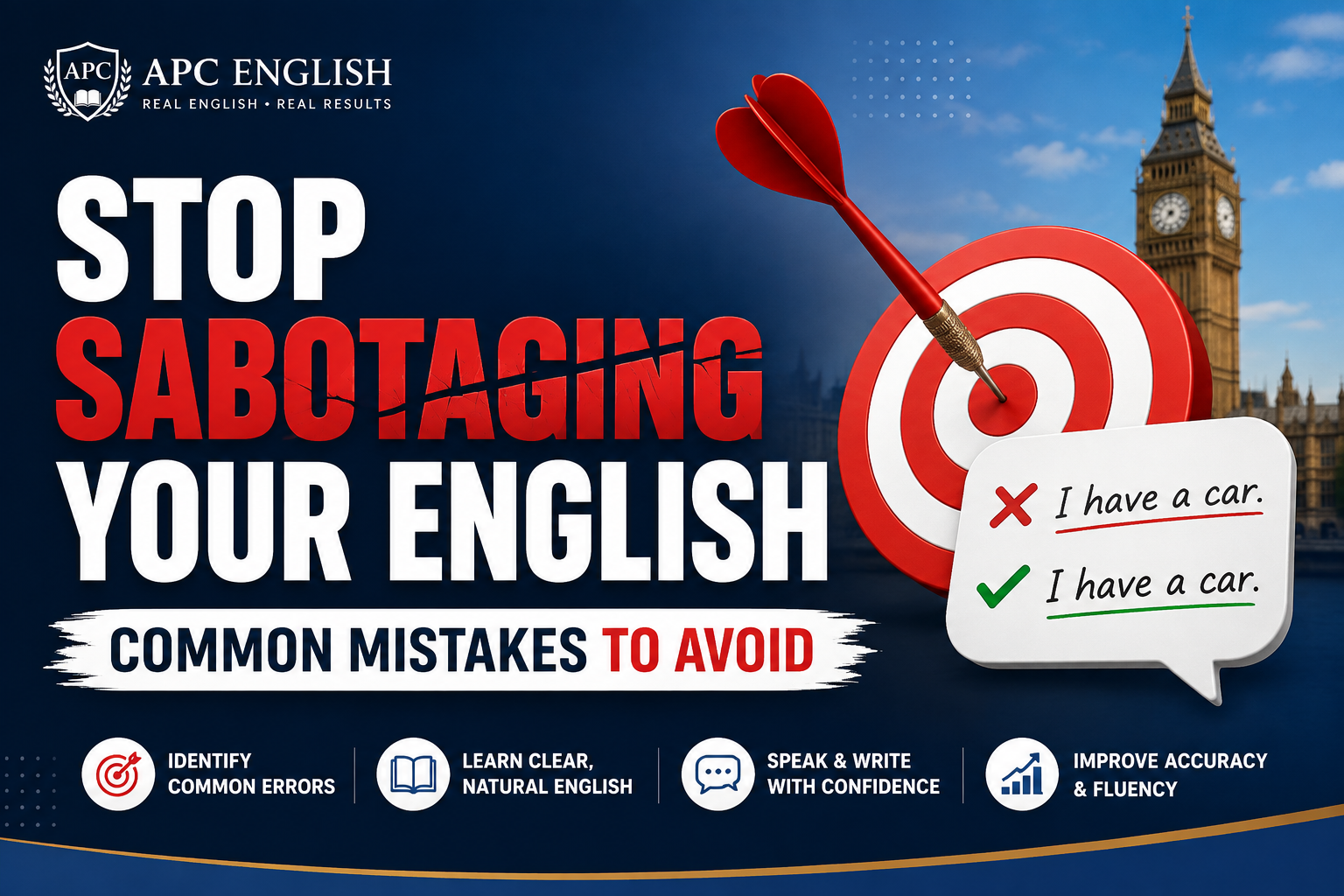
Stop Sabotaging Your English: Common English Mistakes to Avoid and Speak More Naturally
Stop Sabotaging Your English — Common Mistakes to AvoidImprove your English by identifying and fixing the most common mistakes that make your speaking and writing sound unnatural, unclear, or less confident.Course ObjectiveBy the end of this course, learners will be able to:identify common mistakes that make English sound unnatural or unclear;recognize the difference between incorrect and natural English;avoid common grammar, vocabulary, pronunciation, and sentence-structure mistakes;improve the accuracy and naturalness of their spoken and written English;become more confident when communicating in everyday situations.Course StructureIntroduction — What Is Sabotaging Your English?Translating Directly from Your Native LanguageConfusing “Do” and “Make”Confusing “Say”, “Tell”, “Speak” and “Talk”Misusing “Have” and “Be”Articles — “A”, “An” and “The”Countable and Uncountable NounsConfusing “Much”, “Many”, “A Lot”, “Few” and “Little”Prepositions — The Small Words That Cause Big ProblemsWord Order — Building Natural English SentencesQuestions — Stop Asking Questions the Wrong WayNegatives — “Don’t”, “Doesn’t”, “Didn’t” and MorePresent Simple vs. Present ContinuousPast Simple — Common MistakesPresent Perfect vs. Past Simple“For” vs. “Since”Modal Verbs — Can, Could, Should, Must, Have to“Must” vs. “Have to”“Can”, “Could” and Polite EnglishFalse Friends — Words That Look Familiar but Mislead YouVocabulary Mistakes — Choosing the Wrong WordPronunciation MistakesThe “-ED” Pronunciation TrapThe “TH” SoundPronunciation vs. Accent“Very”, “Really”, “So” and “Too”Common Adjective MistakesCommon Mistakes with “People”, “Person”, “Man” and “Human”Common Mistakes with “Good”, “Well”, “Bad” and “Badly”Common Mistakes with “Know”, “Know How”, “Meet” and “Know Someone”Common Conversation MistakesStop Speaking English Like a TranslationCommon Mistakes in Everyday SituationsWriting Mistakes That Also Affect SpeakingCommon Mistakes in Email and MessagingThe Most Common “Beginner” MistakesThe Most Common “Intermediate” MistakesHow to Fix a Mistake Without Losing ConfidencePersonal Error ChecklistCourse ConclusionContinue Learning with APC1. Introduction — What Is Sabotaging Your English?Making mistakes is a normal part of learning a language. The problem is not making mistakes. The problem is repeating the same mistakes so often that they begin to affect the way your English sounds.Some mistakes are small and may not prevent people from understanding you. However, when they are repeated frequently, they can make your English sound unnatural, unclear, or less confident.This course focuses on the mistakes that learners are most likely to repeat and the practical changes that can make their English clearer and more natural.Why Small Mistakes MatterA small grammatical or vocabulary mistake may seem unimportant when it happens once. But repeated mistakes become part of your speaking habits.The goal is therefore not to eliminate every possible mistake immediately. Instead, the goal is to identify the mistakes that affect your communication most and gradually replace them with correct and natural patterns.Accuracy vs. Natural EnglishCorrect English and natural English are closely related, but they are not always exactly the same.A sentence can sometimes be understandable and technically possible, while still sounding unusual to a native or proficient English speaker.This course therefore focuses on both:AccuracyUsing the correct grammar, vocabulary, pronunciation, and sentence structure.Natural EnglishExpressing the same idea in a way that sounds normal and appropriate in real communication.Mistakes Are Part of LearningMaking mistakes does not mean that you are failing. Mistakes show you where your current knowledge is still developing.The important thing is to notice repeated mistakes, understand why they happen, and learn a better way to express the same idea.The purpose of this course is therefore not to make you afraid of making mistakes. It is to help you become more aware of them and more confident about correcting them.Which Mistakes Should You Prioritize?Not every mistake deserves the same amount of attention.Prioritize mistakes that:you repeat frequently;change or confuse the meaning of your sentence;make your English sound noticeably unnatural;appear in everyday conversations;continue even after you have learned the correct form.Correcting a small number of repeated mistakes can often make a much bigger difference than trying to memorize hundreds of isolated grammar rules.How to Use This CourseEach section focuses on a specific type of mistake. You will see the incorrect form, the correct form, an explanation, and practical examples.Pay particular attention to mistakes that you recognize in your own English. These are the ones that will give you the greatest benefit when corrected.As you progress through the course, try to notice the same patterns in your own speaking and writing. The goal is not only to recognize mistakes in the lesson, but also to stop repeating them in real communication.Next StepOne of the biggest sources of English mistakes is translating directly from another language.In the next section, we will look at why word-for-word translation often produces English that is understandable but unnatural.2. Translating Directly from Your Native LanguageOne of the most common sources of English mistakes is translating directly from your native language.When learners build an English sentence by translating each word separately from another language, the result may be understandable but still sound unnatural or incorrect.This happens because languages do not always organize ideas in the same way. A sentence that is perfectly natural in one language may require a completely different structure in English.Why Word-for-Word Translation Causes ProblemsWord-for-word translation can lead to mistakes in grammar, vocabulary, sentence structure, prepositions, and common expressions.The main problem is that learners translate the words first instead of thinking about how the idea is normally expressed in English.English has its own patterns, combinations, and expressions. Learning these patterns directly is much more effective than trying to reproduce the structure of another language in English.English Sentence Patterns vs. Other Language PatternsLearners often make mistakes because their native language and English express the same idea in different ways.A learner may know the meaning of every individual English word but still produce a sentence that does not follow a natural English structure.The solution is not to translate faster. The solution is to learn common English expressions and sentence patterns as complete units.Expressions That Cannot Be Translated LiterallyMany everyday English expressions cannot be translated word for word. English may use a completely different verb, structure, or combination of words to express the same idea.This is especially common with expressions related to age, activities, physical states, daily routines, and social interaction.Common Literal Translation — Talking About Age❌ I have 20 years.✅ I am 20 years old.In natural English, age is normally expressed with the verb be, not have.The same structure can be used with different ages:I am 18 years old.She is 30 years old.They are 25 years old.Common Literal Translation — Talking About Sports❌ I make sport.✅ I play sports.✅ I exercise every morning.English uses different expressions depending on what you mean. The verb make is not normally used to express the general idea of doing or playing sports.Learn Ideas, Not Individual TranslationsInstead of memorizing isolated translations, learn the complete English expression that communicates the idea.❌ I have 20 years.✅ I am 20 years old.❌ I make sport.✅ I play sports.Learning complete expressions makes your English more natural and reduces the need to translate every sentence in your head.How to Think in English InsteadThinking directly in English does not mean that you must stop using your native language immediately. It means gradually learning common English structures so that you can recall them directly.A useful progression is:Understand the idea.Learn the natural English expression.Notice the sentence pattern.Reuse the pattern with new vocabulary.Build Expressions as Complete UnitsInstead of learning only individual words, learn combinations that naturally occur together.be + ageI am 20 years old.play + sportsI play sports.Why This Is ImportantThe more natural English patterns you learn, the less you need to translate sentence by sentence.Over time, common expressions become easier to recall automatically. This makes your speaking faster, clearer, and more natural.Next StepDirect translation is not the only source of unnatural English. Another major problem is choosing between words that seem similar but are used in different ways.One of the most important examples is the difference between do and make.3. Confusing “Do” and “Make”Do and make are two of the most common verbs in English, but learners often confuse them because they can express similar general ideas in other languages.The difficulty is that English uses do and make in different combinations. Learning these combinations is essential for sounding natural.Do vs. MakeAs a general guideline, do is often associated with activities, tasks, work, or actions, while make is often associated with creating, producing, preparing, or causing something.These are useful general patterns, but they are not absolute rules. Many expressions simply need to be learned as natural word combinations.Common Expressions with DoHere are some common expressions using do:do homeworkdo exercisedo the dishesDo HomeworkEnglish uses do with homework.I do my homework every evening.This is the standard expression. The verb make is not used in this combination.Do ExerciseEnglish can use do when referring to exercise as a physical activity.I do exercise every morning.In everyday English, the shorter form is often more natural:I exercise every morning.Do the DishesThe common household expression is:I do the dishes after dinner.This combination should be learned as a complete English expression.Common Expressions with MakeHere are some common expressions using make:make a mistakemake a decisionmake a planMake a MistakeEnglish uses make when talking about making a mistake.I made a mistake.Make a DecisionThe standard expression is:We need to make a decision.Make a PlanEnglish also uses make with plans.Let's make a plan.Expressions Learners Often Translate IncorrectlyLearners may try to use the same English verb in different expressions because their native language may use one verb where English uses several different combinations.do your homeworkdo exercisemake a mistakemake a decisionmake a planCompare the Patternsdo + activity / taskdo homeworkdo exercisedo the dishesmake + result / creation / decisionmake a mistakemake a decisionmake a planDo and Make in Complete SentencesI do my homework after school.I exercise every morning.We do the dishes after dinner.He made a mistake.They made a decision yesterday.We need to make a plan.Do or Make?When you are unsure, do not translate the verb directly from your native language. Instead, ask yourself which English expression normally goes with the noun or activity.Learning common word combinations, also known as collocations, is one of the best ways to avoid these mistakes.Learn the whole expression:do homeworkmake a mistakemake a decisionAvoid Word-for-Word TranslationThe safest approach is to learn common combinations as natural English units rather than trying to translate a verb every time.Instead of asking: “What verb should I translate here?”ask: “Which English expression is normally used here?”Next StepYou have now seen why direct translation can create unnatural English and why do and make cannot always be used interchangeably.Next, we will look at another group of verbs that learners frequently confuse: say, tell, speak and talk.4. Confusing “Say”, “Tell”, “Speak” and “Talk”Say, tell, speak, and talk are all common English verbs related to communication. However, they are not normally used in exactly the same way.Learners often confuse these verbs because they can all be translated with words related to speaking in other languages. The key is to learn the structures that normally accompany each verb.SaySay focuses mainly on the words or information that someone produces.say + somethingShe said hello.We commonly use say when the thing being said is important or when we want to report someone's words.What did he say?She said that she was tired.He said hello.TellTell usually focuses on giving information to a person. It is normally followed directly by the person receiving the information.tell + person + somethingTell me the truth.Tell me your name.She told me the truth.He told his friend the news.SpeakSpeak is commonly used when referring to the ability to use a language, to address someone in a formal context, or to refer to the act of speaking.speak + languageI speak English.She speaks Spanish.Can I speak to the manager?He spoke to the students.TalkTalk is commonly used for conversations and communication between people. It is especially common in informal everyday English.talk to / talk with + personI talked to my friend.We talked about the movie.She is talking to her brother.They talked for an hour.Compare the Four VerbsVerbCommon PatternTypical Usesaysay + somethingfocus on the words or informationtelltell + person + somethinggive information to someonespeakspeak + language / speak tolanguage, formal communication, speakingtalktalk to / talk aboutconversation and informal communicationCommon Learner ErrorsOne of the most common mistakes is using the wrong structure after the verb.❌ She said me the truth.✅ She told me the truth.❌ He told that he was tired.✅ He said that he was tired.❌ I told hello.✅ I said hello.Say vs. TellA useful distinction is:say + somethingShe said something interesting.tell + someone + somethingShe told me something interesting.Speak vs. TalkSpeak is often used for languages and can sound more formal in certain situations. Talk is very common when referring to everyday conversation.I speak English.I talked to my friend yesterday.She spoke to the manager.We talked about the problem.Useful Structures to Remembersay + somethingsay hellosay somethingsay that...tell + someone + somethingtell metell hertell themspeak + language / speak to + personspeak Englishspeak to the teachertalk to / talk abouttalk to my friendtalk about workNext StepThe difference between say, tell, speak, and talk becomes much easier once you learn their common sentence patterns.Next, we will look at another major source of mistakes: confusing have and be.[[NEW_PAGE]]5. Misusing “Have” and “Be”Have and be are two of the most important verbs in English, but learners sometimes use one when English requires the other.This is especially common when another language expresses an idea differently from English. Learning the English structure directly can prevent many repeated mistakes.Have vs. BeAs a general rule, have is commonly used for possession and certain fixed expressions, while be is commonly used for identity, age, feelings, conditions, and descriptions.Talking About AgeIn English, age is expressed with the verb be.❌ I have 25 years.✅ I am 25 years old.The same structure is used with other subjects:She is 18 years old.He is 40 years old.They are 30 years old.Talking About Feelings and Physical StatesEnglish commonly uses be for many feelings and physical states.✅ I am hungry.✅ I am thirsty.✅ I am tired.✅ I am cold.These expressions use be rather than have.Talking About PossessionUse have to talk about possession, relationships, or things that someone possesses.I have a car.She has a new phone.We have two children.Common Expressions with BeMany common English expressions use forms of be.I am hungry.I am thirsty.I am tired.She is afraid.They are ready.Common Expressions with HaveEnglish also uses have in many fixed expressions. These combinations should be learned as complete expressions.have a carhave breakfasthave a showerhave a problemhave a questionCompare the Two PatternsBe + feeling / stateI am hungry.Have + possessionI have a car.Common Learner Errors❌ I have hungry.✅ I am hungry.❌ I have 25 years.✅ I am 25 years old.❌ I am a car.✅ I have a car.Three Ideas to RememberAge → beI am 25 years old.Feelings and physical states → beI am hungry.Possession → haveI have a car.Do Not Translate the Structure DirectlyWhen learning an expression, focus on the English structure rather than choosing the verb by translating it word for word from another language.Ask yourself: “How is this idea normally expressed in English?”Useful Sentence PatternsSubject + be + adjectiveI am tired.Subject + be + ageI am 25 years old.Subject + have + nounI have a car.Subject + have + common expressionI have breakfast at 8 o'clock.Build Natural English HabitsThe best way to avoid confusing have and be is to learn common expressions as complete patterns and reuse them regularly.I am hungry.I am tired.I am 25 years old.I have a car.I have a question.Next StepYou have now seen why have and be cannot always be chosen by translating directly from another language.Next, we will examine another major area of English mistakes: a, an, and the.6. Articles — “A”, “An” and “The”Articles are small words, but they are one of the most common sources of mistakes for English learners.English mainly uses three articles: a, an, and the. In some situations, no article is used at all.Learning when to use each form is essential for producing clear and natural English.“A”Use a before a singular countable noun when you are referring to one non-specific person or thing.a + singular countable nouna booka cara teacherFor example:I bought a book.“An”Use an instead of a before a singular countable noun when the following word begins with a vowel sound.an + singular countable nounan applean orangean interesting bookThe important point is the sound, not simply the spelling of the word.“The”Use the when the person or thing is specific or already known to the listener or reader.the + specific nounthe bookthe carthe teacherFirst Mention vs. Known InformationOne of the most useful ways to understand the difference between a and the is to look at whether something is being mentioned for the first time or is already known.I saw a dog.The dog was very friendly.The first sentence introduces the dog, so a is used. Once the dog is identified, the can be used because both people know which dog is being discussed.Singular Countable NounsA singular countable noun generally needs a determiner such as a, an, or the when used in a normal sentence.✅ I bought a car.✅ The car is new.✅ My car is outside.❌ I bought car.No ArticleEnglish sometimes uses no article when speaking about things in a general sense, especially with plural countable nouns and many uncountable nouns.Books are useful.Water is important.Students need practice.The meaning changes when the reference becomes specific.Books are useful.The books on this table are useful.Common MistakesLearners often forget an article, use the wrong article, or use a or an when the noun is specific.❌ I bought car.✅ I bought a car.❌ She is teacher.✅ She is a teacher.❌ I saw dog. Dog was friendly.✅ I saw a dog. The dog was friendly.Useful Patterns to Remembera + singular countable nouna studentan + singular countable noun beginning with a vowel soundan applethe + specific or already known nounthe studentno article + general plural or uncountable nounStudents need practice.A Simple Decision ProcessWhen you are unsure which article to use, ask yourself a few questions:Is the noun singular and countable?Am I talking about one non-specific thing?Is the thing specific or already known?Am I speaking about something in general?These questions can help you choose between a, an, the, and no article.Next StepArticles are closely connected to another important topic: whether a noun can be counted or not.Next, we will examine countable and uncountable nouns, including much, many, few, little, some, and any.7. Countable and Uncountable NounsUnderstanding whether a noun is countable or uncountable is essential for choosing the correct words around it.This distinction affects which determiners and quantifiers you can use, including many, much, few, little, some, and any.Countable NounsCountable nouns refer to things that can be counted as separate units. They have singular and plural forms.one book → two booksone car → three carsone student → many studentsA singular countable noun can normally be used with a, an, or another determiner.a bookan applethe studentUncountable NounsUncountable nouns refer to substances, concepts, information, materials, or things that are not normally treated as separate individual units.informationadvicewatermoneyThese nouns are generally not used with a or an when referring to the substance or concept in general.ManyUse many with plural countable nouns.many + plural countable nounmany booksmany studentsmany questionsMuchUse much with uncountable nouns.much + uncountable nounmuch informationmuch moneymuch timeFew and A FewUse few and a few with plural countable nouns.few booksvery small number of booksa few bookssome books; a small number of booksLittle and A LittleUse little and a little with uncountable nouns.little timealmost no timea little timesome timeSomeSome can be used with both plural countable nouns and uncountable nouns.some bookssome informationsome adviceAnyAny is commonly used in questions and negative sentences with plural countable and uncountable nouns.Do you have any questions?I don't have any money.We don't have any information.Common Vocabulary MistakesSome nouns that may look countable to learners are normally uncountable in English.A very common example is advice.❌ an advice❌ advices✅ some advice✅ a piece of adviceSome Advice vs. A Piece of AdviceAdvice is normally uncountable, so we do not usually say an advice or two advices.some adviceShe gave me some advice.a piece of adviceHe gave me a useful piece of advice.Many BooksBooks are countable, so use many with them.many booksI have many books.Much InformationInformation is uncountable, so use much when the context requires it.much informationWe don't have much information.Some Advicesome adviceCan you give me some advice?A Piece of Advicea piece of adviceLet me give you a piece of advice.Quick ComparisonExpressionTypeExamplemanyplural countablemany booksmuchuncountablemuch informationfewplural countablefew bookslittleuncountablelittle timesomecountable plural / uncountablesome adviceanycountable plural / uncountableany informationA Simple Rule to RememberAsk yourself whether the noun can normally be counted as separate units.Countable:one book → two books → many booksUncountable:information → much informationOnce you identify the noun type, choosing words such as many, much, few, and little becomes much easier.Next StepNow that you understand the difference between countable and uncountable nouns, we can look more closely at one of the most common areas of confusion: much, many, a lot, few, and little.8. Confusing “Much”, “Many”, “A Lot”, “Few” and “Little”Words such as much, many, a lot of, few, and little are used to talk about quantity.The main difficulty is knowing which expressions can be used with countable nouns and which ones are used with uncountable nouns. The meaning can also change depending on whether the quantity is presented as large, small, sufficient, or insufficient.Many + Countable NounsUse many with plural countable nouns.many + plural countable nounmany booksmany studentsmany questionsFor example:There are many students in the classroom.Much + Uncountable NounsUse much with uncountable nouns.much + uncountable nounmuch informationmuch moneymuch timeFor example:We don't have much time.A Lot ofA lot of can be used with both plural countable nouns and uncountable nouns.a lot of booksa lot of informationa lot of peoplea lot of moneyIt is especially common in everyday English.She has a lot of friends.We have a lot of work.Few vs. A FewUse few and a few with plural countable nouns.few booksalmost no books; a very small numbera few bookssome books; a small numberThe presence of a changes the meaning and tone. Few often suggests that the number is smaller than expected or insufficient, while a few usually presents the small number more positively or neutrally.FewFew people came to the meeting.This suggests that the number was very small.A FewA few people came to the meeting.This means that some people came, even though the number was small.Little vs. A LittleUse little and a little with uncountable nouns.little timealmost no time; not enough timea little timesome time; a small amount of timeLittleWe have little time.This suggests that there is almost no time available.A LittleWe have a little time.This means that some time is available, even though the amount is small.Difference in MeaningThe difference between few and a few, or between little and a little, is not simply grammatical. It also changes the meaning of the sentence.Few students passed the exam.Almost no students passed.A few students passed the exam.Some students passed.There is little water left.Almost no water is left.There is a little water left.Some water is still available.Quick ComparisonExpressionNoun TypeGeneral Meaningmanyplural countablea large numbermuchuncountablea large amounta lot ofcountable / uncountablea large quantityfewplural countablealmost none / very small numbera fewplural countablesome / small numberlittleuncountablealmost none / very small amounta littleuncountablesome / small amountCommon Mistakes❌ much books✅ many books❌ many information✅ much information❌ little students✅ few students❌ few time✅ little timeLearn the Noun Type FirstBefore choosing a quantity expression, first identify whether the noun is countable or uncountable.Countable: books → many books / a few booksUncountable: information → much information / a little informationNext StepQuantity words become much easier when you recognize the type of noun and understand the difference in meaning between similar expressions.Next, we will examine another small group of words that causes many mistakes: prepositions.9. Prepositions — The Small Words That Cause Big ProblemsPrepositions are short words, but they are responsible for many common English mistakes.Words such as in, on, at, to, for, from, by, and with may look simple, but their correct use depends heavily on context and common expressions.The best way to learn many prepositions is to study them in complete phrases rather than trying to memorize one translation for each word.InIn is commonly used with enclosed spaces, areas, months, years, and longer periods of time.in a carin the housein Julyin 2026OnOn is commonly used with days and dates and with certain surfaces and forms of transportation.on Mondayon July 5on the tableon a busAtAt is commonly used for specific points in time and certain locations or situations.at nightat 8 o'clockat homeat schoolToTo is commonly used to indicate movement toward a destination or another person.go to schoolgo to workgive it to meForFor can express purpose, duration, or the intended recipient of something.a gift for youfor two hourssomething for workFromFrom commonly indicates origin, starting point, or source.I am from Spain.The train comes from London.from Monday to FridayByBy has several uses. It can indicate the method of transportation, the person responsible for an action, or a deadline.by busby traina book by Shakespeareby tomorrowWithWith commonly indicates accompaniment, a tool, or a person or thing involved in an action.with my friendwrite with a pencoffee with milkPrepositions of TimeEnglish commonly uses at, on, and in differently when talking about time.PrepositionTypical UseExampleatspecific time / certain expressionsat 8 o'clock / at nightondays / dateson Mondayinmonths / years / longer periodsin July / in 2026Prepositions of PlaceIn, on, and at can also describe location, but the correct choice depends on the relationship between the person or object and the place.in the roomon the tableat homePrepositions of MovementTo is commonly used to indicate movement toward a destination.go + to + destinationI go to school every morning.Notice that the preposition is part of the complete expression.Prepositions and TransportationEnglish uses different prepositions depending on the type of transportation.in a carin a taxion a buson a trainCommon Expressions with PrepositionsSome combinations should be learned as complete expressions because their prepositions cannot always be predicted from another language.at nighton Mondayin Julyat homein a caron a busCommon Learner Mistakes❌ in Monday✅ on Monday❌ on July✅ in July❌ in night✅ at night❌ on a car✅ in a carDo Not Translate Prepositions Word for WordOne of the most important lessons about prepositions is that a preposition in one language does not always correspond to the same preposition in English.Instead of memorizing isolated translations, learn common combinations as complete English expressions.Learn the whole expression:at nighton Mondayin Julyat homein a caron a busA Practical Learning StrategyWhen you encounter a new preposition, learn it together with the words around it.Instead of learning only: atlearn: at night, at home, at school.Instead of learning only: onlearn: on Monday, on a bus, on the table.Next StepPrepositions may be small words, but using them correctly makes a major difference to the naturalness of your English.Next, we will examine another important source of unnatural English: word order and how to build natural English sentences.[[NEW_PAGE]]10. Word Order — Building Natural English SentencesEnglish word order is relatively structured. The position of words in a sentence helps communicate who is performing an action, what is happening, and what information is being emphasized.Learners often make mistakes when they transfer the word order of their native language directly into English. A sentence may contain the correct words but still sound unnatural because those words are placed in the wrong positions.Basic English Sentence StructureA very common English sentence pattern is:Subject + Verb + ObjectShe speaks English.This structure appears in a large number of everyday English sentences.I read books.They play football.We study English.Adjective PlacementIn English, adjectives generally come before the noun they describe.adjective + nouna beautiful housean interesting booka new carThis is an important pattern to recognize when building sentences.She has a beautiful house.He bought a new car.It is an interesting book.Adverb PlacementAdverbs can appear in different positions depending on what they modify. Their position is therefore important for natural English.With many common adverbs, placing the adverb in the wrong position can make a sentence sound unnatural.❌ I very like English.✅ I really like English.The problem is not simply the word very. The sentence needs a natural adverb structure. In this context, really is the natural choice.Adverbs with VerbsMany adverbs can appear after the verb or after the object, depending on the sentence.She speaks English very well.He works very quickly.They speak English fluently.Common Word-Order Error❌ She speaks very well English.✅ She speaks English very well.The object English normally comes directly after the verb, while very well comes after the object in this sentence.Question StructureEnglish questions often require an auxiliary verb before the subject. The exact structure depends on the verb and the tense.Common auxiliary and helping verbs include: do, does, did, am, is, are, have, has, and modal verbs.Questions with Do and DoesDo / Does + subject + base verb?Do you like English?Does she work here?Questions with DidDid + subject + base verb?Did you go yesterday?Questions with BeAm / Is / Are + subject + ...?Are you ready?Is she at home?Questions with Have and HasHave / Has + subject + ...?Have you finished?Has he arrived?Questions with Modal VerbsModal + subject + base verb?Can you help me?Should we leave now?Question-Word OrderWhen a question begins with a question word such as what, where, when, why, or how, the auxiliary or helping verb normally comes before the subject.Question word + auxiliary + subject + verb?Where do you live?Negative SentencesNegative sentences also follow specific word-order patterns. Auxiliary verbs such as do, does, and did usually appear before not when they are needed.I do not understand.She does not work here.They did not come yesterday.Common Word-Order ErrorsHere are some mistakes that can make otherwise understandable English sound unnatural.❌ I very like English.✅ I really like English.❌ She speaks very well English.✅ She speaks English very well.❌ Where you live?✅ Where do you live?❌ What you are doing?✅ What are you doing?A Simple Word-Order ChecklistWhen building an English sentence, check the basic structure first.Who is the subject?What is the main verb?Do I need an object?Do I need an auxiliary or modal verb?Where should the adverb go?Is the sentence in the correct question or negative structure?Build Sentences Step by StepStart with the basic structure and then add more information.Subject + verbShe works.Subject + verb + objectShe speaks English.Subject + verb + object + adverbShe speaks English very well.Think in Patterns, Not Individual WordsNatural English comes from learning how words work together. Instead of memorizing isolated words and trying to arrange them later, learn common sentence patterns as complete structures.I really like English.She speaks English very well.Where do you live?What are you doing?Next StepCorrect word order is especially important when asking questions. Even when all the individual words are correct, placing them in the wrong order can make the question sound unnatural or incorrect.Next, we will focus specifically on question formation and the most common mistakes with do, does, did, be, have, and modal verbs.11. Questions — Stop Asking Questions the Wrong WayQuestions are essential for real communication. We use them to get information, start conversations, clarify ideas, ask for help, and keep a conversation going.Many learners know the words they want to use but put them in the wrong order. English question structures are therefore worth learning as complete patterns.Questions with DoUse do with the subjects I, you, we, and they in many present simple questions.Do + subject + base verb?Do you like English?Do they work here?Questions with DoesUse does with he, she, and it in many present simple questions.Does + subject + base verb?Does she speak English?Does he live here?Notice that the main verb returns to its base form after does.She speaks English.Does she speak English?Questions with DidUse did for many past simple questions.Did + subject + base verb?Did you go yesterday?Did she call you?After did, the main verb remains in its base form.❌ Did you went?✅ Did you go?Questions with Am, Is and AreWhen be is the main verb or helping verb, it moves before the subject in many questions.Are you ready?Is she at home?Are they working?Questions with Have and HasHave and has can function as auxiliary verbs in questions, especially with the present perfect.Have you finished?Has he arrived?Have they eaten?Questions with Modal VerbsModal verbs such as can, could, should, must, and might come before the subject in questions.Modal + subject + base verb?Can you help me?Could you repeat that?Should we leave now?Question-Word OrderCommon question words include: what, where, when, why, who, and how.When an auxiliary or helping verb is required, the usual pattern is:Question word + auxiliary + subject + main verb?Where do you live?Common Question Mistakes❌ You like English?✅ Do you like English?❌ Where you are going?✅ Where are you going?❌ What you do?✅ What do you do?❌ Why she is tired?✅ Why is she tired?Do Not Add an Extra AuxiliaryWhen be is already functioning as the auxiliary, do not add do or does.❌ Do you are ready?✅ Are you ready?❌ Does she is working?✅ Is she working?Questions in Everyday ConversationCorrect question formation is especially important in everyday communication because questions appear in almost every conversation.What do you do?Where do you live?What are you doing?Did you enjoy it?Can you help me?A Simple Question ChecklistBefore asking a question, identify which structure you need.Is the main verb be?Do I need do or does?Am I asking about the past and need did?Do I need have or has?Am I using a modal verb?Where does the question word go?Learn Questions as Complete PatternsInstead of memorizing isolated question words, learn complete structures that you can immediately reuse.Do you + verb...?Do you speak English?Where do you + verb...?Where do you live?What are you + verb-ing...?What are you doing?Can you + base verb...?Can you help me?Next StepYou now know the main structures used to form English questions with do, does, did, be, have, has, and modal verbs.Next, we will examine negative sentences and the common mistakes learners make with don't, doesn't, didn't, isn't, aren't, and other negative forms.12. Negatives — “Don’t”, “Doesn’t”, “Didn’t” and MoreNegative sentences are essential for everyday English. We use them to say that something is not true, that something does not happen, that something did not happen, or that someone is not able or willing to do something.English uses different negative forms depending on the subject, tense, and auxiliary or helping verb. Using the wrong negative form can make a sentence incorrect or unclear.Don'tUse don't with I, you, we, and they in many present simple negative sentences.Subject + don't + base verbI don't understand.They don't work here.Doesn'tUse doesn't with he, she, and it in many present simple negative sentences.Subject + doesn't + base verbShe doesn't like coffee.He doesn't work here.Notice that the main verb stays in its base form after doesn't.She likes coffee.She doesn't like coffee.Didn'tUse didn't for many past simple negative sentences.Subject + didn't + base verbI didn't go yesterday.They didn't call me.As with doesn't, the main verb remains in the base form after didn't.❌ I didn't went.✅ I didn't go.Isn'tIsn't is the contracted form of is not. It is used with he, she, and it, and with singular nouns when be is required.He isn't ready.She isn't at home.The door isn't open.Aren'tAren't is the contracted form of are not. It is used with you, we, and they, as well as plural nouns.You aren't late.We aren't ready.They aren't at home.Wasn'tWasn't is the contracted form of was not.I wasn't tired.She wasn't at school.He wasn't ready.Weren'tWeren't is the contracted form of were not.We weren't late.They weren't tired.You weren't there.Haven'tHaven't is the contracted form of have not. It is commonly used with the present perfect.I haven't finished.We haven't seen him.They haven't arrived yet.Can'tCan't is the contracted form of cannot. It is commonly used to express inability, lack of possibility, or lack of permission depending on context.I can't swim.She can't come today.We can't park here.Shouldn'tShouldn't is the contracted form of should not. It is commonly used to give advice about something that is not recommended.You shouldn't worry.He shouldn't drive so fast.We shouldn't be late.Common Negative StructuresNegative FormCommon UseExampledon'tpresent simpleI don't know.doesn'tpresent simple, third person singularShe doesn't know.didn'tpast simpleThey didn't come.isn'tbe, singularHe isn't ready.aren'tbe, plural / youThey aren't ready.wasn'tpast be, singularShe wasn't there.weren'tpast be, plural / youWe weren't there.haven'tpresent perfectI haven't finished.can'tability / possibility / permissionI can't come.shouldn'tadviceYou shouldn't worry.Common Errors — Wrong AuxiliaryOne of the most common mistakes is using the wrong auxiliary verb for the sentence structure.❌ She don't like coffee.✅ She doesn't like coffee.❌ He don't understand.✅ He doesn't understand.❌ They doesn't work here.✅ They don't work here.Common Errors — Wrong Verb FormAfter don't, doesn't, or didn't, the main verb remains in the base form.❌ She doesn't likes English.✅ She doesn't like English.❌ He didn't went home.✅ He didn't go home.Common Errors — Wrong TenseThe negative form must match the time being discussed.Present:I don't work on Sundays.Past:I didn't work yesterday.Double NegativesStandard English generally avoids using two negative elements in the same clause to express a single negative meaning.❌ I don't know nothing.✅ I don't know anything.❌ She didn't see nobody.✅ She didn't see anybody.In some varieties of English, double negatives can have different functions or meanings, but for standard English learning, it is safer to avoid them.Negative Questions and StatementsNegative forms can also appear in questions.Don't you like English?Doesn't she work here?Didn't they call you?Isn't he ready?Learn Negative Forms as PatternsInstead of memorizing the negative words separately, learn the complete sentence structures.Subject + don't + base verbI don't understand.Subject + doesn't + base verbShe doesn't understand.Subject + didn't + base verbThey didn't understand.Subject + be + notHe isn't ready.Subject + modal + not + base verbYou shouldn't worry.Next StepNegative sentences become much easier when you identify the correct auxiliary, tense, and subject before choosing the negative form.Next, we will examine one of the most important distinctions in English: the difference between the present simple and the present continuous.13. Present Simple vs. Present ContinuousThe present simple and the present continuous are two of the most important verb forms in English.Learners often confuse them because both can describe situations happening around the present. The key is to understand whether you are talking about a habit, a general fact, a temporary situation, or something happening now.Present SimpleThe present simple is commonly used for habits, routines, general facts, repeated actions, and situations that are generally true.Habits and RoutinesI work every day.This describes a regular activity or routine.She goes to school every morning.We play football on Saturdays.He usually drinks coffee in the morning.Facts and General TruthsThe present simple is also used for facts, general truths, and situations that are not limited to the current moment.Water boils at 100°C.The Earth goes around the Sun.She lives in London.Present ContinuousThe present continuous is commonly used for actions happening now, around the current moment, and for temporary situations.Subject + am / is / are + verb-ingI am working.She is studying.They are talking.Actions Happening NowI am working now.She is talking on the phone.They are studying at the moment.Temporary SituationsThe present continuous can also describe situations that are temporary rather than permanent or habitual.I am staying with my friend this week.She is working in Paris this month.Compare the Two TensesI work every day.This describes a routine or habit.I am working now.This describes an action happening at the present moment.Another Useful ComparisonShe works in a bank.This is a general fact about her job.She is working now.This describes what she is doing at the moment.Stative VerbsSome verbs normally describe states rather than actions. These verbs are often not used in the continuous form when they describe a current state.Common examples include: know, like, want, need, and understand.✅ I know the answer.❌ I am knowing the answer.✅ I like this book.❌ I am liking this book.Common Mistakes❌ I am work every day.✅ I work every day.❌ I work now.✅ I am working now.❌ She is knowing the answer.✅ She knows the answer.Time ExpressionsCertain time expressions can help you recognize which tense is appropriate, although the context is always more important than the word itself.Present Simpleevery day, usually, often, always, sometimesPresent Continuousnow, at the moment, currently, todayA Simple Decision ProcessAsk whether the action is a habit or general fact.Ask whether the action is happening now.Ask whether the situation is temporary.Check whether the verb normally describes a state.Compare the Main PatternsPresent SimpleSubject + base verbI work every day.Present ContinuousSubject + am / is / are + verb-ingI am working now.The Key DifferenceI work every day.Habit or routine.I am working now.Action happening now.Learning this difference will help you describe everyday activities, current actions, routines, temporary situations, and general facts much more accurately.Next StepYou now know how to distinguish routines and general facts from actions happening now and temporary situations.Next, we will examine the past simple and the mistakes learners commonly make when talking about past events.14. Past Simple — Common MistakesThe past simple is one of the most important verb forms for talking about completed actions and events in the past.Learners often make mistakes with the past simple because regular and irregular verbs follow different patterns, and because the auxiliary did changes the form used in questions and negative sentences.Regular VerbsRegular verbs usually form the past simple by adding -ed to the base form.work → workedplay → playedwatch → watchedFor example:I worked yesterday.Irregular VerbsIrregular verbs do not follow the regular -ed pattern. Their past forms must be learned individually.go → wentsee → sawhave → hadeat → atetake → tookDid + Base VerbOne of the most important rules to remember is that after did, the main verb returns to its base form.Did + subject + base verb?Did you go?Do not use the past form of the main verb after did.❌ Did you went?✅ Did you go?Past Simple QuestionsFor many past simple questions, use did + subject + base verb.Did you work yesterday?Did she call you?Did they arrive on time?Past Simple NegativesNegative past simple sentences commonly use did not or the contraction didn't.Subject + didn't + base verbI didn't go.❌ She didn't went home.✅ She didn't go home.❌ They didn't saw him.✅ They didn't see him.Time ExpressionsThe past simple is often used with expressions that clearly refer to a completed past time.yesterdaylast weeklast yeartwo days agoin 2020Common Mistakes with Regular VerbsA common mistake is using did together with the past form of a regular verb.❌ Did you worked yesterday?✅ Did you work yesterday?Common Mistakes with Irregular VerbsLearners sometimes use the infinitive after a normal affirmative past-tense sentence or use the past form after did.❌ Yesterday I go to work.✅ Yesterday I went to work.❌ Did you went to work?✅ Did you go to work?Affirmative vs. QuestionAffirmative:I went to school.Question:Did you go to school?Notice that went changes back to go after did.Affirmative vs. NegativeAffirmative:She saw him.Negative:She didn't see him.A Simple Past Simple PatternAffirmative:Subject + past verbI worked yesterday.Question:Did + subject + base verb?Did you work yesterday?Negative:Subject + didn't + base verbI didn't work yesterday.Common Learner Errors❌ Did you went?✅ Did you go?❌ I didn't saw him.✅ I didn't see him.❌ Did she worked yesterday?✅ Did she work yesterday?❌ Yesterday I go home.✅ Yesterday I went home.Next StepThe past simple is mainly used for completed past events. However, English also has another important past-related form: the present perfect.Next, we will compare the present perfect and the past simple and learn when each one should be used.[[NEW_PAGE]]15. Present Perfect vs. Past SimpleThe present perfect and the past simple can both refer to past events, but they do not always communicate the same idea.Understanding the difference is important because learners often choose the tense by translating directly from another language instead of considering the relationship between the past event and the present.Past Simple — Completed Past EventsUse the past simple when talking about a completed event at a finished or specific time in the past.I visited London last year.She finished the book yesterday.They moved here in 2020.Present Perfect — Connection with the PresentThe present perfect is commonly used when a past event has a connection with the present, when the exact past time is not the focus, or when talking about experiences.have / has + past participleI have visited London.She has finished the book.Life ExperiencesThe present perfect is commonly used to talk about experiences without focusing on a specific completed time.I have visited Spain.She has never tried sushi.Have you ever been to London?The focus is on whether the experience has happened, not on exactly when it happened.Finished Time vs. Unfinished TimeThe choice of tense can depend on whether the time period is finished or still connected to the present.I saw him yesterday.“Yesterday” is a finished time period.I have seen him today.“Today” is still connected to the present.Recent EventsThe present perfect is often used for recent events when the result or current relevance is important.I have just finished my work.She has just arrived.Ever and NeverEver and never are commonly used with the present perfect when talking about life experiences.Have / Has + subject + ever + past participle?Have you ever visited Spain?Subject + have / has + never + past participleI have never visited Spain.Already, Yet and JustThese words frequently appear with the present perfect.I have already finished.Have you finished yet?She has just arrived.Since and ForSince and for are commonly used with the present perfect to describe situations that began in the past and continue to the present.since 2021starting pointfor five yearsdurationCompare Present Perfect and Past SimpleI visited Spain in 2022.Specific completed past time.I have visited Spain.Life experience; no specific finished time is given.Common Mistakes❌ I have seen him yesterday.✅ I saw him yesterday.❌ I went to Spain several times.✅ I have been to Spain several times.The important question is not simply “Is the action in the past?” Both tenses can refer to the past. The important question is how the speaker connects the event to the present and whether a specific finished time is given.A Useful Decision ProcessIs the event connected to a specific finished past time?Is the event a life experience without a specific time?Is the result or relevance connected to the present?Is the time period finished or still continuing?Next StepThe difference between the present perfect and the past simple becomes even clearer when talking about duration.Next, we will focus specifically on for and since.16. “For” vs. “Since”For and since are both commonly used to describe how long a situation has continued, especially with the present perfect.The main difference is simple: for introduces a duration, while since introduces a starting point.For + DurationUse for when you mention the length of time.for + period of timefor five yearsfor two hoursfor three weeksFor example:I have lived here for five years.Since + Starting PointUse since when you mention the point at which the situation began.since + starting pointsince 2021since Mondaysince last yearFor example:I have lived here since 2021.Compare For and SinceI have lived here for five years.Five years = duration.I have lived here since 2021.2021 = starting point.More Examples with ForI have worked here for three years.She has studied English for two years.We have been friends for a long time.More Examples with SinceI have worked here since 2023.She has studied English since January.We have been friends since school.Common Mistakes❌ I have lived here since five years.✅ I have lived here for five years.❌ I have lived here for 2021.✅ I have lived here since 2021.A Simple Rule to RememberFOR → How long?for five yearsSINCE → Since when?since 2021For and Since with the Present PerfectThese expressions are especially common when a situation started in the past and continues into the present.I have lived here for five years.I have lived here since 2021.She has worked here for ten years.She has worked here since 2016.Think in Duration vs. Starting PointBefore choosing the preposition, ask yourself what information you are giving.Duration:five years → for five yearsStarting point:2021 → since 2021Next StepYou now know how to distinguish a duration introduced by for from a starting point introduced by since.Next, we will study modal verbs such as can, could, should, must, have to, may, and might.17. Modal Verbs — Can, Could, Should, Must, Have toModal verbs are essential for expressing ability, permission, obligation, advice, possibility, and other meanings in everyday English.Common modal verbs and modal expressions include can, could, should, must, have to, may, and might.One important characteristic of modal verbs is that they are usually followed by the base form of another verb.CanCan is commonly used to express ability, permission, and possibility.I can swim.Ability.Can I come in?Permission.We can meet tomorrow.Possibility.CouldCould can be used to talk about past ability, possibility, and polite requests.I could swim when I was five.Past ability.It could rain later.Possibility.Could you help me?Polite request.ShouldShould is commonly used to give advice, make recommendations, or say what is considered appropriate.You should study more.She should see a doctor.We should leave now.MustMust is commonly used to express strong obligation, necessity, or a rule.You must wear a seat belt.I must finish this today.Visitors must show identification.Have toHave to is also used to express obligation or necessity.I have to work tomorrow.She has to leave early.We have to wear uniforms.MayMay can express possibility and, in more formal situations, permission.It may rain tonight.Possibility.May I come in?Formal permission.MightMight commonly expresses possibility.I might go tomorrow.She might be late.Modal Verbs and Their Main UsesModalMain UseExamplecanability, permission, possibilityI can swim.couldpast ability, possibility, polite requestsCould you help me?shouldadvice, recommendationYou should study.muststrong obligation, necessityYou must stop.have toobligation, necessityI have to work.maypossibility, formal permissionIt may rain.mightpossibilityShe might come.The Basic Modal StructureAfter a modal verb, use the base form of the main verb.Subject + modal + base verbI can speak English.She should study.They might come.Do not add to after the modal in this structure.❌ I can to swim.✅ I can swim.PermissionSeveral modal verbs can be used to ask for permission, but their level of formality can differ.Can I leave early?Could I leave early?May I leave early?ObligationMust and have to are both commonly used to express obligation.You must finish this today.You have to finish this today.AdviceShould is the most common modal verb for giving advice.You should + base verbYou should rest.PossibilityMay and might are commonly used to express possibility.It may rain.It might rain.Common Learner Errors❌ She can to speak English.✅ She can speak English.❌ You should to study.✅ You should study.❌ He must to leave.✅ He must leave.Learn Modal Verbs as StructuresThe easiest way to use modal verbs correctly is to learn their complete sentence pattern.can + base verbI can help you.should + base verbYou should try again.must + base verbWe must leave now.might + base verbShe might come later.Next StepThe modal verbs must and have to both express obligation, but there are important differences in how they are used and understood.Next, we will examine must vs. have to, including rules, personal necessity, negative forms, and common mistakes.18. “Must” vs. “Have to”Must and have to are both commonly used to express obligation or necessity.In many situations, they can communicate a similar idea, but the source and meaning of the obligation can be different.Must — Strong ObligationMust is often used when the speaker presents an obligation as strong, necessary, or important.You must be careful.I must finish this work today.You must follow the rules.Have to — External Requirement or NecessityHave to is commonly used when an obligation comes from a rule, requirement, schedule, situation, or external authority.I have to wear a uniform at work.We have to pay before Friday.She has to take the exam.Rules and RequirementsHave to is especially common when describing requirements imposed by a situation or institution.Students have to wear uniforms.Employees have to arrive on time.Personal NecessityMust can be used when the speaker personally expresses a strong sense of necessity.I must study tonight.The speaker presents studying as a personal necessity.Must vs. Have to in Similar SituationsI must leave now.Strong necessity expressed by the speaker.I have to leave now.The situation or circumstances require the speaker to leave.In everyday English, the distinction is sometimes less strict, and have to is extremely common for ordinary obligations.Negative FormsThe negative forms of must and have to are especially important because they do not mean exactly the same thing.Mustn'tMustn't means that something is prohibited or not allowed.You mustn't smoke here.Visitors mustn't enter this room.Don't Have toDon't have to means that something is not necessary. It does not mean that the action is prohibited.You don't have to come early.You can come later if you want.Mustn't vs. Don't Have toYou mustn't touch that.It is prohibited.You don't have to touch that.It is not necessary.Common Mistakes❌ You must to leave.✅ You must leave.❌ You mustn't to go.✅ You mustn't go.❌ You don't must go.✅ You don't have to go.Sentence Patternsmust + base verbYou must study.have to + base verbYou have to study.mustn't + base verbYou mustn't smoke here.don't / doesn't have to + base verbYou don't have to stay.Next StepYou now know the main difference between must and have to, including obligation, external requirements, personal necessity, prohibition, and lack of necessity.Next, we will focus on can and could, especially their use for ability, permission, requests, and polite English.19. “Can”, “Could” and Polite EnglishCan and could are among the most useful modal verbs in everyday English.They can express ability and permission, and they are also frequently used when making requests. The choice between them can affect the level of politeness or formality.Can — AbilityUse can to talk about someone's ability to do something.can + base verbI can swim.She can speak English.He can drive.They can help us.Can — PermissionCan is commonly used in everyday English to ask for or give permission.Can I use your phone?Can I sit here?Can we leave now?Can — RequestsCan you...? is one of the most common structures for making everyday requests.Can you + base verb?Can you help me?Can you open the door?Can you repeat that?Can you wait a moment?Could — Polite RequestsCould is commonly used to make requests in a more polite or less direct way.Could you + base verb?Could you help me?Could you open the window?Could you repeat that, please?Could you wait a moment?Can You Help Me? vs. Could You Help Me?Can you help me?Common and natural in everyday situations.Could you help me?More polite or slightly more formal.Both questions are correct. The difference is mainly one of tone, politeness, and context.Formal and Informal UsageCan is extremely common in everyday conversation. Could can make a request sound more polite, especially when speaking to someone you do not know well.Can you help me?Could you help me?In both cases, the speaker is asking for help. The second form simply creates a slightly softer request.Could for Past AbilityCould can also describe a general ability in the past.I could swim when I was six.She could read English at a young age.Could for PossibilityCould can also express possibility.It could rain later.We could go tomorrow.Common Learner Errors❌ Can you to help me?✅ Can you help me?❌ Could you to repeat that?✅ Could you repeat that?❌ I can speaking English.✅ I can speak English.Basic Patterns to Remembercan + base verbI can help you.Can + subject + base verb?Can you help me?could + base verbI could swim when I was six.Could + subject + base verb?Could you help me?Polite English in Everyday SituationsUsing could can be useful when you want a request to sound softer without making the sentence unnecessarily complicated.Can you send me the file?Could you send me the file, please?Can you repeat that?Could you repeat that, please?Key IdeaThe most important point is not to think of could as simply a “more correct” version of can. Both are correct, but they can communicate different meanings depending on context.For everyday requests, both Can you...? and Could you...? are natural. The second one generally sounds more polite or less direct.Next StepYou have now learned how modal verbs can express ability, permission, obligation, advice, possibility, and polite requests.Keep these structures in mind as you continue through the course, especially the rule that modal verbs are normally followed by the base form of the main verb.[[NEW_PAGE]]20. False Friends — Words That Look Familiar but Mislead YouFalse friends are words that look or sound familiar because they resemble words from another language, but their meanings are different.These words can be especially confusing for learners who speak another European language because the spelling may create a false sense of familiarity.The safest approach is to learn the English meaning, the common context, and an example instead of relying on the word's appearance.ActuallyEnglish word: actuallyCommon wrong interpretation: currentlyCorrect meaning: in fact / reallyExample: I actually like this movie.EventuallyEnglish word: eventuallyCommon wrong interpretation: possibly / eventually in the sense of “possibly”Correct meaning: in the end / finallyExample: We eventually found the right address.LibraryEnglish word: libraryCommon wrong interpretation: a place associated with books that is confused with a bookstoreCorrect meaning: a place where books and other resources can be borrowed or usedExample: I borrowed this book from the library.SensibleEnglish word: sensibleCommon wrong interpretation: sensitiveCorrect meaning: practical, reasonable, or showing good judgmentExample: That sounds like a sensible decision.CurrentEnglish word: currentCommon wrong interpretation: something related only to movement or flowCorrect meaning: present or happening now, depending on contextExample: What is your current address?AttendEnglish word: attendCommon wrong interpretation: assist / helpCorrect meaning: to go to or be present at an event, class, or placeExample: I attend English classes every week.ResumeEnglish word: resumeCommon wrong interpretation: a general summary or a school document, depending on the learner's native languageCorrect meaning: in the verb form, to continue again; as a noun, résumé can mean a document describing someone's education and work experienceExample: We will resume the meeting at two o'clock.AssistEnglish word: assistCommon wrong interpretation: attendCorrect meaning: to helpExample: Can you assist me with this problem?Sensible vs. Sensitivesensible → practical and reasonablesensitive → easily affected, emotionally responsive, or delicateThat was a sensible decision.She is very sensitive to criticism.OpportunityEnglish word: opportunityCommon wrong interpretation: a situation that is guaranteed to produce a resultCorrect meaning: a favorable situation or chance to do somethingExample: This is a great opportunity to improve your English.A Simple False-Friend StrategyWhen a word looks familiar, do not automatically trust the similarity.Check the actual English meaning.Look at the context.Learn a complete example sentence.Reuse the word in a natural English expression.English word → possible wrong interpretation → correct meaning → exampleThis pattern helps you build a more reliable vocabulary.Learn the Meaning Through ContextA word becomes easier to remember when you associate it with complete expressions rather than with a single translation.actually → in factI actually understand the problem.attend → be present atI attend classes every week.assist → helpCan you assist me?opportunity → favorable chanceThis is a great opportunity.Next StepFalse friends are only one part of vocabulary problems. Even when two words are completely different, learners may still choose the wrong word because several English words seem similar.Next, we will look at vocabulary mistakes and how to choose the most natural word for a particular context.21. Vocabulary Mistakes — Choosing the Wrong WordKnowing many English words is useful, but choosing the correct word for the context is just as important.Learners often choose a word that seems logically correct because it has a similar meaning to the word they have in mind. However, natural English depends heavily on context, word combinations, register, and common usage.Similar WordsSome English words have similar meanings but cannot always replace one another.job — a position or employmentwork — activity involving effort or employment in a general sensejob: I have a new job.work: I have a lot of work today.Confusing VerbsVerbs with related meanings can require different objects, prepositions, or sentence structures.say somethingtell someone somethingspeak to someonetalk to someoneChoosing the right verb is not only about understanding the basic meaning. You must also learn how the verb behaves in a sentence.Confusing AdjectivesAdjectives can also be easily confused, especially when they have related meanings.bored — describes how a person feelsboring — describes something that causes boredomI am bored.The movie is boring.Common CollocationsA collocation is a combination of words that commonly occurs together in natural English.Learning collocations can prevent many vocabulary mistakes because you learn which words naturally belong together.make a decisionmake a mistaketake a breakhave a conversationWords That Sound Natural in Translation but Not in EnglishSometimes a direct translation produces a word that seems logical but is not normally used by English speakers in that context.This is why learning complete phrases is often more useful than learning isolated vocabulary.Learn: make a decisionNot simply: make = faireChoose the Word from the ContextWhen two words seem similar, look at the entire sentence rather than translating a single word.Meaning + context + common combination = natural word choiceUseful Vocabulary HabitsLearn words in complete phrases.Notice which nouns and verbs commonly occur together.Pay attention to examples rather than translations alone.Review words in different contexts.Next StepChoosing the correct word is only part of communicating clearly. Even when your grammar and vocabulary are correct, pronunciation problems can make your English difficult to understand.Next, we will examine some of the most common pronunciation mistakes English learners make.22. Pronunciation MistakesGood pronunciation is not about losing your accent or sounding exactly like a native speaker. The main goal is to make your speech clear and easy to understand.Many pronunciation problems come from a small number of repeated patterns. Learning these patterns can make a significant difference to your spoken English.Silent LettersSome English words contain letters that are written but not pronounced.know — the k is silentwrite — the w is silentlisten — the t is silenthour — the h is silentDo not assume that every written letter must be pronounced. Learning the pronunciation of common words as complete units is often more effective.Final ConsonantsLearners sometimes weaken or omit final consonant sounds, especially when those sounds are less prominent in their native language.workneedhelpfastKeeping final consonants clear can help listeners distinguish one word from another.Vowel ConfusionEnglish has several vowel sounds that may be difficult to distinguish for learners.A small difference in vowel pronunciation can sometimes change the meaning of a word.ship vs. sheeplive vs. leavefull vs. foolWord StressEnglish words usually have one syllable that receives greater stress than the others.Incorrect word stress can make a familiar word more difficult for a listener to recognize.When learning a new word, learn both its meaning and its pronunciation.Commonly Mispronounced WordsSome everyday English words are frequently pronounced incorrectly by learners.comfortablevegetableinterestingFebruaryThese words are best learned by listening to and repeating their natural pronunciation rather than trying to pronounce every written letter separately.ContractionsContractions are extremely common in spoken English.I am → I'myou are → you'rehe is → he'sdo not → don'tcannot → can'tLearning contractions helps learners recognize natural connected speech and can make their own speech sound more natural.The Pronunciation of “-ed”The -ed ending of regular past-tense verbs does not always have the same pronunciation.It is commonly pronounced in three ways:/t/watched/d/played/ɪd/wantedThe pronunciation depends on the final sound of the verb stem. It is therefore useful to learn past-tense forms together with their pronunciation.The Pronunciation of “-s”The final -s in English can also have different pronunciations depending on the sound before it./s/books/z/dogs/ɪz/watchesPronunciation Is More Than Individual SoundsClear pronunciation also involves rhythm, stress, connected speech, and the relative importance of words in a sentence.You do not need perfect pronunciation to communicate successfully. Focus first on the sounds and pronunciation patterns that regularly affect understanding.Common Pronunciation Habits to AvoidDo not pronounce every written letter automatically.Do not ignore final consonants.Do not pronounce every English vowel exactly like a vowel in your native language.Do not give every syllable equal stress.Learn Words with Their PronunciationWhenever you learn a new word, connect three things:Spelling + Meaning + PronunciationThis creates a stronger memory and reduces the risk of learning a word correctly in writing but incorrectly in speech.Next StepYou have now seen several pronunciation patterns that can affect clarity, including silent letters, final consonants, vowel sounds, word stress, contractions, and the pronunciation of -ed and -s.Next, we will look more closely at the pronunciation of -ed, one of the most common pronunciation difficulties for English learners.23. The “-ED” Pronunciation TrapThe -ed ending is commonly added to regular English verbs to form the past simple and past participle. However, the ending does not always have the same pronunciation.There are three main pronunciations of -ed: /t/, /d/, and /ɪd/.Learning these three patterns will help you pronounce regular past tense verbs more naturally and avoid adding an unnecessary extra syllable./t/ — The “-ED” Ending Sounds Like /t/The -ed ending is commonly pronounced /t/ when the verb stem ends in a voiceless sound such as /p/, /k/, /f/, /s/, /ʃ/, or /tʃ/.work → workedwatch → watchedlaugh → laughedhelp → helpedIn these words, the -ed ending does not create an additional syllable./d/ — The “-ED” Ending Sounds Like /d/The -ed ending is commonly pronounced /d/ when the verb stem ends in a voiced sound, except the /d/ sound itself.play → playedclean → cleanedcall → calledopen → openedJust like the /t/ pronunciation, this ending normally does not add a new syllable./ɪd/ — The “-ED” Ending Adds a SyllableThe -ed ending is pronounced /ɪd/ when the verb stem ends in the /t/ or /d/ sound.want → wantedneed → neededstart → starteddecide → decidedHere, the ending creates an additional syllable.Compare the Three PronunciationsPronunciationExampleResult/t/workedno extra syllable/d/playedno extra syllable/ɪd/wantedextra syllableCommon Learner MistakeOne common mistake is pronouncing every -ed ending as /ɪd/.❌ work-ed✅ worked❌ play-ed✅ played✅ wantedRemember that only some verbs use the /ɪd/ pronunciation.A Simple Way to Remember/t/ → worked, watched, helped/d/ → played, called, cleaned/ɪd/ → wanted, needed, startedWhy the Difference MattersPronouncing -ed correctly helps your speech sound more natural and makes your rhythm easier to follow.It also helps you avoid adding an unnecessary syllable to words such as worked, played, and watched.Next StepThe -ed ending is only one pronunciation pattern that frequently causes difficulties.Next, we will examine the “TH” sound, including its voiced and unvoiced forms and some of the substitutions learners commonly make.24. The “TH” SoundThe English “th” sound can be difficult for learners because English uses two different sounds that are written with the same two letters.The two main sounds are the voiceless “th” and the voiced “th”.Voiceless “TH”The voiceless “th” is produced without vibration of the vocal cords.Common examples include:thinkthreethankthirtyVoiced “TH”The voiced “th” is produced with vibration of the vocal cords.Common examples include:thisthatthesethoseCommon “TH” SubstitutionsLearners may replace the English “th” sound with another sound that exists in their native language.Common substitutions include sounds similar to /t/, /d/, /s/, or /z/.think → sometimes pronounced too much like “tink” or “sink”this → sometimes pronounced too much like “dis” or “zis”The goal is to produce the appropriate English sound rather than replacing it automatically with a familiar sound from another language.How to Produce the “TH” SoundFor both forms of “th”, the tongue is placed gently between or against the teeth while air passes through.The main difference is whether the vocal cords vibrate.Voiceless: think, threeVoiced: this, thatPractice Wordsthinkthreethisthatthree thingsthis thingWords Frequently MispronouncedSome high-frequency words deserve extra attention because the “th” sound occurs in common expressions.thinkthreethisthatthesethoseVoiceless vs. Voiced “TH”TypeExamplesVoiceless “th”think, three, thankVoiced “th”this, that, these, thosePractice in Short PhrasesThink about it.Three things.This is good.That is right.Focus on ClarityThe goal is not to exaggerate the “th” sound. Produce it clearly enough that listeners can distinguish it from other consonant sounds.Next StepPronunciation is important, but having an accent does not automatically mean that your English is incorrect.Next, we will look at the important difference between pronunciation and accent, and why intelligibility and confidence matter more than trying to sound exactly like a native speaker.[[NEW_PAGE]]25. Pronunciation vs. AccentOne of the most important things to understand when improving your spoken English is that having an accent is not the same as speaking incorrectly.English is spoken by people from many countries and communities, and speakers may have different accents while still communicating clearly and naturally.Having an Accent Is Not the Same as Speaking IncorrectlyAn accent reflects aspects of a speaker's linguistic background, pronunciation habits, rhythm, and speech patterns.You do not need to eliminate your accent in order to speak good English.The most useful goal is to make your pronunciation clear enough that other people can understand you easily.Intelligibility MattersIntelligibility means how easily other people can understand what you are saying.A speaker can have a noticeable accent and still be highly intelligible.On the other hand, even a speaker with a relatively familiar accent can be difficult to understand if certain sounds, word endings, stress patterns, or words are consistently pronounced incorrectly.Pronunciation Errors That Actually Affect UnderstandingSome pronunciation differences have little effect on communication. Others can make one word sound like another or make a sentence difficult to understand.Confusing important vowel sounds.Dropping final consonants.Mispronouncing important word endings.Placing stress on the wrong syllable in a frequently used word.Replacing sounds in a way that changes the word listeners hear.StressEnglish uses stress to highlight particular syllables in words and particular words in sentences.Incorrect stress can sometimes make a familiar word harder for listeners to recognize.When learning new vocabulary, pay attention not only to spelling and meaning, but also to which syllable receives the main stress.RhythmEnglish speech also has a characteristic rhythm. Important words tend to receive more emphasis, while less important words are often pronounced more quickly and with less stress.Developing a natural rhythm can make your speech easier to follow, even when you still have a noticeable accent.Pronunciation vs. AccentAccentThe overall way your pronunciation reflects your linguistic background.PronunciationHow you produce individual sounds, words, stress patterns, and connected speech.IntelligibilityHow easily other people understand what you are saying.What Should You Focus On?Focus your pronunciation practice on the areas that have the greatest effect on communication.Sounds that frequently cause misunderstandings.Important word endings.Word and sentence stress.Clear final consonants.Natural rhythm and connected speech.Do Not Try to Sound PerfectTrying to eliminate every trace of an accent can make speaking stressful and can take attention away from effective communication.A much more useful goal is:Clear pronunciation + natural rhythm + confidenceConfidence MattersGood communication is not only about pronunciation accuracy. Confidence also affects how clearly and effectively you communicate.Do not stop speaking every time you notice a small pronunciation difference. Continue communicating, notice recurring problems, and work on them gradually.Build Better Pronunciation Without Losing ConfidenceA healthy approach to pronunciation is to improve clarity while accepting that your accent may remain part of your speech.Do: work on sounds that affect understanding.Do: practice stress and rhythm.Do: listen to clear English and imitate useful patterns.Do: keep communicating while you improve.Do not: believe that having an accent means your English is wrong.The Main GoalThe goal of pronunciation practice is not to erase your identity or imitate one particular accent.The goal is to make your English clear, understandable, natural, and comfortable for you to use.Next StepYou have now learned why pronunciation, stress, rhythm, and intelligibility matter more than trying to completely eliminate your accent.The next sections will return to vocabulary and language use, focusing on small word choices that can make a big difference to how natural your English sounds.26. “Very”, “Really”, “So” and “Too”Very, really, so, too, and enough are commonly used to modify adjectives and describe degree or intensity.These words can look similar in meaning, but they do not always communicate the same idea. Choosing the wrong one can change the meaning of a sentence or make it sound unnatural.VeryVery is commonly used to make an adjective or adverb stronger.very + adjectivevery importantvery difficultvery tiredThe lesson is very useful.She is very tired.ReallyReally is also used to intensify adjectives and adverbs. It is very common in everyday English.really interestingreally difficultreally wellI really like this book.She speaks English really well.Very vs. ReallyIn many situations, very and really can both make an adjective stronger. However, really is especially common in informal everyday speech and can also modify verbs.very interestingreally interestingI really like it.SoSo can intensify an adjective or adverb, often expressing a strong reaction or degree.It is so beautiful.She is so tired.He speaks so quickly.So is particularly common when the speaker is emphasizing a strong reaction.TooToo usually means that something is more than is desirable, necessary, or possible.It is too expensive.She is too tired to work.This box is too heavy.Notice that too often has a negative or problematic implication: the degree is excessive.EnoughEnough means that there is as much as is necessary or sufficient.The room is warm enough.I have enough time.She is old enough to drive.Too vs. EnoughIt is too expensive.The price is higher than acceptable or affordable.It is cheap enough.The price is sufficiently low.So vs. TooThe bag is so heavy.The bag is very heavy.The bag is too heavy.The bag is heavier than is acceptable or manageable.Common Mistakes❌ I very like English.✅ I really like English.❌ It is too beautiful.✅ It is so beautiful.❌ She is enough tired.✅ She is tired enough.Notice that enough usually comes after an adjective or adverb: good enough, fast enough, old enough.Quick ComparisonWordMain MeaningExampleveryhigh degreevery difficultreallystrong emphasis / high degreereally interestingsostrong degree or reactionso beautifultoomore than desirable or necessarytoo expensiveenoughsufficient degree or amountgood enoughLearn the Difference Through Meaningvery / really → strong degreeso → strong degree or emotional emphasistoo → more than necessary or desirableenough → sufficientNext StepWords such as very, really, so, too, and enough can change the degree or meaning of an adjective.Next, we will look at another common source of mistakes: adjectives such as bored, boring, interested, and interesting.27. Common Adjective MistakesSome English adjectives come in pairs that are closely related but have different meanings and grammatical functions.These adjectives are especially easy to confuse because one form often describes how a person feels, while the other describes the person, thing, or situation that causes the feeling.Bored vs. BoringBored describes a person's feeling. Boring describes something that causes boredom.I am bored.The movie is boring.Interested vs. InterestingInterested describes how a person feels. Interesting describes something that creates interest.I am interested in history.History is interesting.Tired vs. TiringTired describes someone's condition or feeling. Tiring describes something that causes tiredness.I am tired.The journey was tiring.Excited vs. ExcitingExcited describes how someone feels. Exciting describes something that creates excitement.I am excited about the trip.The trip is exciting.Confused vs. ConfusingConfused describes a person's state of mind. Confusing describes something that causes confusion.I am confused.The instructions are confusing.The General PatternA useful way to understand many of these adjective pairs is:-ed → the person's feeling or state-ing → the thing or situation causing the feelingFeeling / StateCause / DescriptionboredboringinterestedinterestingtiredtiringexcitedexcitingconfusedconfusingCommon Mistakes❌ I am boring.✅ I am bored.❌ The movie is bored.✅ The movie is boring.❌ I am interesting in history.✅ I am interested in history.❌ The instructions are confused.✅ The instructions are confusing.Why the Difference MattersChoosing the wrong form can completely change the meaning of your sentence.I am bored.I feel bored.I am boring.I cause other people to feel bored.More Useful ExamplesThe lesson is interesting.The students are interested.The work is tiring.The workers are tired.The game is exciting.The children are excited.A Simple Question to Ask YourselfWhen choosing between these forms, ask:Am I describing the person's feeling?Use the -ed form.Am I describing the thing or situation that causes the feeling?Use the -ing form.Next StepUnderstanding the difference between -ed and -ing adjectives will help you describe feelings and situations much more accurately.Next, we will examine common mistakes involving people, person, man, woman, and human.28. Common Mistakes with “People”, “Person”, “Man” and “Human”Words such as person, people, man, woman, and human are often confused because they all refer to people in some way.However, each word has its own meaning and grammatical form. Understanding these differences will help you choose the correct word in everyday English.PersonPerson refers to one individual.one persontwo peopleThere is one person outside.I met a very friendly person.PeoplePeople is the most common plural form of person in everyday English.There are many people here.People learn in different ways.PersonsPersons is also a grammatical plural of person, but it is much less common in ordinary conversation.It is more likely to appear in formal, legal, administrative, or official language.Unauthorized persons are not allowed to enter.three personsManMan refers specifically to an adult male human.That man is my teacher.I saw a man outside.MenThe plural of man is men.Two men are waiting outside.Many men work in this building.WomanWoman refers specifically to an adult female human.That woman is my teacher.I spoke to a woman at the station.WomenThe plural of woman is women.Two women are waiting outside.Many women work in this company.HumanHuman refers to a person as a member of the human species. It is often used when making a distinction between humans and animals, machines, or other forms of life.Humans need water to survive.Every human being is different.HumansHumans is the plural form of human.Humans are social animals.Humans can learn from experience.Quick ComparisonWordMeaningPluralpersonone individualpeople / personspeoplemore than one person—manadult malemenwomanadult femalewomenhumanmember of the human specieshumansCommon Mistakes❌ Two persons are waiting.✅ Two people are waiting.❌ One people is outside.✅ One person is outside.❌ Three mans are working.✅ Three men are working.❌ Two womans are talking.✅ Two women are talking.Person vs. PeopleThe most important distinction to remember is:one persontwo peoplemany peopleMan vs. Menone mantwo menWoman vs. Womenone womantwo womenHuman vs. PersonPerson is usually the more natural word when simply referring to an individual in everyday conversation.Human is often used when discussing people as a species or contrasting humans with other beings or systems.There is a person at the door.Humans have created many different languages.A Useful Learning RuleLearn these words together with their grammatical number and meaning, rather than memorizing them as unrelated vocabulary items.person → peopleman → menwoman → womenhuman → humansNext StepUnderstanding these words will help you describe people more accurately and naturally.Next, we will examine another group of commonly confused words: good, well, bad, and badly.29. Common Mistakes with “Good”, “Well”, “Bad” and “Badly”Good, well, bad, and badly are commonly confused because they are related in meaning but do not always have the same grammatical function.The key distinction is usually between an adjective, which describes a person or thing, and an adverb, which describes how an action happens.Good — AdjectiveGood is an adjective. It normally describes a person, thing, situation, or result.She is a good student.That is a good idea.The food is good.Well — AdverbWell is commonly used as an adverb to describe how someone performs an action.She speaks English well.He works well under pressure.They played well.Bad — AdjectiveBad is an adjective and describes a person, thing, situation, or condition.It was a bad decision.He had a bad day.The weather is bad.Badly — AdverbBadly is an adverb and describes how an action is performed.He played badly.She performed badly in the test.Adjective vs. AdverbWordGrammatical RoleExamplegoodadjectiveShe is a good teacher.welladverbShe teaches well.badadjectiveIt was a bad experience.badlyadverbHe performed badly.Linking VerbsAfter a linking verb such as be, the word that describes the subject is normally an adjective rather than an adverb.She looks good.He feels bad.The food tastes good.In these sentences, looks, feels, and tastes function as linking verbs, so the adjective describes the subject.Common Spoken StructuresIn everyday English, speakers commonly use good after certain linking verbs.How are you?I'm good.How does the food taste?It tastes good.How do you feel?I feel good.Common Mistakes❌ She speaks English good.✅ She speaks English well.❌ He did bad on the test.✅ He did badly on the test.❌ She feels badly today.✅ She feels bad today.The third example is important: when feel is used as a linking verb, the adjective bad describes the person's condition.Compare the MeaningShe is good.Describes the person or her qualities.She works well.Describes how she performs the action.A Simple Rule to RememberAdjective → describes a person or thinggood, badAdverb → describes how an action happenswell, badlyNext StepChoosing between good, well, bad, and badly becomes easier once you identify whether the word describes a person or thing, or the way an action is performed.Next, we will examine another group of commonly confused expressions: know, know how to, meet, and know someone.[[NEW_PAGE]]30. Common Mistakes with “Know”, “Know How”, “Meet” and “Know Someone”The verbs know and meet can be confusing because several different English expressions may be used when talking about people, information, or familiarity.Understanding the difference between these structures will help you describe knowledge, skills, relationships, and first encounters more accurately.Know — Have Information or KnowledgeUse know when you have information, facts, or knowledge about something or someone.I know the answer.She knows the city well.Do you know his name?Know How to — Have the Ability to Do SomethingUse know how to + base verb when you want to say that someone has learned how to perform an action.know how to + base verbI know how to drive.She knows how to cook.He knows how to use this computer.Do you know how to swim?Meet — First EncounterMeet is commonly used when two people come together, especially when they encounter each other for the first time.I met John yesterday.Nice to meet you.We met at school.Know Someone — Be Familiar with a PersonUse know someone when you are familiar with the person or have a relationship or acquaintance with them.I know John.She knows my brother.Do you know Sarah?Meet vs. KnowA useful distinction is:meet someoneencounter or get introduced to someoneknow someonealready be familiar with that personCompare the MeaningI met Sarah yesterday.Yesterday was when I encountered or was introduced to her.I know Sarah.I am already familiar with her.First MeetingWhen you are introduced to someone for the first time, the natural expression is:Nice to meet you.After the relationship has been established, you can use know:I know her.Common Mistakes❌ Nice to know you.✅ Nice to meet you.❌ I meet him for five years.✅ I have known him for five years.❌ I know to drive.✅ I know how to drive.Know vs. Know How toI know the answer.I have the information.I know how to answer the question.I have the skill or knowledge needed to do it.Useful Sentence Patternsknow + noun / informationI know the answer.know how to + verbI know how to swim.meet + personI met her yesterday.know + personI know her.Get to KnowGet to know means to gradually become familiar with someone or something.I want to get to know her better.We are getting to know each other.This is different from simply know someone, because it emphasizes the process of becoming familiar with that person.Quick ComparisonExpressionMain MeaningExampleknowhave information or knowledgeI know the answer.know how tohave the skill to do somethingI know how to swim.meetencounter or be introduced to someoneI met her yesterday.know someonebe familiar with a personI know her.get to knowbecome familiar with someone or somethingI want to get to know him.Next StepThe difference between know, know how to, meet, and know someone becomes much clearer when each expression is learned in its natural structure.Next, we will move from individual grammar and vocabulary mistakes to a broader area: common mistakes in real conversations.31. Common Conversation MistakesGrammar and vocabulary are only part of speaking good English. A learner can produce grammatically correct sentences and still sound unnatural in a real conversation.Everyday communication also depends on choosing natural responses, using appropriate levels of formality, varying expressions, and responding naturally to what other people say.Answering with Unnatural PhrasesOne common problem is giving a grammatically possible answer that is not the response most English speakers would naturally use in that situation.A: How are you?B: I am fine, thank you.This answer is correct, but depending on the context, everyday English may also use shorter and more natural responses such as:I'm good, thanks.I'm doing well, thanks.Pretty good, thanks.Using Overly Formal EnglishFormal English is useful in appropriate contexts, but using formal expressions in every everyday conversation can make your speech sound distant or unnatural.More formal:I would like to request your assistance.Everyday:Can you help me?The goal is not to avoid formal English. The goal is to choose language that matches the situation.Repeating the Same ExpressionsLearners often rely on a small number of familiar expressions. Repetition is normal, but using the same phrase in every situation can make conversations sound limited.Instead of always saying: That's good.Try: That's great.That sounds good.That's interesting.That's nice.Forgetting Short Conversational ResponsesReal conversations contain many short responses that help show interest, agreement, surprise, or understanding.Really?Oh, I see.That makes sense.Exactly.Right.These expressions help conversations feel more interactive and natural.Poor Use of ContractionsContractions such as I'm, you're, don't, can't, and I've are extremely common in everyday spoken English.Avoiding contractions completely is not grammatically wrong, but using only full forms can sometimes make everyday speech sound unusually formal.I am going to work.I'm going to work.I do not know.I don't know.Translating Conversation Patterns from Another LanguageConversation patterns are often culturally and linguistically specific. Translating them word for word can produce English that sounds unusual even when the grammar is technically understandable.Instead of translating an entire response, learn common English conversation patterns as complete expressions.How are you?I'm good, thanks. How about you?Nice to meet you.See you later.Use the Situation to Choose Your ResponseNatural conversation depends on context. The best response is not always the longest or most grammatically complex one.Listen → understand → choose a natural response → continue the conversationKeep Your Responses NaturalA: Thanks!B: You're welcome.B: No problem.B: Sure.Several responses can be correct. The important thing is to choose one that fits the context and sounds natural for the situation.Build Conversational FlexibilityA strong speaker does not memorize only one response for every situation. Learn several natural alternatives and choose according to the context.Thanks.Thank you.Thanks a lot.Next StepNatural conversation requires more than correct grammar. It also requires natural expressions, appropriate responses, and the ability to use English patterns without translating everything in your head.Next, we will bring these ideas together and focus on how to stop speaking English like a translation.32. Stop Speaking English Like a TranslationOne of the biggest steps toward natural English is learning to move away from translating every sentence word by word.When you translate each sentence internally, you may choose words and structures that are understandable but unusual in English. Natural communication becomes easier when you begin to recall common English patterns directly.Natural Sentence PatternsEnglish speakers rely on many familiar sentence structures. Learning these structures gives you ready-made frameworks that you can adapt to new situations.I would like to + verbI would like to ask a question.I'm looking for + nounI'm looking for a hotel.Could you + base verb?Could you help me?Common ChunksA chunk is a group of words that is frequently used together and can be remembered as one unit.by the wayof coursefor exampleat the momentin my opinionLearning common chunks reduces the need to construct every sentence from individual words.CollocationsCollocations are combinations of words that naturally occur together. They are essential for sounding natural.make a decisionmake a mistaketake a breakhave a conversationdo your homeworkEveryday ExpressionsEveryday English contains many expressions that are easier to remember as complete units.How are you doing?Sounds good.That makes sense.I'll see you later.It depends.Thinking in Complete PhrasesInstead of thinking:individual word → translation → grammar → sentencegradually train yourself to think:idea → natural English phrase → meaningFrom Individual Words to Natural ExpressionsCompare the difference between memorizing isolated words and memorizing a useful expression.Individual vocabulary:make + decisionComplete expression:make a decisionThe complete expression is easier to use because the correct word combination is already stored in memory.Use Patterns with New VocabularyOnce you know a useful sentence pattern, replace part of it with new vocabulary.I'm looking for a hotel.I'm looking for a restaurant.I'm looking for a job.This lets you create new sentences without rebuilding the entire structure from scratch.Reduce Internal TranslationYou do not need to stop translating immediately. Instead, gradually build a larger collection of English expressions that you can recall without passing through your native language.The more familiar the pattern becomes, the faster you will be able to use it when speaking.A Practical MethodNotice a useful English expression.Understand its meaning in context.Memorize the complete expression.Replace one element with new vocabulary.Use the pattern repeatedly in real communication.Build an English Pattern BankKeep a personal collection of expressions that you hear and use frequently.Could you help me?I'm looking for...I'd like to...It depends.That makes sense.The Goal: Natural CommunicationSpeaking naturally does not mean knowing every English word or every grammar rule.It means having enough familiar patterns, expressions, collocations, and sentence structures to communicate without constantly building and translating every sentence word by word.Words give you vocabulary.Grammar gives you structure.Chunks and collocations help you sound natural.Practice turns these patterns into automatic habits.Next StepYou have now seen why direct translation can affect grammar, vocabulary, pronunciation, and conversation, and why learning complete English patterns can make communication more natural.The next sections will put these ideas into practical everyday situations and focus on the mistakes learners commonly make at school, at work, in shops, restaurants, on the phone, and when asking for help.33. Common Mistakes in Everyday SituationsEnglish mistakes become much easier to understand when you see them in real situations. In everyday communication, learners may know the correct grammar but still choose expressions that sound unnatural, too direct, too formal, or simply inappropriate for the situation.This section focuses on practical contexts where English learners communicate regularly. The goal is to recognize common mistakes, understand why they happen, and replace them with more natural expressions.At SchoolSchool situations often require simple questions, requests, explanations, and interactions with teachers or classmates.❌ Can you explain me this?✅ Can you explain this to me?❌ I don't understand nothing.✅ I don't understand anything.❌ I have a question for ask.✅ I have a question to ask.At WorkWorkplace English often requires clear and appropriate requests, updates, questions, and explanations.❌ I want that you send me the file.✅ I want you to send me the file.❌ I will explain you the problem.✅ I will explain the problem to you.❌ I have a meeting in Monday.✅ I have a meeting on Monday.In a ShopShopping situations require natural questions about prices, availability, sizes, and payment.❌ How much costs this?✅ How much does this cost?❌ I want to buy it. How much is it cost?✅ I want to buy it. How much does it cost?❌ Have you another size?✅ Do you have another size?At a RestaurantRestaurant conversations often involve requests, preferences, ordering, and asking for information.❌ I take the chicken.✅ I'll have the chicken.❌ Give me a glass of water.✅ Could I have a glass of water, please?❌ I want the bill.✅ Could I have the bill, please?On the PhoneTelephone conversations often require short, clear, and polite expressions.❌ Who is speaking there?✅ Who is speaking, please?❌ Give me John.✅ Could I speak to John, please?❌ I call for asking about my order.✅ I'm calling to ask about my order.Meeting SomeoneMeeting someone for the first time requires a few natural conversational patterns that learners should know automatically.❌ Nice to know you.✅ Nice to meet you.❌ What is your name called?✅ What's your name?❌ Where you are from?✅ Where are you from?Asking for HelpAsking for help is one of the most common reasons people use English. The way you phrase the request can make a significant difference to how natural and polite you sound.❌ Help me with this.✅ Could you help me with this, please?❌ Explain me this.✅ Could you explain this to me?❌ Give me your pen.✅ Could I borrow your pen, please?What These Situations Have in CommonAcross all these situations, the same problems appear repeatedly:incorrect question structuredirect translationincorrect prepositionsunnatural verb combinationsoverly direct requestsinappropriate conversational patternsLearn the Situation, Not Just the SentenceDo not memorize a sentence without understanding when it is used. Instead, connect the expression to the situation in which you would naturally use it.Situation → Purpose → Natural English expressionRestaurant → ask for something → Could I have...?School → ask for an explanation → Could you explain...?Meeting someone → introduce yourself → Nice to meet you.Choose the Right Level of PolitenessA sentence can be grammatically correct but still sound too direct for the situation.Give me a glass of water.Could I have a glass of water, please?The second sentence is usually more appropriate in a polite everyday interaction.Next StepEveryday situations show how grammar, vocabulary, sentence structure, and politeness work together in real communication.Next, we will look at mistakes in writing that can also affect the way you speak, especially punctuation, contractions, capitalization, sentence structure, and spelling.34. Writing Mistakes That Also Affect SpeakingWriting and speaking are different skills, but they influence each other. The way you write can affect how you understand sentence structure, punctuation, contractions, spelling, and pronunciation.Some writing mistakes also appear in speech because learners have internalized an incorrect structure or are unsure how a word is pronounced.PunctuationPunctuation helps organize written English and clarify the structure of a sentence.Incorrect:Let's eat grandma.Correct:Let's eat, Grandma.A comma can completely change how a written sentence is interpreted. Even though punctuation is mainly a writing feature, understanding sentence boundaries can also improve spoken communication.ContractionsContractions are standard and extremely common in everyday English.I am → I'myou are → you'redo not → don'tcannot → can'tI have → I'veLearners should recognize both the full and contracted forms, especially because contractions are extremely common in spoken English.CapitalizationCapitalization is mainly a writing issue, but regular exposure to correctly written English helps learners recognize proper names, sentence beginnings, countries, languages, and other forms correctly.EnglishSpanishMondayLondonSentence FragmentsA sentence fragment is an incomplete group of words presented as a complete sentence.❌ Because I was tired.✅ I went home because I was tired.❌ When I arrived at the station.✅ When I arrived at the station, the train had already left.Informal vs. Formal WritingEnglish changes according to context. The language you use in a text message may be different from the language you use in a formal email, an academic assignment, or a professional document.Informal:Thanks! See you soon.More formal:Thank you. I look forward to seeing you soon.Neither style is automatically better. The important skill is knowing which style is appropriate for the situation.Spelling Mistakes That Affect PronunciationEnglish spelling and pronunciation do not always correspond directly. A learner who relies entirely on spelling may pronounce a familiar word incorrectly.comfortablevegetableWednesdayFebruaryLearn difficult words together with their pronunciation rather than assuming that every written letter must be pronounced.Writing and Speaking Should Support Each OtherGood writing practice can reinforce good speaking habits by helping you notice sentence boundaries, verb forms, contractions, and common expressions.Read → notice structure → write → say it aloudNext StepWriting mistakes can affect the way you understand and produce English, but different types of writing also require different styles.Next, we will focus specifically on common mistakes in emails and messages, including greetings, requests, thanks, endings, and levels of formality.[[NEW_PAGE]]35. Common Mistakes in Email and MessagingEmails and messages are some of the most common forms of written communication. The language you use should match the relationship, purpose, and level of formality of the situation.A message can be grammatically correct but still sound too direct, too formal, incomplete, or unnatural.GreetingsThe greeting should match the situation and the person you are contacting.Informal:Hi John,Neutral:Hello John,Formal:Dear Mr. Smith,Avoid using the same greeting for every situation. Consider the relationship and the purpose of the message.RequestsRequests should be clear and appropriately polite.Too direct:Send me the document.More polite:Could you send me the document, please?Formal:Could you please send me the document?ThanksEnglish offers several natural ways to express thanks depending on the context.Thanks.Thank you.Thanks for your help.Thank you for your time.EndingsYour ending should match the level of formality of the message.Informal:See you,Take care,Neutral:Best,Best regards,Formal:Kind regards,Sincerely,Overly Direct LanguageMessages are often shorter than spoken conversations, but being concise does not mean being unnecessarily direct.Too direct:I need this today.More appropriate:Could you send this to me today, please?Unnatural TranslationsDirectly translating messages from another language can produce expressions that are understandable but unusual in English.❌ I wait your response.✅ I look forward to your response.❌ I make you a message.✅ I'm sending you a message.Common AbbreviationsMessaging often includes abbreviations, but they should be used carefully.ASAP — as soon as possibleFYI — for your informationBTW — by the wayLOL — laugh out loudAbbreviations such as these may be appropriate in informal messages, but they are usually not suitable for formal or professional emails.Formal vs. Informal MessagesInformal:Hi Sarah,Can you send me the file? Thanks!See you,Formal:Dear Sarah,Could you please send me the file?Thank you for your help.Kind regards,Common Email Mistakes❌ Send me the information.✅ Could you please send me the information?❌ I wait for your answer.✅ I look forward to your response.❌ Thanks you for your help.✅ Thank you for your help.Choose the Right ToneBefore sending an email or message, ask yourself whether the tone matches the situation.Who am I writing to?Why am I writing?How formal does this situation require me to be?A Simple Email StructureGreetingHello James,PurposeI'm writing to ask about the meeting tomorrow.Request or informationCould you please confirm the time?ThanksThank you for your help.EndingBest regards,Messages Should Be Natural, Not ComplicatedGood communication does not require complicated vocabulary. A clear, natural, and appropriately polite message is usually more effective than a message filled with unnecessary formal language.Next StepYou have now seen how English mistakes can appear in everyday situations, writing, emails, and messages.The next section will bring these ideas together by examining some of the most common mistakes made by beginner English learners.36. The Most Common “Beginner” MistakesBeginners often make the same mistakes repeatedly because they translate directly from their native language, apply a grammar rule too widely, or use a familiar structure in the wrong context.The good news is that many of these mistakes are easy to correct once you recognize the pattern.“I Am Agree” vs. “I Agree”❌ I am agree.✅ I agree.Agree is a verb, so it does not need am in this sentence.“I Have Hungry” vs. “I Am Hungry”❌ I have hungry.✅ I am hungry.Hungry is an adjective, so English uses be to describe this physical state.“She Don't Know” vs. “She Doesn't Know”❌ She don't know.✅ She doesn't know.With he, she, and it, use doesn't in the present simple negative.“I Can to Speak” vs. “I Can Speak”❌ I can to speak English.✅ I can speak English.A modal verb such as can is followed directly by the base form of the main verb.“I Am Here Since Two Years” vs. “I Have Been Here for Two Years”❌ I am here since two years.✅ I have been here for two years.When a situation began in the past and continues into the present, English commonly uses the present perfect with for to express a duration.More Common Beginner Mistakes❌ He don't like it.✅ He doesn't like it.❌ I didn't went there.✅ I didn't go there.❌ She can to help me.✅ She can help me.❌ I have 20 years.✅ I am 20 years old.What These Mistakes Have in CommonMany beginner mistakes come from a small number of underlying problems:direct translationwrong auxiliaryincorrect verb formincorrect tensemissing or unnecessary wordsLearn the Correct PatternDo not focus only on memorizing the incorrect form. Learn the complete correct structure and reuse it in new sentences.I agree.I am hungry.She doesn't know.I can speak English.Next StepThese beginner mistakes are important, but they are not limited to people at an elementary level. Even intermediate learners can continue making mistakes with more complex structures.Next, we will look at the most common intermediate-level mistakes.37. The Most Common “Intermediate” MistakesAs your English improves, the mistakes you make often become less obvious. You may be able to communicate successfully while still using the wrong tense, article, preposition, collocation, or sentence pattern.These mistakes are important because they often affect the naturalness and precision of your English rather than simply making the sentence impossible to understand.Tense SelectionIntermediate learners may know the main tenses but still choose the wrong one for a particular context.❌ I have seen him yesterday.✅ I saw him yesterday.❌ I am living here since 2021.✅ I have lived here since 2021.ArticlesIntermediate learners often know the basic article rules but still omit or add a, an, or the in more complex situations.❌ She is teacher.✅ She is a teacher.❌ The life is not always easy.✅ Life is not always easy.PrepositionsPrepositions often remain difficult even after a learner has studied the main grammar rules.❌ It depends of the situation.✅ It depends on the situation.❌ I am interested by this topic.✅ I am interested in this topic.CollocationsIntermediate learners often choose a grammatically possible combination that is not the normal English collocation.❌ make a research✅ do research❌ strong rain✅ heavy rainNatural Word ChoiceAt an intermediate level, the problem is often not whether a word is grammatically correct, but whether it is the most natural word for the context.❌ I did a photo.✅ I took a photo.❌ I made a question.✅ I asked a question.Word OrderIntermediate learners may produce longer sentences with correct vocabulary but unnatural word order.❌ I don't know where is the station.✅ I don't know where the station is.❌ She explained me the problem.✅ She explained the problem to me.Advanced False FriendsSome words remain confusing even at an intermediate level because they look familiar or have meanings that are easy to misinterpret.actually → in facteventually → finally / in the endsensible → practical / reasonablesensitive → easily affected or responsiveUnnatural Sentence PatternsIntermediate learners sometimes create sentences that are grammatically understandable but still do not sound like natural English.❌ According to me, this is wrong.✅ In my opinion, this is wrong.❌ I am agree with you.✅ I agree with you.The Main Difference from Beginner MistakesBeginner mistakes often involve basic grammar structures. Intermediate mistakes more often involve choosing between structures that are already grammatically possible.Beginner: Is the sentence grammatically correct?Intermediate: Is this the most natural way to express the idea?Focus on Precision and NaturalnessAt the intermediate level, progress comes from noticing small differences in meaning, usage, word combinations, and sentence structure.This is where exposure to real English becomes increasingly important.Next StepRecognizing mistakes is important, but noticing an error should not make you afraid to speak.Next, we will look at how to correct repeated mistakes while keeping your confidence.38. How to Fix a Mistake Without Losing ConfidenceImproving your English requires noticing mistakes, but constant self-correction can make speaking stressful and slow.The goal is not to interrupt every sentence you say. The goal is to recognize repeated patterns, correct them, and gradually make the correct form automatic.Don't Stop Every Sentence to Self-CorrectIf you stop after every small mistake, you may lose your train of thought and become afraid of speaking.When communication is still clear, continue speaking and make a mental note of mistakes that you want to review later.Notice Repeated ErrorsPay special attention to mistakes that appear again and again. Repeated errors are usually more important than occasional slips.Repeated mistake → identify the pattern → learn the correct form → reuse itKeep an Error ListA simple personal error list can help you identify your most common problems.My mistake: I am agree.Correct form: I agree.My mistake: She don't know.Correct form: She doesn't know.Correct One Category at a TimeDo not try to fix every possible English mistake at once. Concentrate on one category and build a stronger habit before moving to the next.Week 1 → verb formsWeek 2 → articlesWeek 3 → prepositionsWeek 4 → pronunciationReuse the Corrected SentenceWhen you learn a correction, do not simply read it once. Use the corrected structure in several new sentences.I agree.I agree with you.I completely agree with your idea.Practice in ContextA corrected sentence becomes easier to remember when you use it in meaningful communication.Practice the structure in conversations, messages, writing, or situations that are relevant to your daily life.Do Not Confuse Accuracy with PerfectionSpeaking well does not mean speaking without ever making a mistake. Effective communication and continuous improvement are more important than trying to achieve perfect accuracy in every sentence.A Healthy Correction CycleNotice → Correct → Reuse → Review → ImproveKeep SpeakingConfidence grows when you continue communicating even while you are improving.Make corrections part of your learning process, not a reason to avoid speaking.Next StepNow that you have a strategy for correcting repeated mistakes, the next step is to create a simple checklist that you can use before and after speaking.39. Personal Error ChecklistA personal error checklist can help you become more aware of the mistakes you make most often.You do not need to check everything every time you speak. Focus on the areas that are most relevant to your current level and your personal difficulties.Before SpeakingIs my tense correct?Is my verb form correct?Is my word order natural?Am I translating directly?Am I using the correct preposition?After SpeakingWhat mistake did I repeat?What should I say next time?Build Your Own Error LogYour checklist becomes more useful when you turn repeated mistakes into a personal error log.My MistakeCorrect FormCategoryI am agree.I agree.verb usageShe don't know.She doesn't know.present simplein Mondayon MondayprepositionReview Your Most Frequent ErrorsReview your error log regularly and choose a small number of mistakes to focus on at one time.Identify the mistake → learn the correction → use the correction repeatedlyTurn Awareness into HabitThe ultimate goal of the checklist is not to make you think about grammar forever. It is to help you become aware of repeated mistakes until the correct forms become increasingly automatic.Next StepYou now have a practical system for identifying and correcting your personal English mistakes.The final step is to put everything you have learned into active practice by recognizing, correcting, completing, and rewriting sentences in different ways.[[NEW_PAGE]]40. Practice LabThis practice section is designed to prepare you for the course quizzes and help you actively use what you have learned.The goal is not simply to recognize correct English. You should also be able to identify mistakes, choose natural alternatives, complete sentences, and apply the structures in new contexts.Identify the MistakeRead the sentence and identify what is wrong.She don't like coffee.The problem is the agreement between the subject and the auxiliary verb.Correct: She doesn't like coffee.Choose the Natural SentenceChoose the sentence that sounds correct and natural.A. I am agree with you.B. I agree with you.C. I am agreeing with you.D. I do agree you.Correct the SentenceRewrite the sentence using natural English.❌ Did you went to work yesterday?✅ Did you go to work yesterday?Complete the SentenceChoose the correct form to complete the sentence.She ______ English every day.speak / speaks / is speak / speakingChoose the Correct WordChoose the word or expression that naturally fits the context.I need to ______ a decision.do / make / take / getTranslate NaturallyDo not translate word for word. Express the idea using natural English.Idea: The speaker wants to say that they are 25 years old.Natural English: I am 25 years old.Choose the Correct PronunciationIdentify the correct pronunciation pattern.worked → /t/played → /d/wanted → /ɪd/Rewrite a Sentence NaturallySometimes more than one correction is possible. Focus on producing English that sounds natural and fits the meaning.❌ I very like this book.✅ I really like this book.❌ She speaks very well English.✅ She speaks English very well.Practice Different SkillsStrong improvement comes from practicing several skills rather than repeating only one type of exercise.Recognition → identify mistakes.Selection → choose the natural option.Correction → fix incorrect sentences.Production → create your own natural sentences.From Practice to Real CommunicationThe purpose of these activities is not simply to get the right answer on an exercise. The real goal is to make correct and natural English easier to recognize and use during real communication.Keep returning to the mistakes that are most difficult for you. Repeated exposure and repeated use will gradually turn corrections into stronger habits.Next StepYou have now completed the main learning sections of this course.The next step is active review: use the course quizzes to test how well you can recognize mistakes, choose natural English, understand sentence patterns, and apply what you have learned in context.41. Mini Conversations — Before and AfterOne of the best ways to recognize unnatural English is to compare the way a learner might naturally translate an idea with the way the same idea would normally be expressed in English.The following mini conversations show how small changes in grammar, vocabulary, sentence structure, and tone can make English sound clearer and more natural.Version 1 — Unnatural EnglishA: Hello. How are you?B: I have hungry. And you?A: I am good. What you do today?B: I am work at home. After, I will go to the shop because I need buy some things.A: Can you to buy me some water?B: Yes, no problem. I make it.Version 2 — Natural EnglishA: Hi. How are you?B: I'm hungry. How about you?A: I'm good. What are you doing today?B: I'm working at home. Afterwards, I'm going to the shop because I need to buy a few things.A: Could you buy me some water?B: Sure, no problem. I'll get it.What Changed?I have hungry.→ I'm hungry.What you do today?→ What are you doing today?I am work at home.→ I'm working at home.I need buy...→ I need to buy...Can you to buy...?→ Could you buy...?I make it.→ I'll get it.The Important LessonNotice that the natural version does not necessarily use more complicated grammar. In many cases, it simply uses the correct English structure and a more natural combination of words.This is an important principle throughout the course: natural English is not always more complicated English.Another ExampleVersion 1 — Unnatural EnglishA: Where you are going?B: I go to the bank. Do you want come with me?A: No, I can't to go. I have much work.Version 2 — Natural EnglishA: Where are you going?B: I'm going to the bank. Do you want to come with me?A: No, I can't go. I have a lot of work.Patterns to NoticeWhere are you going?Do you want to come?I can't go.I have a lot of work.When you compare the two versions, focus on the structure rather than simply memorizing the corrected sentences.Next StepYou have now seen how several common mistakes can appear together in real communication.The next section brings together many of the most important mistakes from the course for a final review.42. Final Review — The 50 Mistakes to RememberThis final review brings together many of the most common mistakes discussed throughout the course.Do not try to memorize all of them at once. Use the list to identify the mistakes that you personally make most often and return to those examples regularly.MistakeCorrect EnglishWhy?I am agree.I agree.Agree is a verb.I have hungry.I am hungry.Use be with this physical state.She don't know.She doesn't know.Third-person singular requires doesn't.Did you went?Did you go?Did is followed by the base verb.I can to swim.I can swim.Modal verbs are followed by the base verb.I have 20 years.I am 20 years old.Age is expressed with be.I very like it.I really like it.Use a natural adverb with like.She speaks very well English.She speaks English very well.Natural word order.Where you live?Where do you live?Present simple questions require do.What you are doing?What are you doing?Correct auxiliary placement.She said me the truth.She told me the truth.Tell takes the person directly.He told that he was tired.He said that he was tired.Use say before that + clause.I told hello.I said hello.Common expression with say.Nice to know you.Nice to meet you.Meet is used for an introduction.I know to swim.I know how to swim.Use know how to + verb.I meet him for five years.I have known him for five years.Use know for an ongoing relationship.She is a teacher.She is a teacher.Singular countable nouns need a determiner.I bought car.I bought a car.Singular countable noun needs a determiner.I saw dog.I saw a dog.Use a for first mention.I saw a dog. Dog was friendly.I saw a dog. The dog was friendly.Use the for known information.much booksmany booksBooks are countable.many informationmuch informationInformation is uncountable.few timelittle timeTime is uncountable.little studentsfew studentsStudents are countable.an advicesome adviceAdvice is uncountable.two advicestwo pieces of adviceAdvice is uncountable.in Mondayon MondayDays use on.on Julyin JulyMonths use in.in nightat nightCommon expression.on a carin a carCommon transportation expression.She speaks English good.She speaks English well.Well modifies the action.He played badly.He played badly.Badly is the adverb form.I am boring.I am bored.Describes the person's feeling.The movie is bored.The movie is boring.Describes the cause of the feeling.I am interesting in history.I am interested in history.Interested describes the person's feeling.The instructions are confused.The instructions are confusing.Confusing describes the cause.One peopleOne personPerson is singular.Two persons are waiting.Two people are waiting.People is the normal everyday plural.Three mansThree menIrregular plural of man.Two womansTwo womenIrregular plural of woman.I didn't went.I didn't go.Didn't takes the base verb.I have seen him yesterday.I saw him yesterday.Finished past time uses past simple.I have lived here since five years.I have lived here for five years.For introduces duration.I have lived here for 2021.I have lived here since 2021.Since introduces a starting point.I don't know nothing.I don't know anything.Avoid double negatives in standard English.She can to help me.She can help me.Modal + base verb.You don't must go.You don't have to go.Different negative meaning.You mustn't go.You mustn't go.Indicates prohibition.Can you to help me?Can you help me?Modal + base verb.I am work now.I am working now.Present continuous requires verb-ing.I work now.I am working now.Action happening now uses continuous form.She is knowing the answer.She knows the answer.Know is normally a stative verb.How to Use This ReviewDo not treat this table as a list that you must memorize from beginning to end.Instead, identify the mistakes that appear in your own English. Those are the mistakes that deserve the most attention and repeated practice.Notice → Understand → Correct → ReuseNext StepYou have reviewed many of the mistakes covered throughout the course. Now it is time to test yourself without looking at the corrections first.The next section presents a final challenge designed to see whether you can catch common mistakes in context.43. Final ChallengeCan you catch the mistakes?Read the following conversation carefully. Several sentences contain mistakes involving grammar, vocabulary, word order, prepositions, and natural English.Can You Catch the Mistakes?A: Hi! How are you today?B: I'm good, but I have very hungry.A: What you are doing now?B: I am go to a restaurant with my friend.A: Nice! Did you went there before?B: Yes, I have went there last week.A: How was the food?B: It was very good. The waiter was very kind and he explained me everything.A: Do you know if they have some vegetarian food?B: I don't know nothing about it.A: Can you to ask the waiter?B: Yes, I can ask him when we arrive at the restaurant.One Possible CorrectionA: Hi! How are you today?B: I'm good, but I'm very hungry.A: What are you doing now?B: I'm going to a restaurant with my friend.A: Nice! Did you go there before?B: Yes, I went there last week.A: How was the food?B: It was very good. The waiter was very kind and he explained everything to me.A: Do you know if they have any vegetarian food?B: I don't know anything about it.A: Can you ask the waiter?B: Yes, I can ask him when we arrive at the restaurant.What Did You Notice?The mistakes in the original conversation involved several topics from this course:Present simple vs. present continuousPast simplePresent perfectModal verbsDouble negativesNatural word orderVerb patternsQuantifiersThe Real ChallengeThe most important skill is not simply recognizing an error after someone points it out. The real goal is to notice it yourself and naturally produce the correct form the next time you speak or write.Notice the mistake → identify the pattern → produce the correct formNext StepYou have reached the end of the main course content.Before moving on, remember that making mistakes is a normal part of language learning. What matters most is recognizing your repeated mistakes and gradually replacing them with stronger English habits.44. Course ConclusionLearning English is not about speaking perfectly from the beginning. It is about becoming more accurate, more natural, and more confident over time.Throughout this course, you have seen how relatively small mistakes can affect grammar, vocabulary, pronunciation, word order, and everyday communication.You have also learned that correcting these mistakes does not require learning everything at once. The most effective approach is to identify the mistakes you repeat, understand why they happen, learn the correct pattern, and use it repeatedly.The Main IdeaYou do not need perfect English to communicate well. But fixing the mistakes you repeat most often can make your English clearer, more natural, and more confident.Keep ImprovingDo not be afraid of making mistakes. Use them as information about what you need to improve next.Pay attention to the English you hear, notice useful expressions, compare natural sentence patterns, and continue using English in real situations.Most importantly, keep speaking. Confidence grows through use, reflection, correction, and repetition.What Comes Next?The next step is active review. Use the course quizzes to test how well you can recognize mistakes, choose natural English, correct sentences, understand common patterns, and apply what you have learned in context.Well Done!You have completed Stop Sabotaging Your English — Common Mistakes to Avoid.Keep using English, keep noticing patterns, and keep improving one mistake at a time.45. Continue Learning with APCYour English learning journey does not end with this course. Continue reviewing what you have learned and explore new lessons as they become available.Visit APC Community Academy regularly to discover new and updated learning content:https://apcenglish.com/community/academy/index.phpNew lessons and updated resources will be added to the Academy very soon. Coming back regularly will help you discover new content as the learning platform continues to grow.You can also explore the other English lessons already available on APC English:Explore more English lessonsReview regularly.Practice what you learn.Notice your recurring mistakes.Keep building natural English patterns.Keep learning. Keep practicing. Keep improving.
Chinese
French
English
Aug 31, 2026
استكشاف